A winning Black Friday campaign in November can start losing its momentum the moment December begins.
Your ads are getting clicks, conversions are rolling in and the numbers look great, but then Cyber Monday ends. Next thing you know, costs start creeping up, and conversions slow down.Suddenly your best-performing campaign is on the decline.
Chances are nothing is actually broken. Shoppers are still buying, but their priorities have shifted. Discounts start to matter less once Christmas delivery deadlines start closing in, and throwing more budget at the campaign can make it worse.
So when do you stick with what works, when do you adjust and when is it time to rethink the whole approach? It comes down to what your campaign data is saying and what shoppers actually want at that moment.
- One Season, Several Different Shoppers
- Before Black Friday: Is Your Audience Ready to Buy?
- Black Friday: When Does Scaling Stop Paying Off?
- After Cyber Monday: Is Your Campaign Losing Momentum or Is Demand Shifting?
- What Happens to Your Offer When Christmas Gets Closer?
- Keep, Adjust or Reset: What's the Right Move for Your Campaign?
- After Christmas: Which Campaigns Deserve Another Run?
One Season, Several Different Shoppers
Black Friday tends to put discounts in the spotlight, while Christmas brings gift choices and delivery deadlines into focus. In between, plenty of shoppers are comparing prices, building wishlists or wondering whether an even better offer is around the corner.
While some people finish their Christmas shopping in October, others don’t start until December. However, the shopper personas often blur during the holiday season. Even a bargain hunter can turn into a last-minute gift buyer under the right circumstances. That’s what makes holiday advertising tricky. The calendar gives marketers a schedule but shoppers don’t necessarily follow it.
The numbers back this up. EMARKETER expects Cyber Five to account for 16.5% of US holiday ecommerce sales in 2026. Meanwhile, Basis found that 54% of surveyed shoppers don't consider Black Friday or Cyber Monday essential because deals are available throughout the season.
Shopping lists are just as flexible: 39% of holiday gift buyers plan most of their purchases, while 43% mix planned purchases with products they discover along the way. That flexibility is good news for content-led advertising, since someone reading about winter skincare can run into a product they hadn’t considered.
| Holiday stage | What's on shoppers' minds | What advertisers should reconsider |
|---|---|---|
| Before Black Friday | Researching products, comparing options and deciding what deserves a spot on the wishlist. | Is the audience ready to convert, or does the campaign need to build interest first? |
| Black Friday and Cyber Monday | Finding worthwhile deals and deciding whether to buy now. | Can the campaign scale without sacrificing profitability? |
| December and Christmas | Choosing meaningful gifts, checking availability and worrying about delivery deadlines. | Does the offer still address what matters most to buyers? |
| After Christmas | Exploring post-holiday deals, personal purchases and new priorities. | Which campaigns still have demand behind them, and which have run their course? |
Think of these stages as overlapping mindsets. For example, a shopper comparing products in December may need the same reassurance as someone browsing in October. The job is to match the campaign to the shopper’s mindset at that moment, whether that means introducing a product through relevant content or making an already attractive offer easier to act on.
Before Black Friday: Is Your Audience Ready to Buy?
Black Friday is approaching and competitors are turning up the volume, so the temptation to push every campaign into conversion mode is hard to resist, even though plenty of shoppers haven’t decided what they want yet.
According to Emplifi, 49% of surveyed US and UK consumers expected to be thinking about holiday shopping by the end of October 2026, while 38% planned to have started buying gifts. Interest is building early, although that doesn't mean everyone is ready to buy right away.
Should you build demand or go straight for conversions? It depends on where the campaign starts.
| Decision point | Scenario A: The newcomer | Scenario B: The proven seller |
|---|---|---|
| The situation | A new skincare brand wants to attract holiday shoppers. Brand recognition is limited, and conversion data is scarce. | An established retailer has a popular product, reliable conversion tracking and a history of profitable sales. |
| The temptation | Launch a big Black Friday discount and hope the clicks turn into customers. | Increase the budget aggressively to capture as much demand as possible. |
| The smarter move | Introduce the product, test audience interest and identify which messages attract qualified visitors. | Expand conversion-focused activity gradually while keeping acquisition costs under control. |
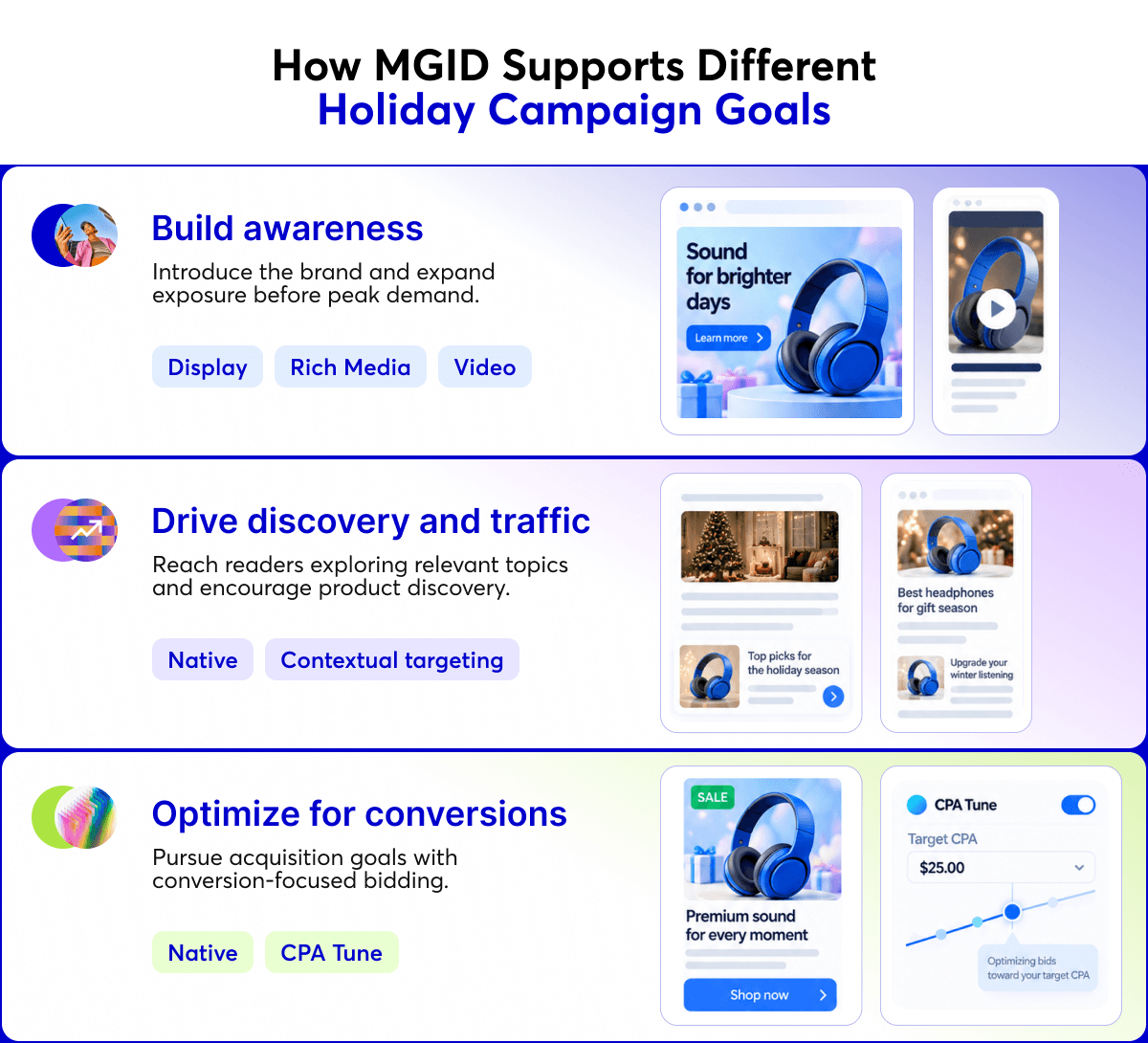
Four Checks Before You Scale
A bigger budget amplifies a winning campaign, but it can also make an expensive mistake even more expensive. Run through these first:
If all four considerations check out, you have a reasonable case for scaling. If a few answers are shaky, a smaller test can save you from a much bigger problem.
Black Friday: When Does Scaling Stop Paying Off?
Black Friday numbers can be dangerously flattering. Even when orders are pouring in and conversion charts are climbing, you need to check the margins to determine if it’s a winning campaign.
Discounts shrink what you earn per sale, and higher acquisition costs can eat into what's left. You might be selling more products and making less money.
More Sales, Less Profit: How the Math Works
Let’s take a product that sells for $100 with $40 in product and fulfillment costs, and see what happens when a discount and higher advertising costs enter the picture.
| Metric | Regular campaign | Black Friday campaign |
|---|---|---|
| Selling price | $100 | $75 |
| Product and fulfillment costs | $40 | $40 |
| CPA | $20 | $25 |
| Profit per order | $40 | $10 |
| Orders | 100 | 200 |
| Total contribution profit | $4,000 | $2,000 |
The orders doubled and the profit halved. A lower margin can still be a good trade if the campaign brings in customers who come back later, but that should be a number you’ve calculated.
Three Signals Worth Watching
1. Your CPA is approaching the break-even point.
A discount changes how much you can afford to pay for a customer, so recalculate your allowable CPA from the actual promotional price and your variable costs, including fees and fulfillment.
2. More budget isn't bringing proportional growth.
If spend rises faster than conversions, check whether you’re reaching less qualified traffic, paying more per click or seeing weaker conversion rates. From there, scale in measured steps instead of assuming yesterday’s performance will hold.
3. Your best-performing audience is getting more expensive.
As budgets rise, additional conversions may come from less responsive audiences or pricier placements. Compare CPA and conversion quality across segments to see whether scaling is still bringing in worthwhile customers.
Put Your CPA Target to Work
Let’s get back to the $75 product. After $40 in product and fulfillment costs you have $35 left before advertising, and that is your break-even CPA under these simplified assumptions. Set a $35 target and the first order contributes nothing toward overhead or profit. If you want to keep $15 per order, your ceiling drops to $20.
Decide Your Stop-Loss Rules Before the Weekend
Black Friday is a terrible time to make calm decisions. Use your margins, conversion volume and reporting delays to determine when you intervene rather than reacting to every dashboard wobble.
1. CPA is getting too close to your limit
Set a warning threshold below your maximum allowable CPA. If costs stay above it long enough to suggest a real trend, check traffic quality, conversion rates and profitability before deciding whether to reduce spend.
2. Extra spending isn't delivering enough conversions
If your budget increases but conversions barely move, hold off on further scaling. Compare the additional spend with the conversions it generated and investigate whether higher CPC or weaker traffic quality is eating into your returns.
3. Yesterday's results look unusually bad
Check conversion delays and reporting errors before making changes. The most recent day's performance may still be missing conversions, especially for offers with longer decision cycles.
After Cyber Monday: Is Your Campaign Losing Momentum or Is Demand Shifting?
When dust settles after Cyber Monday, your campaign dashboard may start to look a little less cheerful, and the “Pause campaign” button may suddenly become more tempting.
However, December isn't exactly a shopping ghost town. According to Epsilon's 2026 Holiday Strategy Playbook, 33% of surveyed US consumers did most of their 2025 holiday shopping during the first two weeks of December, compared with 25% in the final week of November.
So, if your campaign starts struggling after Cyber Monday, the reason could be that shoppers may be changing their behaviors. However, the trouble could just as easily be hiding in your creatives, landing page or traffic costs.
| What you're seeing | What might be happening | Your next move |
|---|---|---|
| CTR ↓, CVR stable | The ads may be experiencing creative fatigue, changing traffic mix or weaker engagement. | Compare performance by creative and placement. Test fresh variations if the decline persists. |
| CTR stable, CVR ↓ | The offer may be losing appeal, or something is going wrong after the click. | Check landing pages, pricing, availability and checkout performance before replacing creatives. |
| CPC ↑, CVR stable | Traffic is becoming more expensive, potentially due to competition or changes in the auction. | Review CPA and margins. Higher CPC may still be acceptable if conversions remain profitable. |
| CPA ↑, CPC stable | Fewer clicks are converting or the conversion mix has changed. | Break down CVR by device, audience and landing page to locate the drop. |
| Conversions ↓, efficiency stable | Traffic volume may be declining even though the campaign still converts efficiently. | Check spend, budget limits, traffic availability and category trends before reducing investment. |
These are starting points, so don't treat one metric as a verdict. A falling CTR doesn't always mean your creative is tired, just as a higher CPA doesn't automatically make a campaign unprofitable.
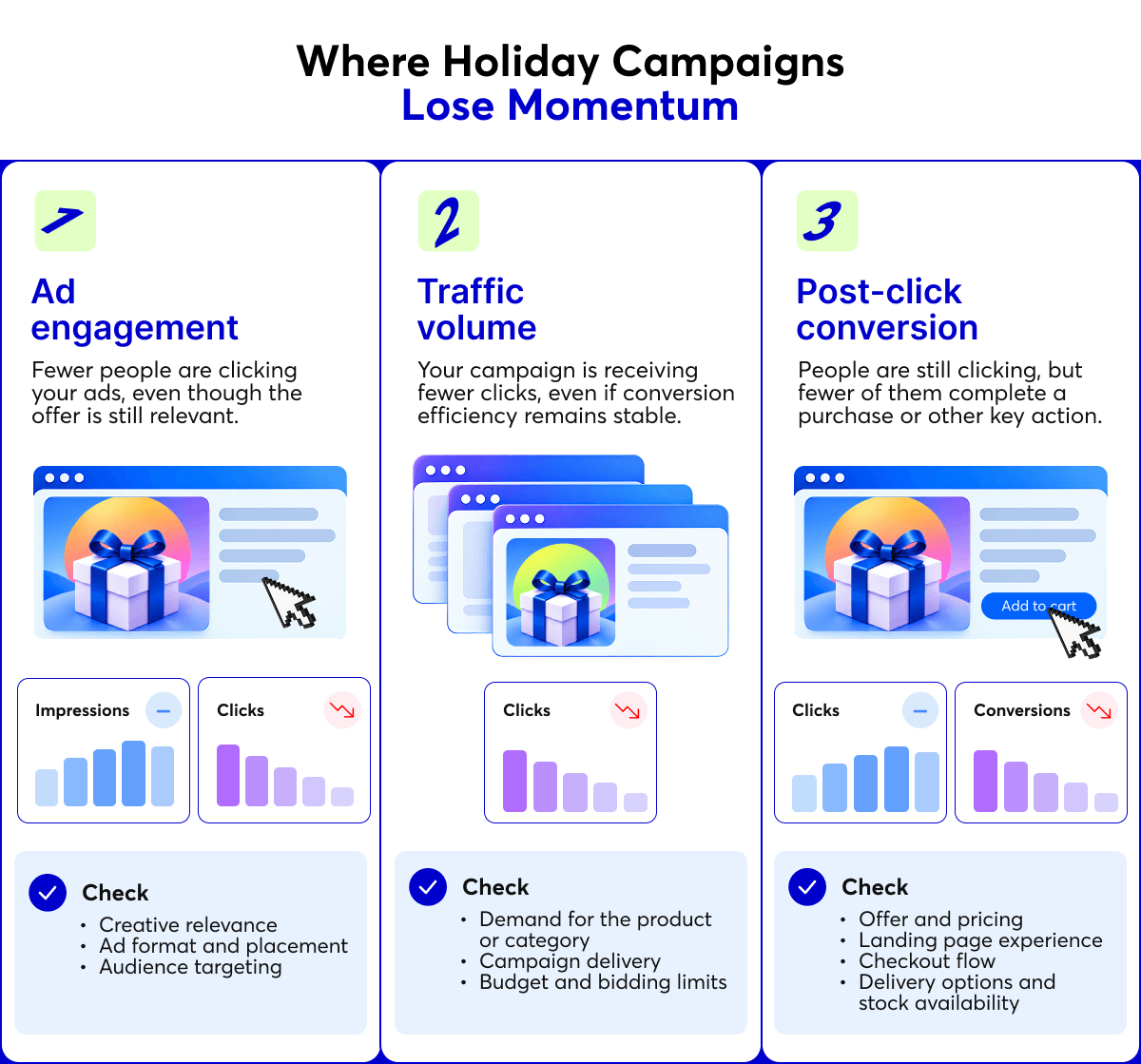
Why a 30% Conversion Drop Doesn't Tell the Whole Story
Imagine two advertisers reporting a 30% decline in conversions after Cyber Monday.
Campaign A: The conversion problem
- Click volume remains stable.
- CPC barely changes.
- CVR falls from 4% to 2.8%.
The campaign is attracting roughly the same amount of traffic, but fewer visitors are converting. That points toward a post-click problem — the offer, landing page, checkout process or audience mix — that is worth investigating.
Campaign B: The traffic volume problem
- Click volume drops by 30%.
- CVR stays at 4%.
- CPA remains stable.
Here, the traffic that arrives is still converting at the same rate. The advertiser should investigate why fewer clicks are coming in. Has campaign delivery changed? Is the budget limiting traffic? Are fewer relevant impressions available?
A seasonal decline in demand is another possibility, which requires broader market or category data. Without that context, cutting the budget or replacing creatives could address a problem the campaign doesn't actually have.
Daily fluctuations can also mislead, especially when conversions arrive with a delay. Compare meaningful periods and avoid changing several variables at once. Sometimes the real issue lies beyond the campaign. For example, the offer itself is becoming less convincing as Christmas approaches.
What Happens to Your Offer When Christmas Gets Closer?
A generous discount can get someone's attention, but it won't guarantee that a Christmas gift arrives on time. As December progresses, delivery options, product availability and confidence in the purchase are just as persuasive as the price tag.
Shoppers pay attention to those practical details. According to Emplifi's Peak Season 2026 report, 89% of surveyed US and UK consumers consider free shipping important, while 73% say they're willing to pay extra for guaranteed delivery.
1. The Price Looks Good, but the Value Isn't Obvious
Take an $80 skincare gift set with 20% off. The price is attractive, yet shoppers may wonder what exactly is in the box, and whether it’s worth giving as a gift.
What to change: Test an ad angle that highlights the contents and benefits of the set rather than leading with the discount. On the landing page, make product details, genuine customer reviews and gift packaging options easy to find.
What to watch: Compare conversion rates and CPA between the original discount-led approach and the new value-focused variation.
2. Delivery Has Become the Dealbreaker
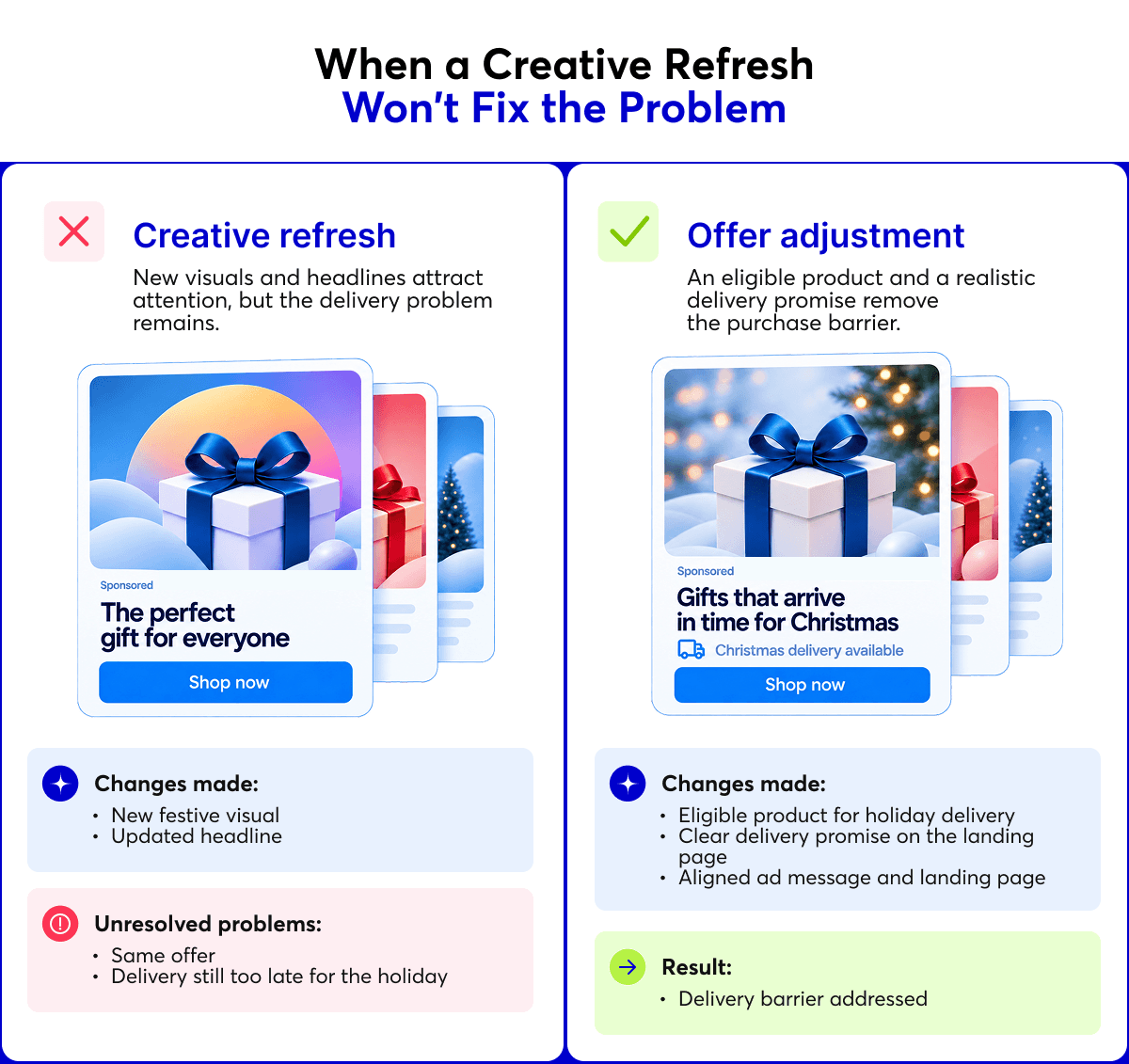
Your ad promises the perfect Christmas gift, but checkout says delivery takes seven business days. The kicker? It’s December 21. No creative can fix that.
What to change: Check shipping cutoffs before promoting delivery-related claims. If express shipping or local pickup is available, make those options visible in the ad and on the landing page. If Christmas delivery is no longer realistic, switch to eligible products or digital gift options where available.
What to watch: Track checkout abandonment and conversion rates after updating the delivery information. If shoppers still leave, investigate shipping costs, stock availability and other purchase barriers.
One Product, Five Angles to Test
When the offer is fine but the message is stale, it may need a quick creative refresh. For the same product, try:
- The occasion: Who needs the product now, and what makes this moment relevant?
- The value: What's included, and why is it worth the price?
- Social proof: What do genuine customer reviews reveal about the experience?
- The deadline: Is there a real reason to act before a certain date?
- For yourself: Could the same product appeal to people buying for their own needs?
Test one angle at a time against your current best creative, so you know which change made the difference.
Keep, Adjust or Reset: What's the Right Move for Your Campaign?
By now, you've probably spotted a few things worth changing in your holiday campaigns. The temptation is to fix everything at once, but then, you have no idea which change caused it. A temporary dip, a tired creative and an expired offer each call for a different response. Before touching anything, decide how much intervention the campaign actually needs.
The Holiday Campaign Reset Check
Answer four quick questions about your holiday campaign to receive a suggested next move, the metrics worth checking and the changes to consider testing.
This result is a place to start, but it isn’t a verdict. We recommend checking the underlying data before you change anything, especially if automated bidding is involved.
After Christmas: Which Campaigns Deserve Another Run?
By December 26, some holiday campaigns have clearly overstayed their welcome, while others still have life in them. Gift card redemptions, post-holiday sales and New Year resolutions give people fresh reasons to spend. Depending on your vertical, the weeks after Christmas can be worth another round of testing.
1. Keep profitable campaigns in the game.
If an evergreen product still converts at an acceptable CPA, there’s no reason to pause it just because Christmas is over. Check that demand, conversion quality and margins have held up before you change anything.
2. Give interested audiences another reason to return.
Visitors who browsed or started a checkout without buying may still be valuable. If data, permissions and targeting options allow, re-engage them with a post-holiday offer that matches what you’re selling now, not a Christmas discount that expired last week.
3. Look beyond gift shopping.
Not every January buyer is a leftover gift shopper. A fitness subscription will find more interest among people setting New Year goals than among those hunting for presents.
Lead generation follows the same logic. An insurance advertiser can test messaging about reviewing coverage for the year ahead, and a financial services brand can explore planning-related offers. The opportunity depends on the product, the market and real demand.
4. Retire campaigns that have run their course.
Some promotions really do have an expiration date. If the offer is gone, the product is unavailable or acquisition costs consistently exceed its value, keeping the campaign running out of habit won't help.
Give Next Year's Campaigns a Head Start
Before the numbers disappear into a quarterly report, write down what you’ll want to know next October:
- Winning combinations: Which audiences, creatives and offers delivered profitable conversions?
- Turning points: When did performance start changing, and which adjustments actually helped?
- Missed opportunities: Were there promising campaigns you paused too early or audiences you reached too late?
- Reusable learnings: Which results can inform future targeting, bidding and creative tests?
One final reminder: Christmas isn't the finish line in every market. Boxing Day, regional shopping events and Lunar New Year can extend seasonal opportunities into January and beyond. Check local buying patterns before applying the same campaign calendar everywhere.
The Holiday Calendar Won't Make Your Decisions
You can plan your holiday promotions months ahead, but shoppers have a habit of making their own plans. Suddenly that carefully prepared campaign calendar needs a few edits.
The advertisers who handle these moments best have already worked out what deserves attention, what can wait and when it's worth stepping in. And sometimes, the smartest move is to let a profitable campaign get on with its job.