The more precise your audience, the easier it is to miss those outside of that description.
Ad targeting loves a label, whether that is keywords, interests, categories or audience segments. The problem is that customers rarely organize their interests according to an ad platform’s targeting menu.
Someone who needs better sleep might never have the keyword "sleep" in their search. Instead, they look up why they're exhausted at 3 p.m. or how to survive a week of night shifts. A campaign built around the obvious can miss these moments. The potential customer is there, but the targeting rule simply never made the connection.
For native advertising, that gap is particularly expensive. A large part of the job is finding the right moment to display the most relevant ad to the user’s current reading experience. Unfortunately, there are far more of those moments than any one marketer can list manually. That is where vector-based targeting enters the picture.
What Is Vector-Based Ad Targeting?
To do this, a model turns available signals — content, interests, behavior, creative attributes or first-party data — into numerical representations called vector embeddings. Think of them as coordinates for meaning: content, audiences and ads each get a position on a very large map, and similar things end up as neighbors. That's how the system can see what sits closer together, even when the words don't match.
Back to the sleep example. "Sleep" may sit close to insomnia and bedtime routines, which you might have been able to guess. Although, the interesting part comes when you expand that idea. For example, stress, night-shift recovery, jet lag, late-night screen habits or post-workout recovery may also appear nearby. Suddenly, the campaign has more places to look than the targeting setup originally listed.
And that is the basic idea behind vector targeting. It starts with signals you care about, finds similar signals and uses that similarity to discover the next relevant opportunity.
How Does Vector-Based Targeting Work?
Every vector-targeting setup needs a starting point. It might be a group of converters, first-party audience data, a piece of content, a successful creative or another signal connected to the campaign goal.
The model turns those signals into vectors and maps their relationships. Similar things land closer together. Now the interesting part begins. The campaign can search outward from its starting point, often called a seed, and explore progressively less similar matches. A tighter radius keeps the campaign near familiar territory; however, expanding it brings progressively more distant contexts and audiences into the pool.
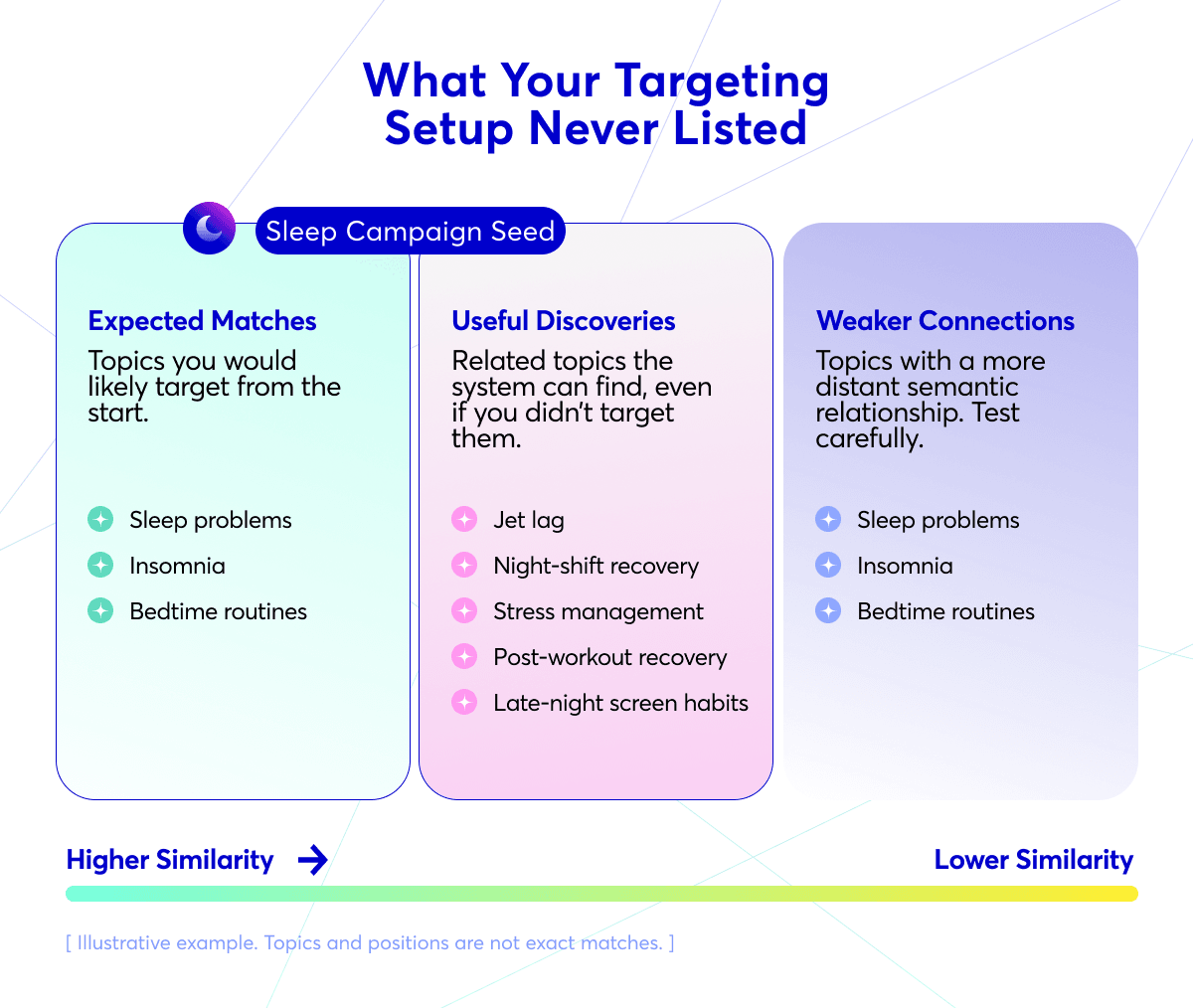
For an advertiser, this turns into a very practical optimization question: how far can we move from what already works before performance starts to fall?
That question matters because similarity lets a campaign grow reach in steps, instead of guessing the next perfect keyword, interest or audience segment.
Vector-Based Targeting vs. Traditional Ad Targeting
Say your sleep campaign needs more reach. With traditional targeting, the next move is for you to add another keyword, interest, category or audience segment.
Vector targeting gives the campaign another route, with the model exploring outward from relevant signals and ranking new opportunities by similarity.
| Comparison point | Traditional targeting | Vector-based targeting |
|---|---|---|
| Target is defined by | Keywords, categories, segments and rules | Similarity between vector representations |
| How a match works | Meets a predefined condition | Receives a degree of similarity |
| Context discovery | Follows selected labels and categories | Can identify related meanings and patterns |
| Reach expansion | Adds more keywords, segments or rules | Expands the similarity range |
| Campaign control | Direct and easy to interpret | Requires interpreting similarity thresholds and model outputs |
| Best suited for | Clear requirements and known targeting criteria | Complex relationships and discovery beyond predefined criteria |
| Typical miss | Relevant contexts nobody thought to list | Loosely related contexts that only look relevant |
| Where the human effort goes | Guessing the next keyword or segment | Choosing the seed, setting thresholds, reviewing results |
This doesn't mean handing the whole campaign over to a similarity model and wishing it luck. You still need to set clear boundaries. However, inside those boundaries, vectors give the campaign more freedom to answer the question: where else might this work?
Why Vector-Based Targeting Matters for Native Campaigns
Let's put all of this into a native campaign. Our sleep supplement campaign has been running for a while. The obvious contexts are covered, the strongest audience pockets are delivering conversions. So, where does the next chunk of profitable reach come from?
First, Look Beyond the Obvious Context
The campaign started around sleep-related content. Vector similarity might lead it toward articles about recovering after night shifts, fixing jet lag, or managing stress.
These are valuable discoveries because nobody had to sit down beforehand and build an exhaustive list of every situation in which poor sleep might matter. And for native campaigns, this opens up inventory that can make sense to the reader even when the connection isn't obvious from the page category alone.
Then See How Far the Campaign Can Travel
Finding additional inventory is easy, but finding inventory that converts at an acceptable cost is what matters to advertisers most.
Suppose the closest group of matches is delivering conversions at a $38 CPA. Expanding the similarity range takes the campaign from 100 to 140 conversions at a blended $41 CPA. Expand again and CPA climbs to $57. Those numbers are illustrative, but the decision behind them is very real.
A small warning about those numbers: blended CPA flatters you. Say the tight audience delivered 100 conversions at a $38 CPA ($3,800 spent). After the first expansion, you have 140 conversions at a blended $41 CPA ($5,740 spent). The extra 40 conversions cost $1,940, or about $48.50 each. The dashboard says $41. The new reach actually cost $48.50 per conversion. Whether that's acceptable depends on your margin. So track CPA per similarity band, not just per campaign.
The first expansion may have found real scale. The second may have found the edge of it. This changes the scaling conversation. Instead of endlessly asking which audience or category to add next, consider how far from what already works can we go before the economics stop working?
Now Add the Creative
Context is only part of a native recommendation. The ad itself still has to be relevant.
Imagine the campaign has four creatives:
- “Reset your routine after travel”
- “Recover better overnight”
- “Build a better bedtime routine”
- “Wake up feeling rested”
The travel angle has a natural relationship with jet-lag content. Recovery makes sense around training and fitness. A bedtime-routine message gets trickier around night-shift content, and the broader “wake up rested” angle can travel across a wider range of sleep and lifestyle contexts. If creatives are represented as vectors too, these differences can become another signal in the matching process.
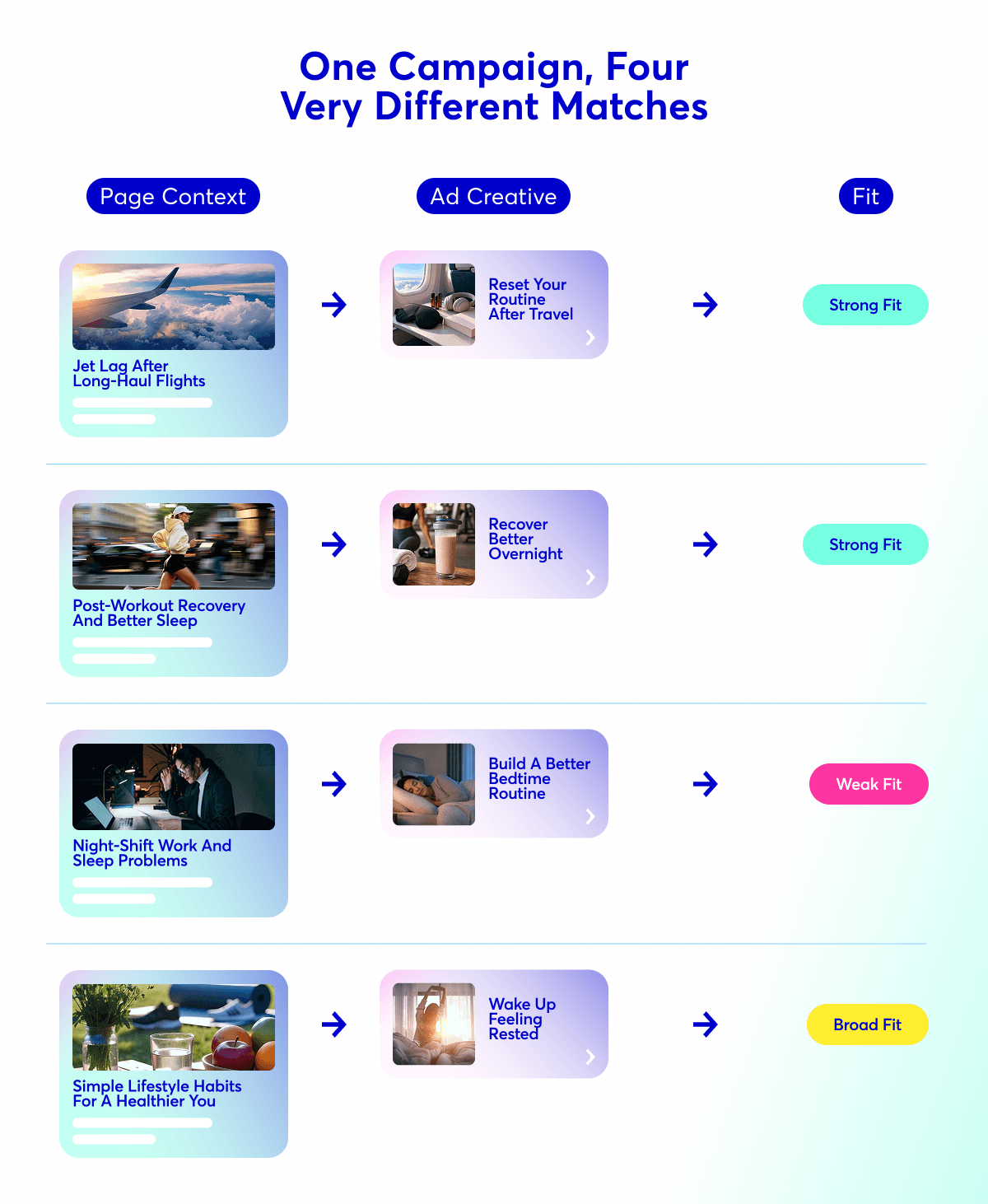
This is where vector targeting starts to earn its place in native advertising. With this model, the campaign can look for alignment across audiences, pages and creatives.
A creative can be perfectly relevant to the product and still be a strange recommendation for the page where it appears, and vector similarity gives the system more information to work with.
Where Vectors Shouldn't Make the Decision
Some targeting decisions don't need a similarity score. Need the campaign to run in Germany? Target Germany. Or, need to exclude a content category for brand-safety reasons? Exclude it..
Vectors are helpful when the answer depends on how closely things relate:
- Which other contexts resemble the ones already performing?
- Which users share meaningful patterns with existing converters?
- How far can we expand before relevance starts getting weak?
- Which creative fits this particular context best?
- Where are the useful connections our original targeting setup didn't include?
How to Test Vector-Based Targeting in a Native Campaign
You don't need to rebuild your campaign to try this. Here's a simple way to test vector-based targeting on a native campaign without losing control of the budget:
- Start with a seed of your best converters rather than all converters.
- Set hard rules first: geo, language, brand-safety and sensitive-topic exclusions.
- Split the similarity range into 3–4 bands with comparable test budgets.
- Compare bands on CPA and what happens after the conversion: refunds, repeat purchases, lead quality.
- Review placements by similarity and note the contexts that surprised you, good or bad.
- Move the winners into your regular contextual lists; next, cut the band where marginal CPA crosses your limit.
What Are the Limitations of Vector-Based Targeting?
Vector targeting can surface connections you'd never list by hand, but it comes with a few things worth watching:
- A similarity score doesn't explain itself: If the model decides that two audiences or contexts belong close together, the reason may not be obvious. Good reporting matters to understand why a surprising placement is spending or converting.
- The model shapes the map: By changing the model, the data or the way embeddings are created, the relationships between vectors change as well. “Highly similar” only means something within the system that calculated it.
- Similarity isn't intent: Someone reading about insomnia might be researching it for a parent, a newborn's schedule or a novel. While the context is close to your seed, the reader's need may not be. With that in mind, treat similarity as a reason to test a placement instead of as proof that the audience wants your product.
- A weak seed produces confident-looking nonsense: The model will always find neighbors, even for a poor starting point. Seed it with high-CTR placements that had terrible retention, and you'll get more of that. Review the seed as seriously as the similarity settings.
- There is such a thing as exploring too far: Keep expanding the similarity range and eventually the campaign will reach connections that are technically related and commercially useless. CPA has a habit of making that distinction quite clear.
- More automation creates a greater need for visibility: Advertisers still need to see where spend is going, which contexts are being discovered and how those discoveries perform. Otherwise, smarter matching can quickly turn into a very sophisticated black box.
Is Vector-Based Targeting Replacing Contextual and Audience Targeting?
No. You probably won't open an ad platform tomorrow and find a shiny new “Vector Targeting” button sitting next to Contextual and Audience.
Vectors can work underneath targeting methods advertisers already use. In contextual targeting, they can connect pages that discuss related ideas despite using different language or belonging to different categories. An article coping with shift work and one on why I can't fall asleep may share no keywords and still belong together. In audience targeting, they can help identify patterns shared with customers, converters or other valuable groups. The same logic can support lookalike expansion and creative matching.
Campaign setup can still involve familiar audiences, contexts and controls, while the technology underneath gets better at finding relationships between them. You may never see the word "vector" in the interface, and still see it in the placement report.
For advertisers, what matters most is understanding what vectors change for native advertising: the pool of potentially relevant opportunities no longer has to end where the predefined segment or category ends.
FAQ on Vector-Based Ad Targeting
How is this different from lookalike audiences?
Lookalikes find users who resemble your customers. Vector similarity can do that too, but the same logic applies to pages and creatives. With vector-based targeting, you can look for similar contexts and matching ads, not just similar audiences.
Do I need a data science team to use vector-based targeting?
No. The platform builds and compares the vectors. Your job is to choose a strong seed, set hard rules, decide how far to expand and understand the results.
How do I know how far to expand the similarity range?
Let marginal CPA decide. Split the range into bands, track each one separately and stop expanding where the cost of the extra conversions crosses your margin. Check post-conversion quality too: refunds, repeat purchases and lead quality can turn a cheap band into an expensive one.
Can vector targeting place ads next to sensitive content?
It can. Similarity measures how close two topics are, not whether the placement is appropriate. Keep brand-safety and sensitive-topic exclusions as hard rules, and spot-check the outer similarity bands manually.
What should I use as a seed?
Your best outcome, not your easiest one to count: customers who bought repeatedly or stayed, rather than everyone who clicked.
Finding What You Didn't Think to Target
Marketers have spent years getting better at describing exactly who and what they want to target. Vector-based targeting gives the system a strong starting point and explores from there.
That changes the questions worth asking during a campaign. The questions below are a good place to start:
- How good is the seed? Your answer should describe the outcome you want to pay for.
- What shows up in the outer band? Which contexts did nobody expect to work, and did any of them convert?
- Where does marginal CPA cross your limit? Don’t look at the blended number on the dashboard but rather the cost of the extra conversions.
For native advertising, those are useful questions to ask yourself. Relevance rarely arrives in a perfectly labeled package. The next valuable context may use different language, sit outside the category you selected or only become visible once the campaign starts exploring around a strong seed. Sometimes the next pocket of scale is sitting just outside the box.