Updated: August, 2026
Editor’s note: This article has been contributed by Matthew Villa, MGID’s Head of Sales, US, with a front-row view of what makes affiliate campaigns scale and where their margins get squeezed.
Let’s say you’ve heard about all the benefits of native advertising. Now comes the practical question: how much does native advertising actually cost in 2026?
Here comes everyone’s least favorite answer to a pricing question: it depends. Not very satisfying, I know, but with native advertising, there really isn’t one universal price tag. Native advertising costs vary depending on your industry, GEO, targeting, competition and campaign goals, while CPC and CPM can differ significantly from one market to another.
Since this is a question I hear a lot from advertisers, let’s break down the numbers that matter: how native ads are priced, what affects their cost, how much budget you may need to start and where you can avoid unnecessary spend.
How Much Does Native Advertising Cost?

Native advertising is typically priced using one of two models: cost per click (CPC) or cost per mille (CPM).
With CPC, you pay each time someone clicks on your ad. With CPM, you pay for every 1,000 ad impressions. Which model makes more sense depends largely on what you want the campaign to achieve: clicks and conversions, reach and awareness or a combination of both.
So, what does that mean in actual dollars?
Industry benchmarks can give you a useful starting point as long as you don’t mistake them for a rate card. Native advertising costs and performance vary considerably from one platform, market and campaign to another, but broad ranges can at least give you an idea of what to expect.
Native Advertising Cost Benchmarks
Here’s what the broader industry benchmarks currently look like.
| Metric | Typical range |
|---|---|
| CPC | $0.20–$0.50 |
| CPM | $5–$15 |
| CTR | 0.30–0.60% |
For a little extra context, EMARKETER considers a CTR above 0.4% a sign of strong native advertising performance in 2026.
Treat these numbers as reference points rather than promises. They’re broad industry benchmarks rather than MGID rates, and your actual CPC, CPM and CTR can look quite different depending on the platform, GEO, vertical, targeting and competition.
Now, let’s get a little more specific.
How Much Does It Cost to Start Advertising with MGID?
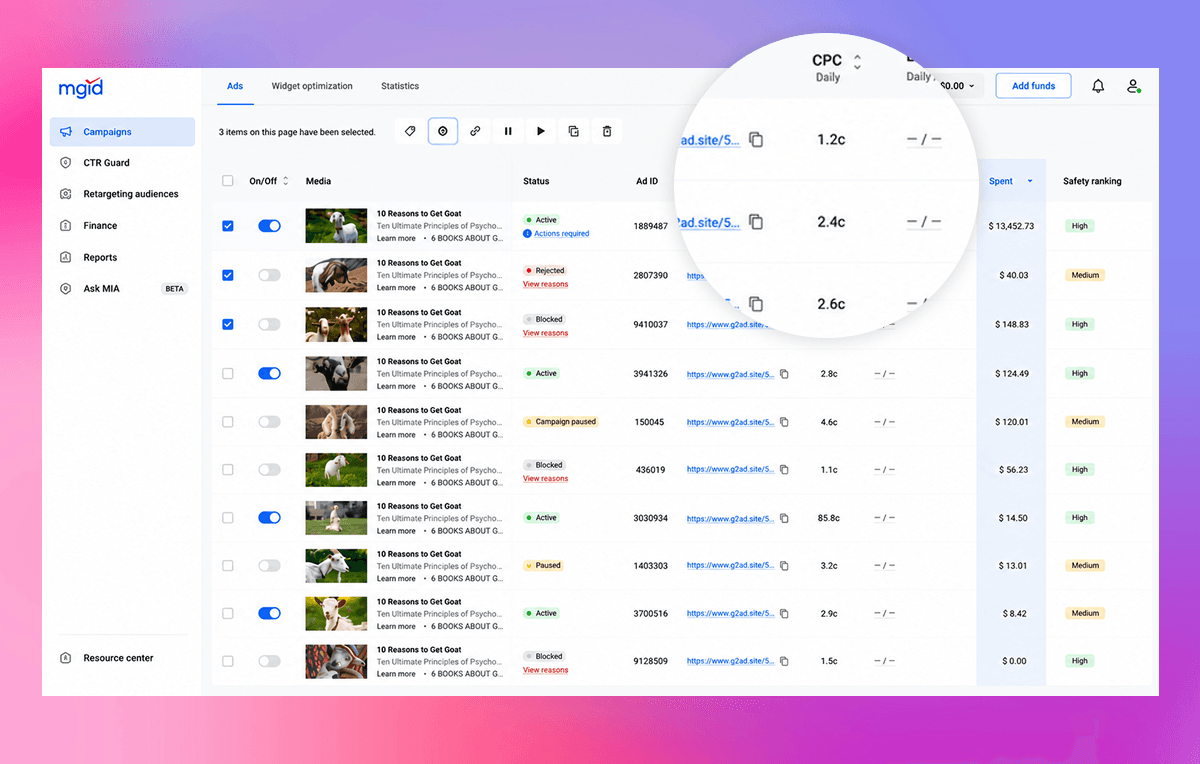
MGID Ads primarily uses an auction-based CPC model, which means there is no single fixed price per click. CPCs vary depending on factors such as GEO, competition and campaign settings. CPM pricing is also available for specific ad formats.
Before launching, keep these key numbers in mind:
| Metric | MGID starting point |
|---|---|
| Minimum campaign budget | $50 daily or overall |
| Minimum account deposit | $100 |
| Recommended starting deposit | $650+ |
| Recommended test volume | 5,000–10,000 clicks |
One important distinction here: the $650 recommendation isn’t a fixed campaign price or a fee to access MGID. Think of it as a suggested starting deposit that gives your campaign enough room to collect data, test traffic and optimize performance.
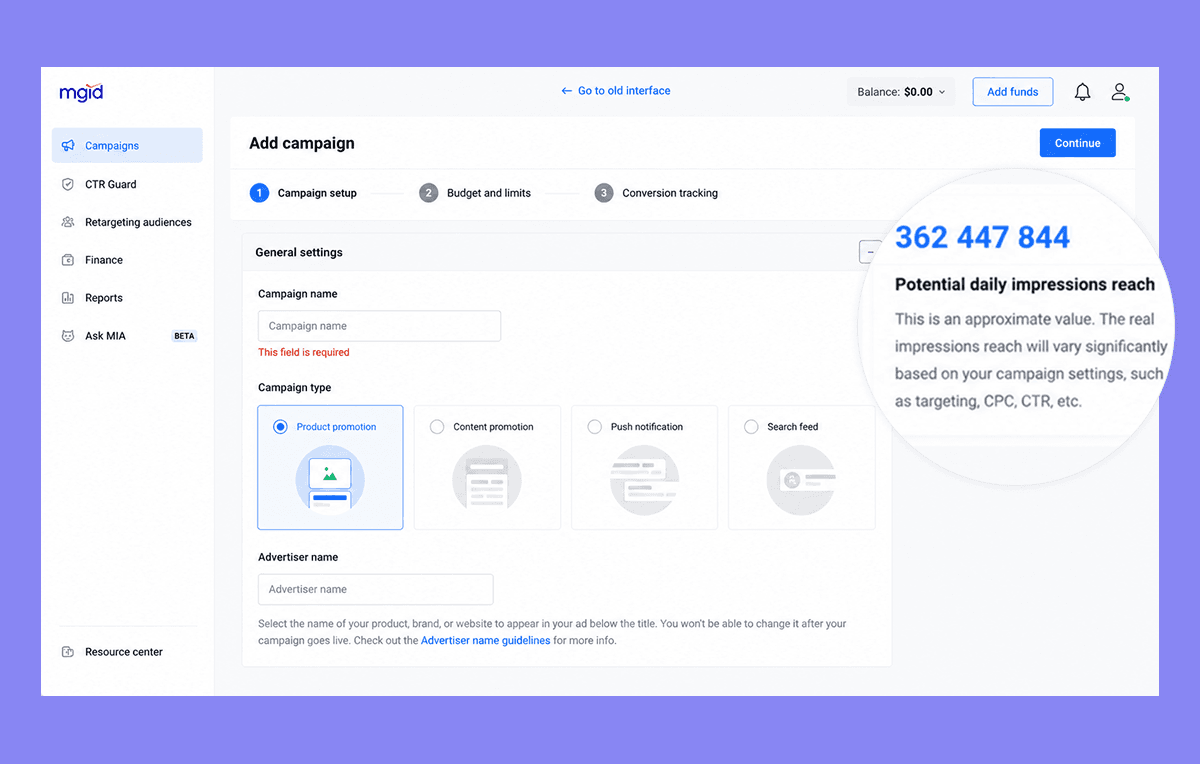
When setting your campaign budget, you can choose between a Daily and Overall limit. Daily caps how much the campaign can spend each day, while Overall sets a total budget for a defined campaign period and automatically paces spending across the remaining days.
Your test budget can also be estimated based on the CPC available for your campaign:
For example, MGID’s campaign recommendations use an optimal CPC of $0.12 to illustrate the calculation: at that CPC, 5,000 clicks would require approximately $600. See how the same formula plays out at different CPC levels:
| CPC | 5,000 clicks | 10,000 clicks |
|---|---|---|
| $0.05 | $250 | $500 |
| $0.10 | $500 | $1,000 |
| $0.12 | $600 | $1,200 |
| $0.20 | $1,000 | $2,000 |
Have a different CPC in mind? Use the calculator below to estimate the test budget for your own CPC.
So yes, you can technically start with a relatively small budget. But “How little can I spend?” probably isn’t the best question to ask. The more useful one is: “How much do I need to properly test my campaign?” And that depends on more than CPC alone.
What Factors Affect Native Advertising Costs?
By now, we’ve established that there’s no single price for native advertising. Thankfully, that doesn’t mean your campaign budget is a complete guessing game. Several factors have a direct impact on how much you may need to bid and, ultimately, how far your budget can take you.
Let’s look at the ones that matter most.
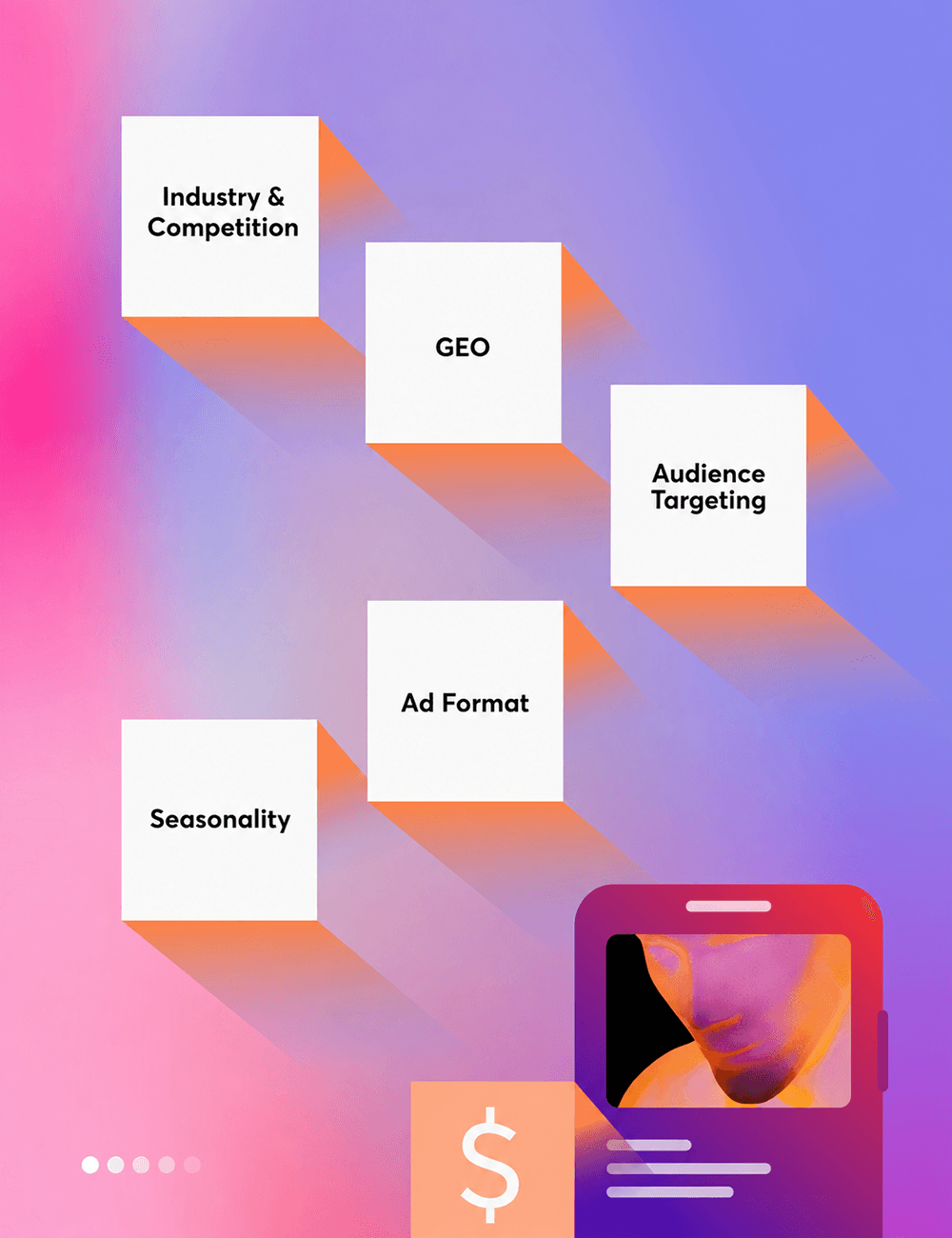
Industry and Competition
What you advertise matters. Different verticals come with different levels of competition, audience size and conversion economics, all of which can influence how advertisers approach bidding and budgeting.
A mass-market eCommerce product, for example, may give you a much larger potential audience than a highly specialized financial or luxury offer. At the same time, a popular vertical with many advertisers competing for the same traffic may require stronger bids.
In practice, some verticals are more competitive than others. Categories such as nutra, finance and dating can attract strong advertiser demand, which may require more competitive bids. Broader categories such as mass-market eCommerce and content/media, meanwhile, can offer larger audiences and more room to scale, though actual costs still depend on the market and campaign setup.
Long story short: there’s no universally “cheap” or “expensive” vertical. What matters is the combination of audience size, advertiser competition and the economics of your offer.
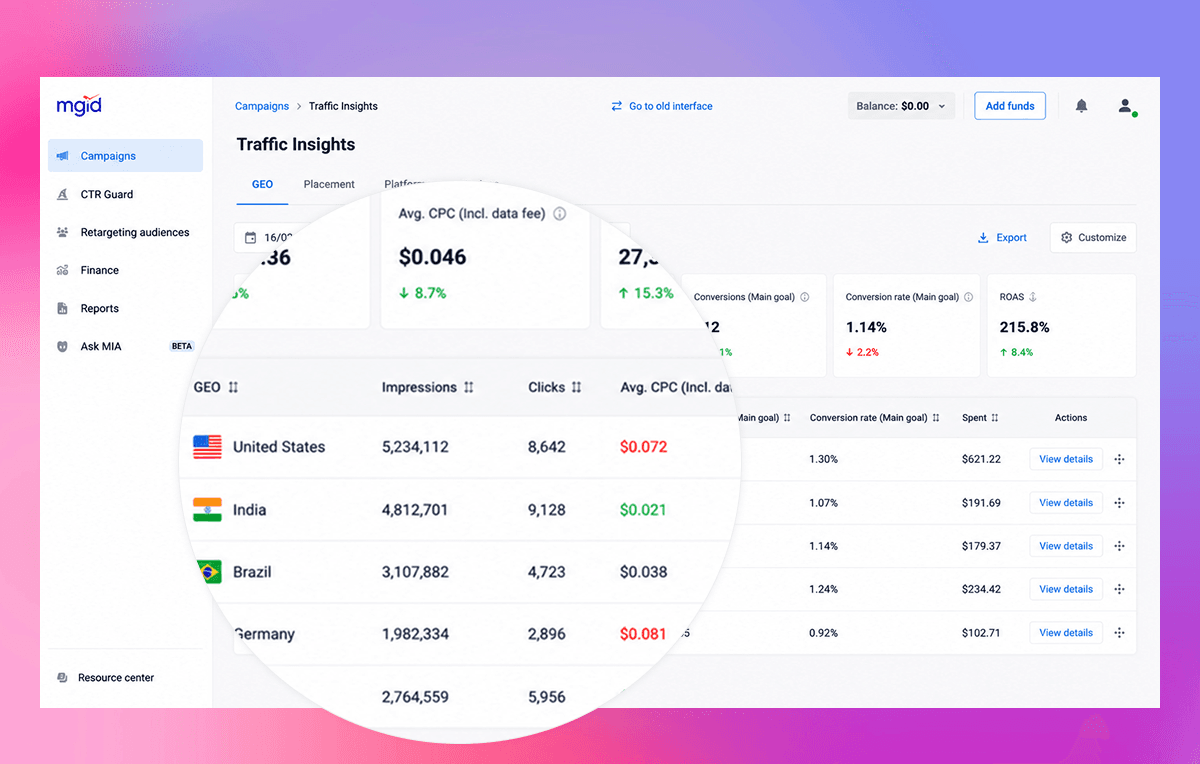
GEO
Where you advertise can make a substantial difference to your native advertising costs.
Competition, available traffic and advertiser demand vary from one country to another. Even campaigns within the same vertical can therefore require different CPCs when targeting different GEOs. Same offer, same creative, different country — potentially very different economics.
This is also why it can be useful to separate campaigns by GEO instead of applying the same bid and budget strategy across multiple markets.
Audience Targeting
Targeting gives you control over who can see your ads, but every additional restriction also changes the pool of traffic available to your campaign.
Broad targeting gives the system more traffic to work with, while a very specific combination of location, device, browser, interests or other targeting parameters can substantially narrow your potential reach.
Does that mean you should target everyone and hope for the best? Definitely not. The goal is to find a balance between having enough traffic to collect meaningful data and keeping that traffic relevant to your offer.
Ad Format
The format you choose can also affect how you pay for native advertising. CPC is the primary pricing model in MGID Ads, while CPM is available for specific formats.
That makes it important to evaluate costs in the context of the campaign objective. A campaign focused on clicks and conversions shouldn’t be measured in exactly the same way as one designed primarily for reach and impressions.
Seasonality
Competition and traffic demand change throughout the year. Holidays, major shopping periods and industry-specific peaks can bring more advertisers into the auction, potentially affecting bids and campaign costs.
But seasonality doesn’t affect every vertical or GEO in the same way. Black Friday is an obvious battleground for eCommerce, but it won’t tell you much about the seasonal dynamics of a travel or finance campaign. Every vertical has its own peaks, and every market has its own version of them.
Native Advertising vs. Google Ads vs. Meta Ads: How Do Costs Compare?
At some point, this question usually comes up: “Okay, but is native advertising actually cheaper than Google or Meta Ads?”
I’d love to give you a neat yes or no. Unfortunately, comparing advertising channels by CPC alone doesn’t tell you nearly enough.
A cheaper click isn’t necessarily a better click, and a more expensive one isn’t necessarily a bad deal. What matters is how that traffic fits your campaign goal and, eventually, what you pay for the result you actually care about.
Here’s a more useful way to look at the differences:
| Criteria | Native advertising | Google Search Ads | Meta Ads |
|---|---|---|---|
| Common pricing | CPC / CPM | Primarily CPC | CPM / CPC |
| How people discover ads | While consuming content | While actively searching | While browsing social content |
| Key cost drivers | GEO, competition, targeting, format | Keywords, competition, ad quality | Audience, competition, placements |
| Where it fits | Discovery, content-led acquisition and performance | Capturing existing search demand | Social discovery, prospecting and retargeting |
For some cost context, WordStream’s 2026 benchmarks put Google Search Ads at around $5.42 per click and Meta Ads at around $0.78, compared with the broader $0.20–$0.50 CPC range often cited for native advertising. The difference reflects more than price, though: search captures active intent, while native typically reaches people earlier in the journey.
That’s also why I wouldn’t choose between these channels based on CPC alone. Compare what happens after the click: conversion rate, CPA, revenue and ROAS. A $0.20 click that never converts can ultimately cost you more than a $1 click that does.
And there’s no rule saying you have to choose just one. Native, search and social can play very different roles in the same media mix.
How to Save on Native Advertising Costs?
Perhaps we shouldn’t admit this, but native advertising costs can bite at times. And when they do, lowering your CPC may seem like the obvious solution.
I wouldn’t rush into it.
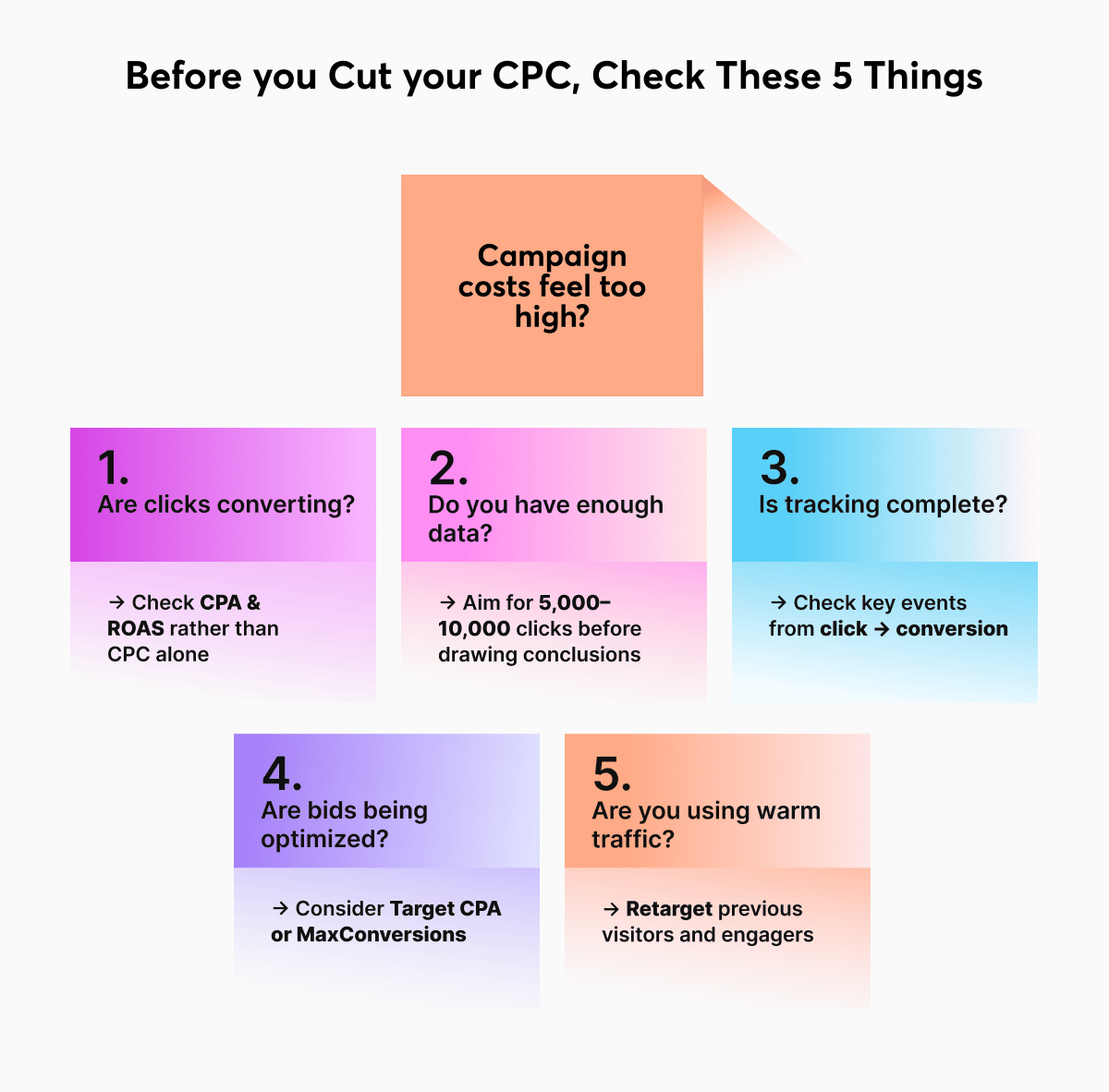
A cheap click that goes nowhere is still wasted money. If you really want to spend less on native advertising, the goal is not to chase the lowest possible CPC. It’s to get more value from the budget you already have.
If you were to ask me where to start, I’d focus on the following.
Don’t Let a High CTR Fool You
I’ve seen plenty of advertisers create clickbait-y ads with one goal in mind: get as many clicks as possible. And yes, that approach can give you a beautiful CTR.
But what good is a beautiful CTR if nobody converts?
Look beyond the click. Compare your CTR with what happens afterward: conversions, CPA, revenue and ROAS. If people are clicking but disappearing somewhere between the ad and the conversion, that’s where you should start looking for wasted spend.
The question I’d ask is simple: “Is my target audience clicking on this ad or just people in general?”
Give Your Tests a Fair Chance
Nobody enjoys watching a campaign spend money while it’s still “learning.” The temptation to pause it after a disappointing first day or two is very real.
The problem is that optimizing on too little data can lead you in the wrong direction.
Give your campaigns enough room to show which creatives, audiences and traffic sources actually work. A test budget isn’t money you’re supposed to burn through. It’s the budget you need to collect enough information to make the next decision with some confidence.
Instead of counting days, look at the data you’ve collected. MGID recommends aiming for 5,000–10,000 clicks so you have enough traffic to spot meaningful patterns before making optimization decisions.
Track What Happens After the Click
This one sounds obvious. Still, I wouldn’t launch a performance campaign without proper conversion tracking in place.
MGID Ads currently supports several options, including MGID Pixel, Google Tag Manager, Postback, Webhook and Native Integration. You can also set up a primary conversion goal and two additional goals to see what happens at different points in the funnel.
For example, a purchase might be your main goal, while add-to-cart and sign-up events tell you what happened before it.
The more of that journey you can see, the easier it becomes to spot where your budget is actually working and where it’s quietly disappearing.
Let Automation Do Some of the Bidding
You don’t necessarily have to adjust every CPC manually.
For conversion-focused campaigns, MGID’s CPA Tune uses predicted conversion probability to adjust CPC bids automatically. You can optimize toward a target CPA or use MaxConversions when the priority is getting as many conversions as possible within your daily budget.
Does that mean you can switch it on and forget about the campaign? I wish.
You still need solid creatives, enough conversion data and a realistic budget. But automated bidding can take some of the guesswork out of deciding how much to bid for each opportunity.
Don’t Forget the People Who Already Know You
Not everyone converts after seeing or clicking an ad once. That doesn’t necessarily mean the opportunity is gone.
Retargeting lets you build audiences from people who have already interacted with your website or MGID ads and reach them again with a more relevant message. In MGID Ads, audiences can be created using signals such as website activity, ad clicks, ad views and conversion goals.
And that gives you something valuable: instead of starting from zero every time, you can use what you’ve already learned about your audience to decide who deserves another impression and another piece of your budget.
FAQ on Native Advertising Costs
How much does native advertising cost per click?
There’s no single CPC for native advertising. Costs vary by GEO, competition, targeting and campaign setup. On MGID, CPC is auction-based, with suggested bids tailored to your specific campaign conditions.
What is a good budget for native ads?
A good budget is one that gives you enough traffic to properly test and optimize your campaign. On MGID, you can start with a $50 daily or overall campaign budget and a $100 minimum deposit, while $650+ is the recommended starting deposit for a more meaningful test.
How long should you test a native advertising campaign?
There’s no fixed number of days, since traffic volume and delivery vary by campaign. A better benchmark is the amount of data you collect. MGID recommends aiming for 5,000–10,000 clicks to give your campaign enough traffic for meaningful optimization decisions.
What affects the cost of native advertising?
The biggest factors include GEO, advertiser competition, targeting, ad format and seasonality. Your vertical matters too, since audience size and competition can vary significantly from one category to another.
Is native advertising cheaper than Google Ads?
It can be, but a lower CPC doesn’t necessarily mean better value. The more useful comparison is what happens after the click, including conversion rate, CPA, revenue and ROAS.
Where These Numbers Come From
The benchmarks in this article draw on third-party industry sources, including industry benchmark data and EMARKETER’s 2026 reporting, while MGID-specific figures come from our campaign recommendations and pricing documentation. Google and Meta figures are based on WordStream’s 2026 benchmarks. We’ll update this page as newer data becomes available.
So, How Much Should You Budget for Native Advertising?
If you came here hoping for one magic number, I’m afraid native advertising still refuses to make things that easy.
The good news is that you don’t need one. A realistic budget starts with knowing what you want to achieve, how much traffic you need to test it properly and what CPC makes sense for your market. From there, it’s all about watching what happens after the click and putting more of your budget behind what actually works.
If you’re considering MGID, you can preview native ads to see how different formats look before launching a campaign. And when you’re ready to get into the actual numbers, your Account Manager can help estimate the costs and starting budget based on your campaign goals and setup.
Hope this article comes in handy and saves you from spending money just to learn what doesn’t work.