The more AI enters the ad-making process, the more important it becomes to understand what shouldn’t be automated.
Give an AI tool a decent brief and it will hand you fifty headlines before your coffee gets cold. What’s difficult for advertisers to understand is that none of them may be worth publishing.
This is where the advertiser's job is evolving. AI can expand an idea, adapt it and help test it faster, but someone still has to know what the audience cares about and which angle has something real behind it.
The question isn't whether AI can make ads. The question is where to put it in the creative process without letting AI flatten the entire thing.
Don’t Ask AI for an Ad Just Yet
“Write 10 native ad headlines for our product” is a perfectly reasonable prompt. It’s also a good way to get 10 headlines that could have been written for almost any competitor.
Before AI touches the copy, give it context. Start with four things:
- Who: The specific audience you want to reach
- Problem: What they are trying to solve
- Tension: What makes that problem frustrating, urgent or interesting now
- Promise: What you can credibly offer them
This will help the AI create something worth multiplying. The context that you give it should come from customer conversations, campaign data, reviews, search behavior or what your team already knows about the market.
Ask for Angles Before Headlines
Instead of jumping straight to:
“Write 20 headlines for our accounting software.”
Try:
“Our audience is small business owners who lose several hours every Friday reconciling invoices. Give me five distinct ways to frame that problem. Don’t write the ads yet.”
Now you have something useful to judge: the thinking rather than the wording. Pick the angle that feels sharp enough to pursue, then let AI produce the variations.
Give AI a Clear Lane
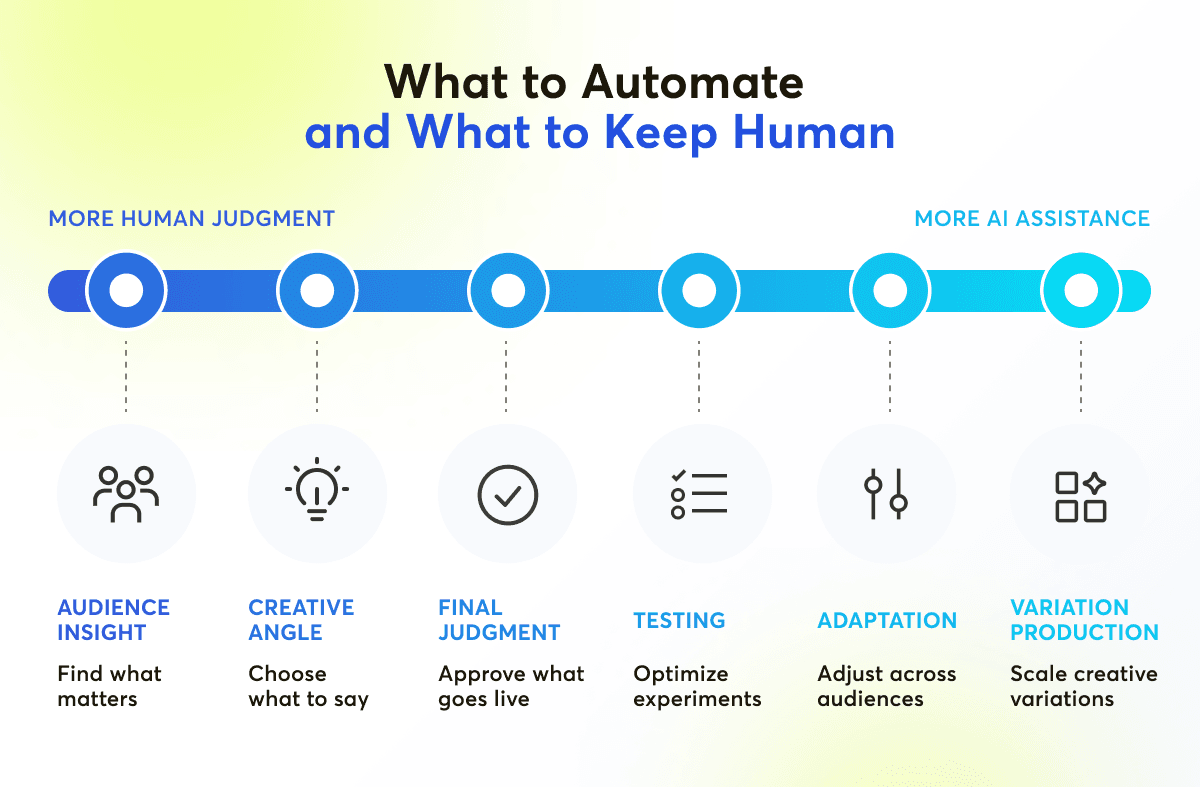
Once the angle is clear, AI can move fast. The trick is not handing over the entire creative process in one prompt. Instead, think of it as a series a prompts, each with its own specific job:
- Expand: Turn one strong angle into headline and copy variations.
- Adapt: Reshape the same idea for different audiences, markets or formats.
- Challenge: Find weaker claims, predictable wording or angles that sound too similar.
- Refine: Tighten copy without changing the original idea.
This is where AI earns its keep: it can explore more creative territory without forcing the team to start from zero every time.
Set the Boundaries Before Generating
Once you’ve chosen what to say, tell AI what it must or cannot change. The objective should be to have AI create copy that aligns with your brand voice, so give it
- a small creative kit:
- a few examples of copy that actually sounds like the brand
- words and phrases you use or avoid
- claims that are safe to make
- relevant customer language
- the landing page the ad will lead to
One rule matters more than the rest: preserve the idea, vary the execution. Without it, ten variations quietly turn into ten different promises, five new brand voices and one claim nobody approved.
Make Variations Mean Something
AI makes it tempting to treat sheer volume as a strategy. If five headlines are useful, fifty must be better. However, in practice, that often leaves you with a crowded test and very little idea of what you actually learned. A better approach is to organize AI-generated variations around a hypothesis.
Before you scale the experiment, set a baseline first. If AI-assisted creative is supposed to improve the campaign, compare it with something, whether that is your existing ads, your usual production time or the performance of human-written variants.
Say you're promoting the same accounting software from earlier, the one that saves small business owners a few hours every Friday. Instead of asking for 30 similar selling points, test three different angles that have the same benefit in the end:
- Problem-led: Still losing Friday afternoons to reporting?
- Outcome-led: Get your weekly reporting done before lunch.
- Contrarian: Your reporting process probably has more steps than it needs.
Now AI can create several executions within each direction. Instead of simply finding a winning headline, you’re testing which idea behind the headline actually moves the audience.
Let the Data Answer a Creative Question
If problem-led ads consistently beat outcome-led ones, you’ve learned something about what gets this audience moving.
This is where the workflow starts to compound:
AI gives advertisers the speed to test more ideas, but the real advantage comes from making sure every test leaves you with something you didn’t know before.
Don’t Let AI Sand Off the Good Parts
While grammatically perfect and persuasive, an AI ad is often forgettable. The problem is rarely bad writing. It’s that AI tends to smooth things out.
Specific language becomes safer language. An odd but interesting observation becomes a familiar benefit. A sharp point of view loses its charm.
Our advice? Give AI material that makes the brand sound like it lives in the real world.
A customer saying “I spend Friday afternoon fixing numbers from three different spreadsheets” is more useful than telling AI your audience “struggles with inefficient reporting workflows.” The first is person-centered. The second already sounds robotic before AI gets anywhere near it.
Keep Some Fingerprints on the Copy
When reviewing a generated ad, look for the details that AI was too eager to clean up. This could be a specific customer phrase, an unexpected product comparison or a joke that only makes sense in your category. Overall, be suspicious of copy that sounds universally acceptable.
“Simplify your workflow and save valuable time” could sell almost anything. But “Your Friday report shouldn’t take until Friday night” has somewhere to go.
Ask yourself: could a competitor swap in their logo and run the exact same ad? If the answer is yes, the copy lost its human touch, and another round of generation won’t help.
The Last Click Should Be Human
Before an ad goes live, read it once without thinking about prompts, models or how efficiently it was produced. Read it as the person who is about to see it between two articles. Ask one simple question: does this ad earn the click it is asking for?
Native ads have less room for bait-and-switch than most formats because they appear within an experience the reader has already chosen. The creative has to earn attention without borrowing trust it can’t repay on the landing page.
A headline like "Still doing Friday reports the hard way?" may win on curiosity. But If the landing page turns out to be a generic product pitch with no real payoff, AI has optimized the hook and quietly damaged the experience. The same goes for personalization. Sometimes it just makes the reader wonder how much you know about them.
Watch out for three things AI can make look better than they are:
- A strong hook with a weak payoff: The landing page needs to deliver on the reason someone clicked.
- A confident claim with shaky proof: AI has no qualms around making mediocre evidence sound definitive.
- Personalization without a reason: Personalization should enhance the message rather than just demonstrate that you have this audience info.
This final review is there to catch what AI often misses: the difference between an ad that earns a click and one that merely gets it.
The 5-Minute AI Ad Check
- Before generation: Do we have an actual audience insight?
- Before variations: What is AI allowed to change and what stays fixed?
- Before testing: What question is this test supposed to answer?
- Before choosing a winner: What did the performance tell us about the audience?
- Before launch: Would we make the same claim if AI hadn’t written it?
More Ads Were Never the Point
The real advantage of AI is that it makes the distance between an idea, a test and the next better idea much shorter. That only works if there’s still someone making the calls. Someone has to bring the audience insight, recognize when a strange idea is worth keeping, read the results and decide what deserves another round.
So use AI generously where speed helps. Don’t use it to automate the decisions that make the advertising worth noticing in the first place.