If you judge your native advertising campaigns strictly by last-click attribution in 2026, you are actively choking your own revenue stream.
Today, most performance marketers rely on default dashboard metrics. For many, when they see a lower direct return on ad spend (ROAS) for native compared to other advertising campaigns, they immediately cut the budget. While that decision looks mathematically correct on the screen, it is fundamentally flawed in practice.
The real problem is last-click attribution, not native traffic.
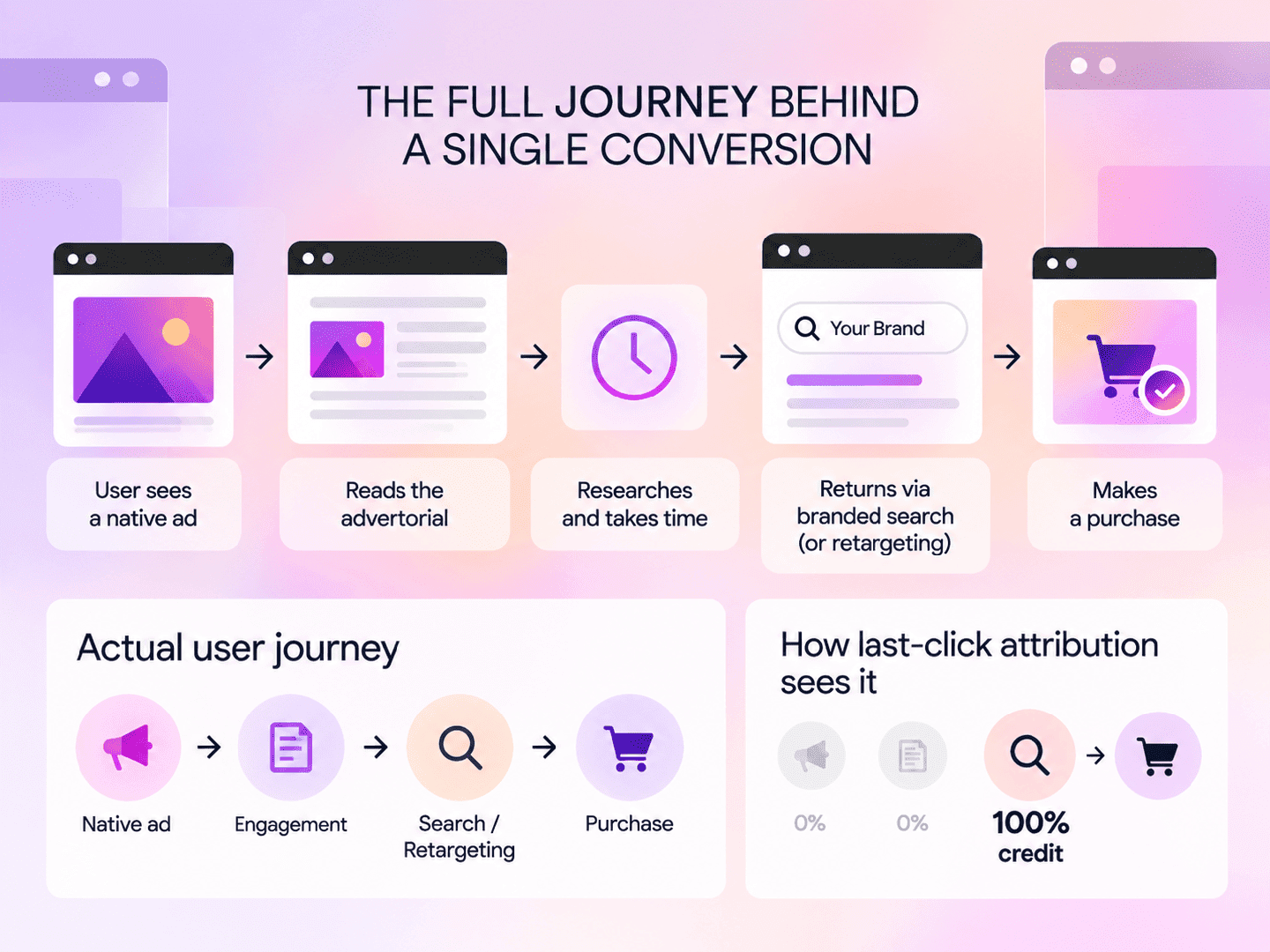
Last-click attribution is a legacy framework. It assigns 100% of the conversion credit to the final touchpoint before a purchase. Imagine a user discovering your product through a native advertorial on a news site, researching it for three days and finally buying it after clicking a branded search ad. With last-click attribution as the measurement model, that search ad gets all the credit.
This creates a massive data blind spot. Let's break down exactly why last-click attribution is so misleading and how it systematically undervalues the impact of native campaigns across the open web.
The Legacy of Intent Harvesting vs. Demand Generation
To understand why last-click fails native advertising, you have to look at why the model was created in the first place.
Last-click attribution was standardized over a decade ago, heavily pushed by search engines. It makes perfect sense for a search-dominant ecosystem. When a user types a highly specific commercial query into a search bar, they already have high purchase intent. The search ad simply harvests that existing intent and facilitates the transaction.
Because search platforms capture the final step of the user journey, they naturally champion an attribution model that rewards the final click.
The Cannibalization of Native Data
Look closely at how a multi-channel campaign actually operates in the wild. Ad networks do not operate in a vacuum: they constantly step on each other's toes. Since last-click attribution looks strictly at the final touchpoint, bottom-of-funnel channels routinely cannibalize the data from top-of-funnel channels.
Imagine you launch a heavy native campaign promoting a complex SaaS product. You buy a placement on a premium news publisher. From there, a user clicks, lands on your advertorial and spends four minutes reading the entire product breakdown. The native ad did exactly what it’s designed to do, educating the product and establishing total product authority.
But the user is currently at work. They cannot grab their credit card right now, so they close the tab. The tracking pixel fires, logging them into your audience pool.
Two days later, that exact same user is scrolling through a social media app. They are hit with a cheap, static retargeting banner for your product. They click it. They complete the checkout.
According to a standard last-click tracking dashboard, the social platform just delivered a hyper-profitable conversion. The native network gets completely ignored.
The social platform receives 100% of the credit, overshadowing the top-of-funnel channels that actually initiated the buyer's journey. A similar misattribution happens with branded search. A user reads your native prelander, remembers your brand name, and goes straight to Google the next morning. They type in your exact company name, click the top sponsored link, and buy. Search takes the credit. Native gets nothing.
The Threat of Funnel Starvation
This data cannibalization leads media buyers to make the single most destructive optimization mistake in performance marketing.
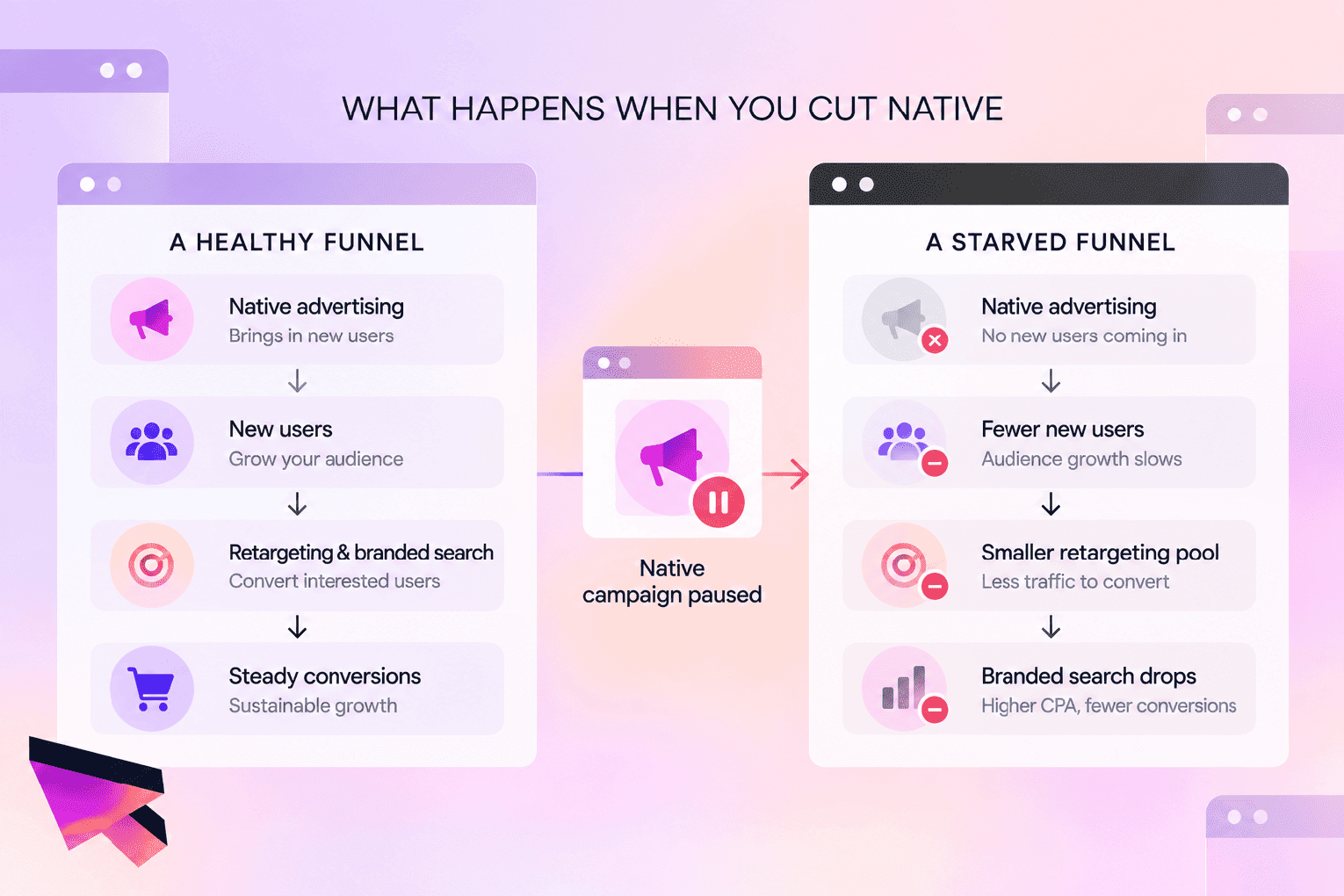
They open their analytics dashboard at the end of the week. The data shows branded search and social retargeting pulling massive returns. Meanwhile, the native campaign looks like it is bleeding money with a terrible direct ROAS. Following the raw numbers, the buyer pauses the native campaigns to allocate more budget toward the "winning" channels.
At first, the overall ROAS spikes. The buyer thinks they made a brilliant optimization move.
Then, exactly fourteen days later, everything crashes. The retargeting pool runs completely dry. Branded search volume plummets to zero. CPA across all remaining channels skyrockets.
By killing the native campaign based on last-click data, they essentially cut off the water supply to the rest of the ecosystem. Retargeting and branded search cannot survive on their own. They rely entirely on a steady influx of fresh, educated users. When you pause the native traffic that was secretly doing all the heavy lifting, the bottom of your funnel starves.
Rethinking the Ecosystem: Channels as a Team
Instead of pitting ad platforms against each other, the most successful media buyers view their traffic sources as a highly specialized team.
Search engines are unparalleled at capturing high-intent demand. Social media platforms excel at visual retargeting and maintaining brand presence. Native advertising specializes in the initial introduction.
Each source has a distinct role. Sophisticated buyers understand that native advertising will never behave like a bottom-of-funnel search ad, and flawed last-click dashboards are unable to capture the entire user journey.
Moving Beyond the Final Click
To accurately measure native traffic, you have to look at assisted conversions. Modern ad trackers and robust analytics platforms offer multi-touch attribution (MTA) models. These frameworks distribute the conversion credit across multiple touchpoints rather than giving 100% of the glory to the final click.
One of the most effective setups for native advertising is the Time-Decay model.
In a Time-Decay framework, every channel that the user interacted with before buying gets a share of the credit. The touchpoints closest to the sale (like a branded search click) still receive a larger percentage, acknowledging their role in closing the deal. However, the initial native ad click is finally recognized and recorded in your ROI calculations.
This shift in perspective changes the math completely. A native campaign that looked unprofitable under a last-click model suddenly reveals itself as the primary engine driving your cheaper search and social conversions.
Implementing Server-Side and Post-Purchase Tracking
Relying entirely on client-side pixels is no longer enough. Browser restrictions and privacy updates make tracking a multi-day user journey across different platforms incredibly difficult.
To map the real impact of native campaigns, performance agencies utilize Server-to-Server (S2S) tracking. By passing click IDs directly through their own servers, they maintain a much cleaner record of the user's path, even if that user switches from a mobile browser to a desktop computer two days later.
Additionally, buyers are reverting to one of the oldest and most accurate attribution methods available: the post-purchase survey.
Adding a simple, mandatory "How did you first hear about us?" dropdown on the final checkout page provides unfiltered truth directly from the consumer. When a user selects "Read an article on a news site," you gain concrete proof of native advertising's impact, completely bypassing whatever the last-click analytics dashboard claims.
The True Metrics of Native Success
Moving away from strict last-click attribution requires a different set of Key Performance Indicators (KPIs) to evaluate native campaigns. In fact, expecting immediate, day-one profitability from cold editorial traffic is an unrealistic standard. Instead, look for strong intent signals.
If the goal of native advertising is demand generation, your dashboard needs to reflect that specific objective. Here is exactly what successful performance teams track when running open-web campaigns.
Cost Per Unique Visitor
Search networks target users who already know what they want. Native networks introduce your product to people who didn't even know a solution existed. Because of this, native should be judged on its ability to find fresh eyes.
Evaluate the cost of acquiring a net-new user. If your native campaigns consistently deliver unique, first-time visitors to your bridge pages at a significantly lower cost than your social media prospecting campaigns, the channel is executing its primary function flawlessly.
Deep Engagement and Micro-Conversions
A direct, high-ticket sale is a heavy lift for an initial touchpoint. Instead, track the micro-commitments.
Look at the average time on page for your advertorials. A user spending three minutes reading a complex financial breakdown is a massive win, even if they do not convert that exact same day. Track scroll depth. Measure how many users click through the native prelander to the actual merchant site. Monitor soft conversions, like email newsletter opt-ins or interactive quiz completions. These micro-conversions prove that the native widget successfully captured attention and built trust.
Marketing Efficiency Ratio (MER)
The ultimate financial metric for a mature, multi-channel setup is the Marketing Efficiency Ratio, often referred to as blended ROAS.
Stop evaluating ad platforms in a vacuum. Instead, look at the total ad spend across search, social and native combined, and divide it by the total revenue generated across the entire business.
When you scale up a native campaign, watch the blended CPA. If adding native spend causes your overall company CPA to drop over a 14-day window, the native campaign is a massive financial success.
The Bottom Line: Protecting Your Funnel
Evaluating every ad platform with the exact same last-click ruler breaks media buying ecosystems. It forces marketers to make defensive decisions. It pushes them to pause top-of-funnel discovery channels and overfund bottom-of-funnel retargeting until the audience pool simply dries up.
Search, social and native are not enemies. They are a team. Search captures the existing demand. Social maintains the visual frequency. Native advertising builds the initial trust and generates new demand.
To scale revenue properly in 2026, media buyers have to respect the entire consumer journey. By adopting multi-touch attribution and analyzing blended metrics, you stop starving your funnels. And you finally allow native advertising to do what it does best: fill the ecosystem with fresh, highly qualified buyers.