The rollout of AI-driven search engines has caused massive disruption across the digital marketing space. Between Google’s AI Overviews, Perplexity and direct ChatGPT queries, performance marketers are watching traditional search volumes fracture. The common assumption is that if artificial intelligence answers a user's question directly on the results page, the user will never click through to a website, which would effectively starve the open web of traffic.
While there is no doubt the mechanics of search are changing, treating this shift purely as a threat is a strategic mistake. Generative search is not destroying the open web: it is filtering it.
For media buyers running native advertising campaigns, this evolution presents a massive advantage. AI search is actively altering consumer behavior, changing the type of intent users carry when they arrive on publisher sites and introducing new surfaces for ad placement. To capitalize on this, advertisers must stop optimizing for the legacy search model and understand exactly how artificial intelligence is rewriting the rules of user discovery.
The Shift From Link Retrieval to Answer Synthesis
Let’s begin by looking at how user queries are evolving. Traditional search engines functioned as retrieval systems. A user typed a fragmented keyword, and the engine provided a list of destinations. The user had to click multiple links and browse different sites to piece together the information themselves.
Generative AI reverses this dynamic. Modern search interfaces are synthesis engines. They compile the data, extract the value and deliver a definitive answer directly within the chat interface. This conversational shift is highly quantifiable. Recent data shows the average AI query is now three times longer than a traditional search, signaling a dialog-driven interaction rather than a simple keyword lookup.
Therein lies the new "zero-click" reality. When a user asks a simple, fact-based question, the AI provides the answer immediately. The user gets what they need and leaves. The click never happens.
Why the Zero-Click Web Elevates Native Ad Quality
At first glance, a drop in overall search clicks sounds alarming for publishers and the native networks that monetize their inventory. However, for direct-response media buyers, this filtering effect is highly beneficial.
AI search engines act as a massive net that catches low-intent, informational queries. The users who do not click through were never going to read a 1,200-word advertorial anyway. They just wanted a quick fact. By keeping those rapid-fire queries contained within the search results page, AI purifies the traffic that makes it out to the open web.
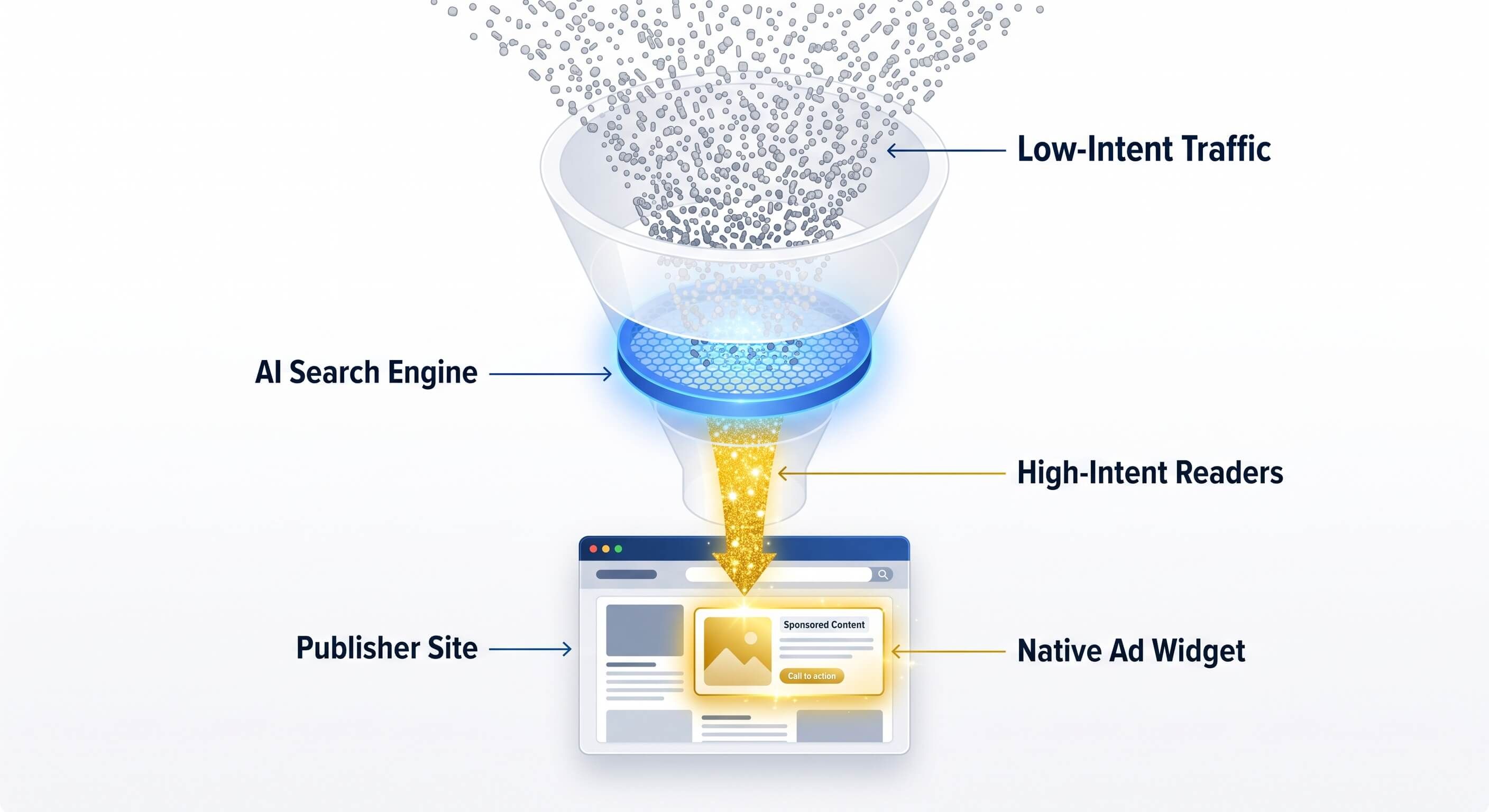
When a user actively chooses to click past an AI summary and visit a publisher's website, their mindset is fundamentally different. They are seeking perspective, deep narratives, human opinion and editorial context.
Native ads thrive on curiosity and content consumption. When you run a sponsored widget on a premium news site today, you are tapping into an audience that has deliberately bypassed instant AI answers in favor of deep reading. The overall volume of organic search traffic reaching publishers might stabilize at a lower baseline, but the concentration of high-intent, engaged readers is significantly higher.
Bypassing the AI Black Box
Organic discovery is currently undergoing a structural overhaul. Search Engine Optimization (SEO) is actively transitioning into Generative Engine Optimization (GEO). Brands are now formatting their content specifically so that Large Language Models (LLMs) cite them as primary sources in direct AI answers.
The primary challenge with GEO is the lack of predictability. AI ranking algorithms operate as closed loops. Securing a brand mention inside an AI-generated overview is a highly volatile strategy. The models update their weighting constantly, meaning a brand can lose its top-tier citation overnight without making a single change to its actual website content.
This volatility emphasizes the stability of native advertising.
While organic search teams spend months trying to reverse-engineer AI citations, performance marketers use native platforms to bypass the black box entirely and guarantee visibility on the exact pages where deep research happens.
Instead of fighting the artificial intelligence for a top-of-page mention, native campaigns position the brand directly on the premium publisher sites that the AI relies on for its data.

Consider the modern user journey. A buyer asks an AI engine for an analysis of "enterprise cybersecurity protocols." The AI provides a detailed summary and lists three tech journals as its sources. The buyer clicks the first link to verify the data. There, they find a native ad for a B2B security software platform. The native ad captures the same high-intent user, while completely sidestepping the unpredictable AI ranking model.
The Evolution of Contextual Targeting
The same machine learning technology powering AI search is also actively upgrading the infrastructure of native ad platforms.
For years, digital advertising relied heavily on user-based tracking, such as cookies, past search histories and third-party data pools. As privacy regulations tighten and browser restrictions increase, that model is steadily degrading. To maintain ROI, native ad networks are deploying advanced natural language processing to read and analyze publisher content in real-time.
The system no longer needs to track the user across the internet. It just needs to understand the exact semantic meaning of the article the user is currently reading. This creates a hyper-accurate targeting environment based on immediate context rather than outdated historical data.
Here is how AI-driven contextual matching directly alters the media buying workflow:
- Semantic Concept Mapping: Instead of relying on rigid, exact-match keywords, AI evaluates the overarching theme of an article. A news page discussing "sustainable urban commuting" automatically triggers native ads for electric bicycles or transit apps, even if those specific keywords never appear in the publisher's text.
- Sentiment Analysis: LLMs can now detect the emotional tone of the editorial content. If a financial news article discusses a recent market downturn with a pessimistic tone, the native platform can dynamically suppress aggressive stock-trading ads and instead serve creatives for stable, risk-averse savings accounts.
- Dynamic Creative Alignment: Advanced native networks use AI to scan the publisher's page and automatically adjust the formatting, font and layout of the ad widget. This preserves the user’s reading experience as they transition from the editorial article to sponsored content.
By relying on contextual AI rather than user-level tracking, native advertising provides media buyers with a privacy-compliant, highly scalable method to reach audiences exactly when they are consuming relevant information.
Adapting Creative Strategy for a Post-AI Audience
As large language models synthesize complex data into neat bullet points, consumer’s patience for low-value content drops to zero. Media buyers have to recognize that users arriving on a publisher's site from an AI-filtered search are seeking something specific. They want perspective.
To convert this highly filtered traffic, performance teams must overhaul their native ad creatives and bridge pages. The tactics that worked in a traditional search ecosystem are actively penalized by the modern user's attention span.
The Death of the Information Gap Headline
For years, native advertising relied heavily on the "information gap" — teasing a secret or a missing piece of data to force a click. Headlines like "The One Trick to Lower Your Car Insurance" worked because users were accustomed to digging for answers.
Today, if a user wants a generic trick, they ask a chatbot. To secure a click in a post-AI environment, the headline must promise something an algorithm cannot instantly generate. It has to signal exclusive data, expert opinion or a highly specific case study. Successful media buyers are swapping vague curiosity hooks for concrete value propositions. A headline like "How a 40-Year-Old Freelancer Cut Their Premium by 30% After the 2026 Rate Hikes" performs significantly better because it guarantees a specific, human-driven narrative.
Leaning Into Lived Experience on Prelanders
If an AI engine excels at aggregating facts, your native prelander must excel at delivering empathy and lived experience.
When a user clicks a native widget and lands on an advertorial, they expect a narrative. Without it, the user will bounce immediately. This is why first-person reviews, detailed case studies and expert interviews are seeing a massive spike in conversion rates.
Artificial intelligence can list the ingredients of a health supplement and explain their biological functions. However, an AI cannot explain how that supplement actually tastes, how it feels to integrate it into a morning routine or the physical relief it provides after two weeks of use. Native advertising provides the human context that algorithms lack.
By structuring advertorials around genuine human experiences, advertisers build a layer of trust that data synthesis simply cannot replicate.
The Bottom Line: A Purified Traffic Source
The panic surrounding AI search engines is largely misplaced. Generative AI is not erasing the open web, nor is it making native advertising obsolete. It is simply restructuring the top of the marketing funnel.
Search engines are claiming the low-intent, informational queries. By answering basic questions instantly on the results page, they filter out the casual browsers who were never going to convert on a direct-response offer anyway. The traffic that actually flows through to premium publishers is now highly concentrated. These are users actively seeking editorial depth, human opinion and detailed narratives.
For media buyers, this is a massive operational advantage. Instead of paying for clicks from users who just want a quick definition, advertisers are bidding on inventory where the audience is already in a state of deep content consumption.
As AI upgrades the contextual targeting capabilities of native ad networks, buyers can match their offers to the exact semantic meaning of the publisher's page without relying on restrictive user tracking. The combination of filtered, high-intent traffic and privacy-compliant targeting makes native advertising one of the most stable and scalable acquisition channels available right now.
To maintain margins in 2026, advertisers need to stop treating AI search as a competitor. Let the algorithms handle the raw data retrieval. Use native advertising to deliver the human context, build trust and ultimately close the sale.