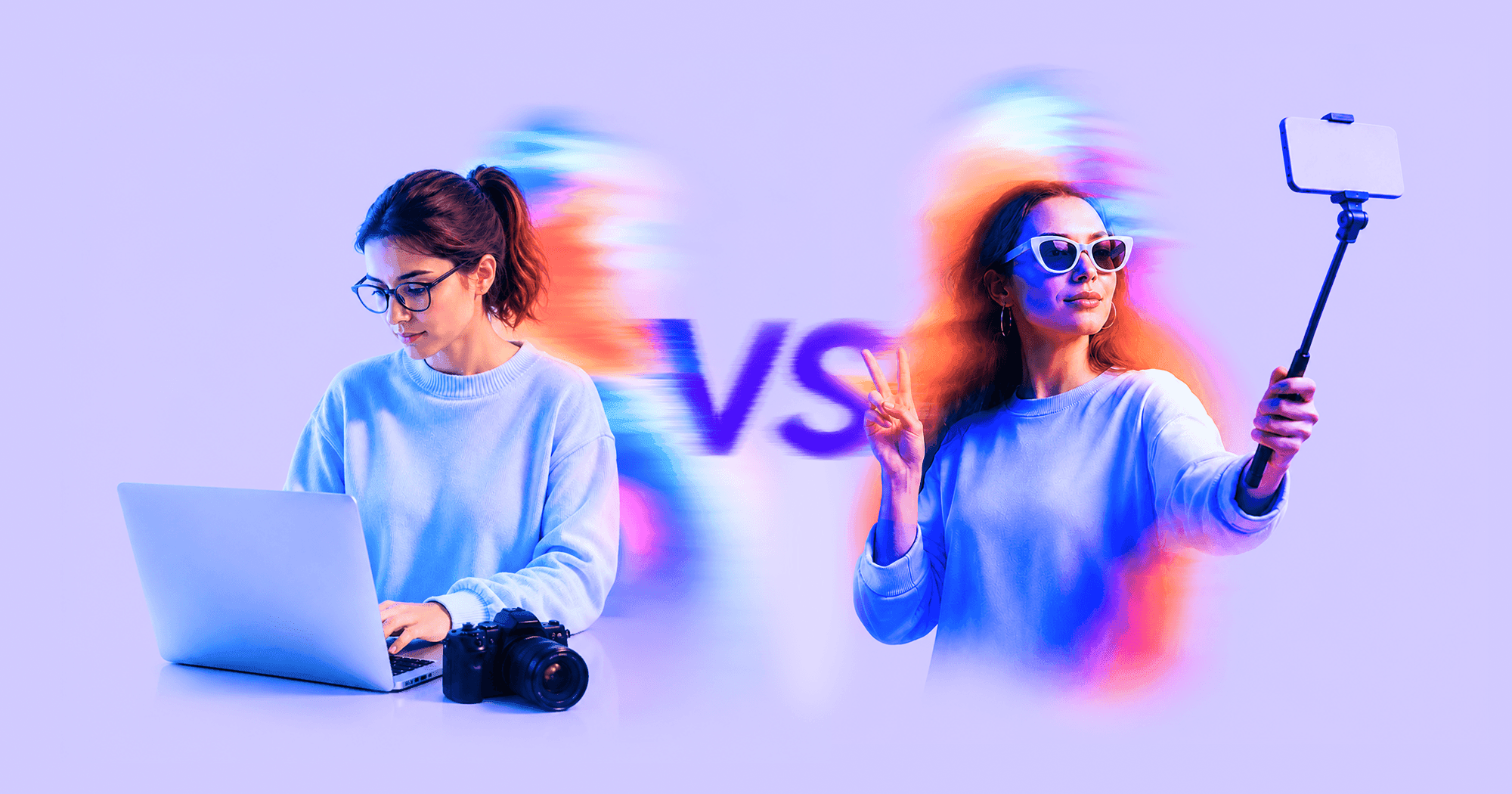
The terms content creator and influencer are often used interchangeably, but they describe two different jobs. Understanding the difference helps brands choose the right partner for every marketing goal.
Not long ago, calling someone an influencer covered just about everyone creating content online. Today, that label is far less precise.
Some people are experts at producing videos, photos and articles that brands can turn into high-performing ads. Others build loyal communities whose recommendations shape what people buy, watch and trust.
Choosing the wrong partner can mean paying for reach when you actually need creative assets, or investing in great content without the audience to amplify it. Knowing which role your campaign actually needs is where smart marketing starts.
Why Do People Confuse Content Creators and Influencers?
Scroll through LinkedIn, Instagram, TikTok or YouTube, and you'll quickly notice how loosely these labels get applied. Even brands, agencies and media outlets frequently switch between the two without much thought.
The confusion is understandable. Most influencers create content, and many content creators build loyal audiences over time. On the surface, they can look almost identical.
The biggest difference is in their respective values. In most campaigns, that value falls into one of three categories:
- Creative production: Producing videos, photos, blog posts or UGC that brands can use across marketing channels
- Audience influence: Reaching an established community that trusts the creator's recommendations
- Combination of the two: Blending strong creative skills with an engaged audience
However, the line separating the two roles isn't always clear-cut, either. Some creators build outstanding content and a loyal following. Many influencers, meanwhile, have evolved into full creative studios, producing content not only for their own channels but also for brands' websites, paid ads and native advertising campaigns.
Сreators vs. influencers aren't interchangeable roles. They're different marketing assets, and the right choice depends entirely on your campaign goals.
What Is a Content Creator?
Content creators aren't defined by the size of their audience. Many work behind the scenes or have relatively small followings, yet create assets that generate millions of views through paid campaigns.
Brands hire content creators primarily for their ability to communicate an idea, tell a story or showcase a product in a way that feels authentic and engaging.
Common types of content creators include:
- UGC creators
- Video creators
- Bloggers and writers
- Podcasters
- Photographers
- Graphic designers and illustrators
- Livestream creators
- Educational creators
Their work often appears across the internet with brands repurposing creator-made content for:
- paid social campaigns;
- native advertising;
- landing pages;
- email marketing;
- ecommerce product pages;
- brand websites.
Content creators are hired for their skills and not their reach. A creator with a few thousand followers and a strong eye for storytelling can still fuel an entire ad campaign.
What Is an Influencer?
That relationship can influence purchasing decisions, shape brand perception and introduce products to communities that are already engaged.
For brands, working with an influencer often means gaining access to an established audience and a level of social proof that's hard to manufacture any other way.
Influencers are good fit for brands that want to:
- Launch a new product
- Build brand awareness
- Generate social proof
- Reach niche communities
- Encourage conversations around a brand
- Drive engagement through authentic recommendations
Influencers are typically evaluated using metrics such as audience size, engagement rate, audience demographics and campaign reach. Creative quality still matters, but the value of an influencer campaign often comes down to who sees the content.
Brands hire influencers because people trust them.
That said, influence isn't measured by follower count alone. In 2026, many brands have begun to partner with nano- and micro-influencers, whose smaller but highly engaged communities often generate stronger engagement and better conversion rates than celebrity accounts.
The real question for brands is whether a campaign needs trusted recommendations, high-quality creative assets or both.
Content Creator vs. Influencer: Key Differences
By now, you've probably noticed that content creators and influencers have plenty in common. Both create digital content, collaborate with brands and may have loyal online communities. The difference lies in what brands primarily hire them to do.
| Content сreator | Influencer |
|---|---|
| Creates content for brands and digital platforms | Promotes products to an existing audience |
| Primary value: creative production | Primary value: audience trust and reach |
| May have a small or no public following | Usually has an established community |
| Success is measured by content performance | Success is measured by engagement, reach and influence |
| Often creates assets for paid advertising | Often publishes sponsored content on personal channels |
| Best for performance marketing and UGC | Best for awareness and social proof |
To truly make the most of either role, brands should ask the question: what does this campaign need most great content, trusted recommendations or both?
The answer will determine which type of partnership delivers the strongest results.
Quick Decision Guide
Choose a content creator if you need:
- UGC for paid advertising
- Product videos
- Native ad creatives
- Landing page visuals
- Content for A/B testing
- Assets you can reuse across multiple channels
Choose an influencer if you need:
- Brand awareness
- Product launches
- Reviews and recommendations
- Social proof
- Community engagement
- Organic reach on social media
✔️ An influencer helps people decide to buy it.
When Brands Need Both
The content creators vs. influencers debate often suggests that brands have to choose one over the other. In reality, the strongest campaigns combine both strategies.
A content creator can produce authentic, high-quality assets designed for paid advertising, while an influencer introduces the product to an audience that already trusts their recommendations. Together, they cover different stages of the customer journey.
For example, a typical campaign might look like this:
| Stage | Best partner |
|---|---|
| Create product videos and UGC | Content creator |
| Introduce the product to an audience | Influencer |
| Repurpose the best-performing content into paid ads | Brand or media team |
| Scale results across multiple channels | Paid advertising platforms |
This approach separates content production from content distribution. It’s become an increasingly common practice because brands work with specialists who excel at different parts of the campaign, rather than expecting one person to do everything.
For performance-focused brands, this model also makes content more scalable. A single creator can produce multiple creative variations for testing, while influencer partnerships help generate awareness, credibility and fresh user-generated content that can later be adapted for paid campaigns.
Each partner contributes a different kind of value, and the strongest strategies are built around that idea.
Why This Difference Matters for Native Advertising
One common misconception is that creator and influencer content only lives on social media. In practice, the best-performing content has a much longer life.
Let’s imagine a skincare brand launching a new serum.
An influencer posts a "Get Ready With Me" video explaining why they've added the product to their routine. The video generates comments, shares and plenty of discussion.
Rather than letting that content fade after a few days, the brand partners with a content creator to produce several new versions tailored for different marketing channels.
The campaign might evolve into something like this:
| Channel | How the content is used |
|---|---|
| Instagram or TikTok | Influencer introduces the product to their audience |
| Native advertising | Creator-style storytelling appears inside editorial environments |
| Landing page | The same product story becomes part of the buying journey |
| Product page | Short UGC clips answer common questions before purchase |
| Email campaign | Creator images and testimonials reinforce the message |
Notice what does and doesn’t change within the campaign. The message stays consistent, but the content is adapted to fit each environment and each stage of the customer journey.
That's one reason brands increasingly invest in creator-led assets: a single piece of content can work across multiple touchpoints instead of vanishing after one post.
Native advertising is particularly fitting for this. This is because content that feels educational or genuinely interesting is much more likely to earn attention. Creator-style assets, whether they're product explainers, tutorials or authentic UGC, naturally fit into the native experience because they focus on telling a story rather than simply promoting a product.
For brands running native campaigns through platforms like MGID, that means creator content can continue delivering value long after the original social campaign ends.
The most valuable content is flexible enough to work wherever your audience discovers your brand.
The Bigger Picture
The labels will keep evolving. New platforms will emerge, algorithms will change and today's marketing buzzwords may fade out entirely. What won't change is the value of content that earns attention and people who inspire trust.
Whether that comes from a content creator, an influencer or someone who successfully combines both roles, brands that understand the difference will always be better equipped to build campaigns people actually want to engage with.