For years, creators positioned themselves as the human alternative to algorithmic content. Although now, generative AI is no longer sitting on the sidelines of the creator economy. In 2026, it’s becoming part of the team.
A year ago, most creators treated AI like an experiment, but today AI is inside the workflow, helping write scripts, sort brand deals, reply to DMs and in some cases, talk to fans directly.
The shift happened faster than most expected. According to a Wondercraft report, 80% of creators are already using AI at some point in their process. The conversation has moved on from “should I use this?" to something more interesting: “how far is too far and will my audience even notice?“
The Creator Economy Has Entered Its AI Operations Era
Growing an audience used to be the hard part — now it's table stakes. The real challenge today is keeping up with the operations behind the creator from managing brand partnerships to staying active across platforms, answering DMs and tracking what's actually working.
For solo creators or small teams, it’s almost unmanageable, and that's exactly where AI is quietly taking over. These repetitive behind-the-scenes tasks, like scheduling posts, repurposing clips, sorting inbound requests and analyzing engagement, no longer need to eat up hours every week.
With AI, what we see is a widening gap between creators who use AI for operations and those who don't. What was once a preference is now a competitive disadvantage.
The New Competitive Advantage is Speed
The creator economy has always rewarded consistency. If you show up often enough, the algorithm will eventually notice. Although, in 2026, consistency alone isn't enough. Algorithms move faster, trends have a half-life of days and audiences expect creators to be present everywhere at once: TikTok, Instagram, newsletters, podcasts and private communities.
That pressure is changing how creators think about scale. A few years ago, the goal was to grow a team that could handle the load. Now the goal is to build systems, where AI takes care of the repetitive execution so the creator can focus on what actually requires a human: direction, tone, personality, judgment.
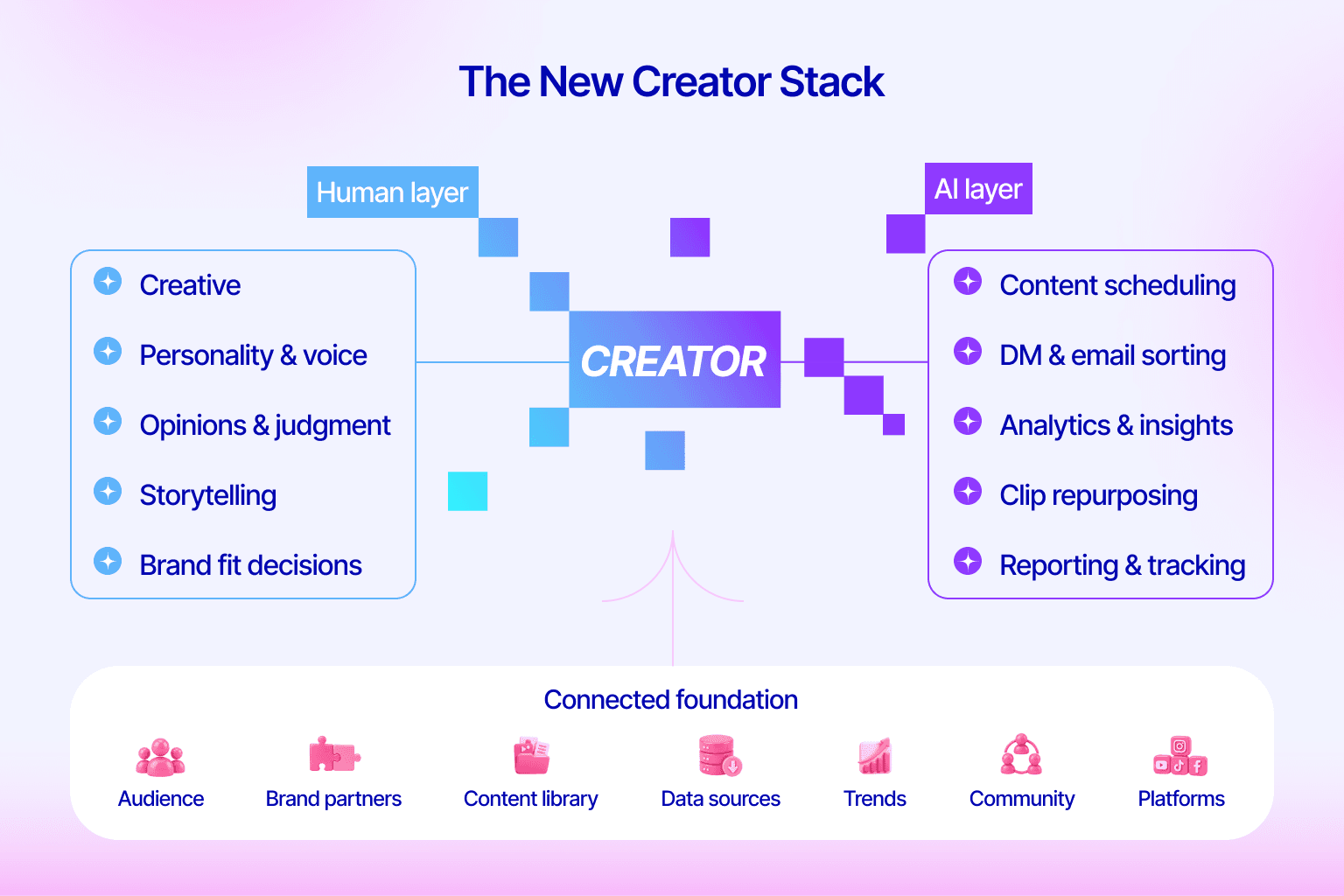
It's a similar shift to what happened when businesses moved to cloud software or social media schedulers. At some point, those stopped being tools and became infrastructure.
| What used to work | What works now | Why it changed |
|---|---|---|
| Posting once a day was enough | Showing up across multiple platforms consistently | Algorithms reward presence, not just quality |
| Growth came from reach and virality | Growth comes from speed, consistency and retention | Feeds are saturated, attention is harder to keep |
| Small creators worked mostly manually | Automation handles the repetitive operational layer | The volume of tasks grew faster than teams did |
| Big teams were a sign of success | Lean, well-automated setups can outperform large ones | AI reduced the cost of scale |
Why Human-Led Content Still Wins
Platforms are already responding to the flood of AI-generated content. Earlier this year, YouTube promised to reduce the spread of low-quality AI content and removed 16 of the top 100 most-subscribed "slop channels" within days of that announcement. Deepfake detection tools that were once available only to Hollywood studios are now open to any creator in the YouTube Partner Program.
Although, the more interesting pressure is coming from audiences. People may not care whether a creator used AI to edit clips or organize their inbox. What they do care about is whether there's a real perspective behind the content.
The difference is harder to define than it sounds. Octavio Maron, chief creative partner at Dentsu, put it well: content that falls flat usually has a certain recognizable quality to it — generic composition, predictable structure, no real point of view. Even when they can't name it, audiences can recognize it. However, when AI is in service of a genuine creative vision, it stops being visible. The work just lands.
The Rise of AI Creators Creates a New Trust Problem
Some brands are starting to experiment with fully AI-generated influencers. The appeal is obvious: no scandals, no off-message moments, no morality clauses triggered at 2 am on a Sunday. Behind the industry data, there is interest on the side of brands.
From a purely operational standpoint, the advantages are real:
- No risk of a creator saying something that ends a partnership overnight.
- Content can be produced continuously without scheduling constraints.
- AI personas can be localized and adapted across markets faster than any human team.
- Production costs are significantly lower than working with established creators.
Although, there is still no definitive evidence that AI creators can outperform human creators, and audience trust is a different equation entirely. Creator marketing became powerful because people felt connected to a real person making a real judgment: someone who actually tried the product, visited the place or formed an opinion. Synthetic influencers can replicate the visual layer of that relationship, but emotional credibility is much harder to automate.
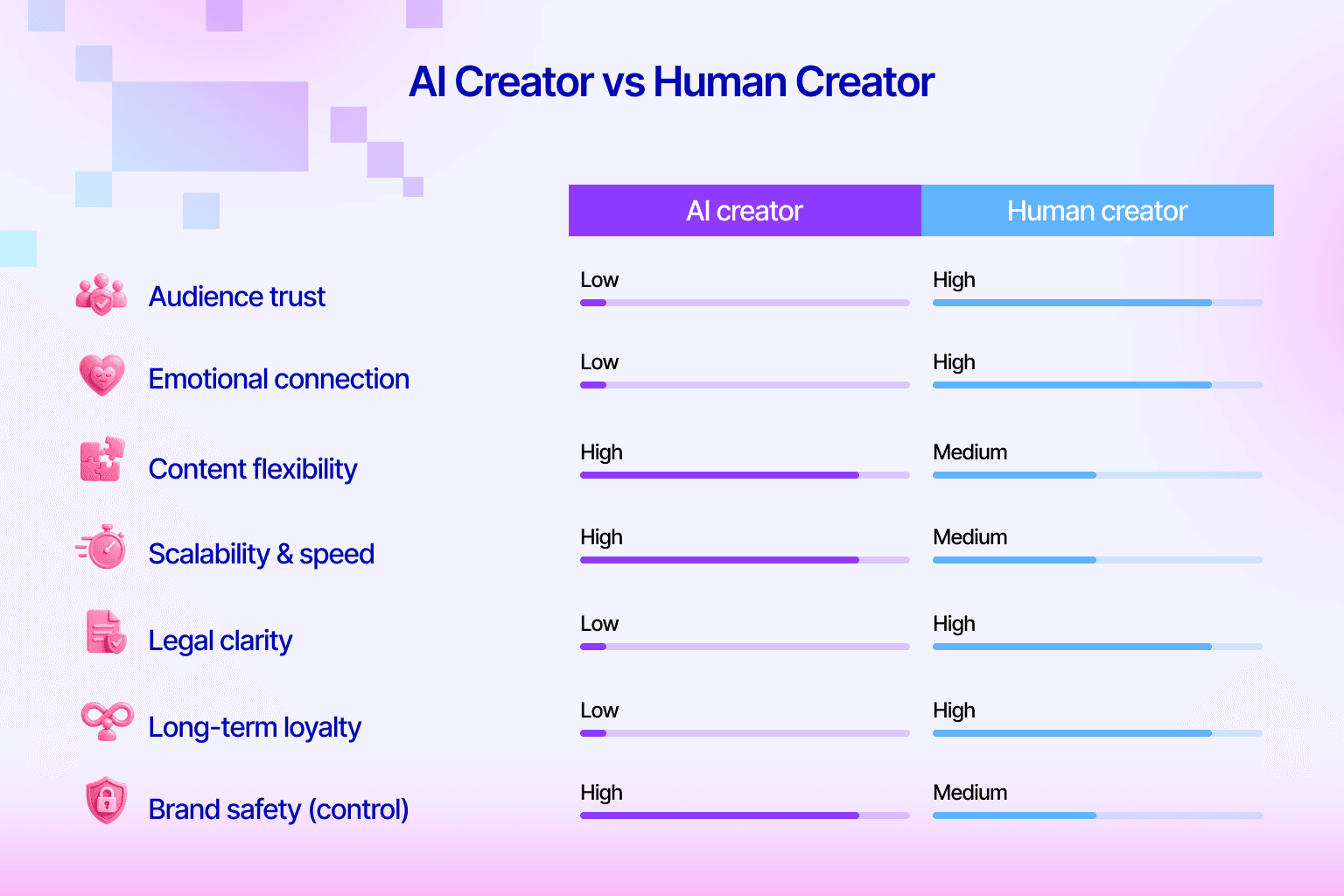
The legal side is just as murky. AI-generated personas sit in genuinely uncharted territory. If a real person's likeness is used without consent, there's an established right of publicity claim. But what if the face was never real to begin with? That question hasn't been litigated yet and the brands building AI influencers right now are largely operating without a clear legal framework.
The risks aren't hypothetical either. Khaby Lame signed a deal in January 2026 worth a reported $975 million, licensing his AI-generated twin to a Hong Kong-based printing firm. Within months, the firm's stock had collapsed 90%, major brokerages restricted trading on it and Lame quietly removed the stock ticker from his social media bios. It was supposed to be the future of creator monetization but instead became a cautionary tale.
| Factor | AI-generated influencer | Human creator |
|---|---|---|
| Brand safety | High, fully controlled messaging | Variable, depends on the creator |
| Audience trust | Hard to earn, easy to lose | Built over time through authenticity |
| Content flexibility | Fast to produce and localize | Slower but more culturally nuanced |
| Legal clarity | Largely unresolved | Well-established frameworks |
| Long-term loyalty | Unproven | Strong when the relationship is genuine |
The smarter approach for brands is to build human-focused creator systems and use AI to support the process (research, scripting, trend analysis, reporting) rather than replace the person at the center of it.
How Creators Are Actually Using AI Day-to-Day
A new wave of AI tools is being built specifically for creators, and they're less about generating viral videos and more about handling everything else.
RHEI's platform Made, launched in early 2025, positions itself as a creative operating system for creators. Instead of a general-purpose AI tool, it offers a set of specialized agents, each responsible for a different part of the workflow. This includes creative direction, production, community management and distribution. The platform was first tested with enterprise clients including Sony Pictures, Lionsgate and Universal Pictures before opening up to individual creators. RHEI estimates that within the next year or so, around 90% of content will either be fully AI-generated or human-created with significant AI assistance.
On the audience side, creator super-app POP.STORE launched its ECHO ME program in March 2026, and it goes further than most tools in this space. Connected to a creator's social accounts, it monitors incoming DMs and emails, identifies whether a message is coming from a brand or a fan, assesses the size and relevance of the sender and flags anything with a clear commercial opportunity. By the end of April 2026, the platform had 20,000 creators signed up across lifestyle, fitness, real estate and food verticals.
What makes ECHO ME more controversial is what comes next. The tool can also respond to messages as the creator and act as a selling agent in the comments, identifying followers most likely to convert and sending them offers. It's effective, but it raises a question the industry hasn't fully answered yet. At what point does AI assistance become AI impersonation?
What This Means for Native Advertising
As feeds fill with AI-optimized content, the formats that still reliably earn attention are the ones that don't feel like advertising at all. Native advertising sits at exactly that intersection, and the AI moment in the creator economy is making it more relevant.
For Brands
The creators worth investing in right now are not necessarily the ones with the highest follower counts or the most automated workflows. They're the ones whose audiences actually pay attention and who have enough creative identity to make a brand message feel like a natural extension of their content rather than an interruption of it.
Brands that rely on synthetic influencers or fully automated pipelines are trading short-term efficiency for long-term trust. Native advertising works in the opposite direction: slower to scale but far more durable.
For Creators
Partnerships that respect your voice and fit your format are easier to integrate, easier to disclose and far less likely to cost you audience trust. In a new landscape where trust is harder to earn and easier to lose, the quality of brand partnerships matters as much as the quantity.
The irony of the AI moment is that it's making authenticity more commercially valuable than it's ever been, which means creators who've built real relationships with their audiences are in a stronger position than the volume of their content alone would suggest.
Originality is Becoming the Scarcest Resource Online
As more creators adopt the same tools, optimize for the same algorithms and follow the same trend cycles, large parts of the internet are starting to feel interchangeable. The hooks sound familiar, the thumbnails look alike and the storytelling follows predictable patterns because it's increasingly being shaped by the same underlying systems.
That's the paradox AI creates in the creator economy. The same technology that makes it easier to produce more content also makes it harder to stand out. Volume is no longer a differentiator when everyone has access to the same acceleration.
What's harder to replicate is a recognizable voice, a specific point of view, cultural awareness and the kind of humor that only works because it comes from a particular person with a particular history.
For brands, the implication is straightforward. The creators worth partnering with are those who've built genuine trust with a specific audience, and whose identity is strong enough to survive an internet increasingly shaped by automation.
The creator economy is heading toward a split. On one side: high-volume, AI-assisted content that's efficient, consistent and largely forgettable. On the other: creators who use the same tools but bring something to them that the tools can't generate on their own. The audience will know the difference, even if they can't always explain why.