Tell a performance marketer you want to run an Augmented Reality (AR) campaign, and they will probably roll their eyes. For years, "immersive advertising" was synonymous with wasted budgets.
The early iterations of AR ads were a nightmare for conversion rates. They required users to leave the article they were reading, download a 300MB application and grant just about a dozen permissions to see a 3D shoe spin on their screen. That level of friction is completely incompatible with direct-response media buying.
Previously considered a vanity metric tool used by global brands who cared more about clout than CPAs, AR formats have shifted massively. Due to evolving infrastructure, the focus is now entirely on WebAR and interactive 3D native widgets embedded directly into the open web.
Immersive tech is no longer a gimmick. When deployed correctly within a native ad framework, it is actively driving down acquisition costs. Let's break down why this shift happened and which specific immersive formats are surviving the brutal landscape of performance marketing.
The Death of the Download Barrier
The biggest enemy of any media buyer is the extra click. Every hurdle you put between the initial impression and the checkout page destroys your conversion rate.
That was the fatal flaw of the old AR model. Today, the heavy lifting is done directly within the user's mobile browser via WebGL and advanced WebAR protocols.
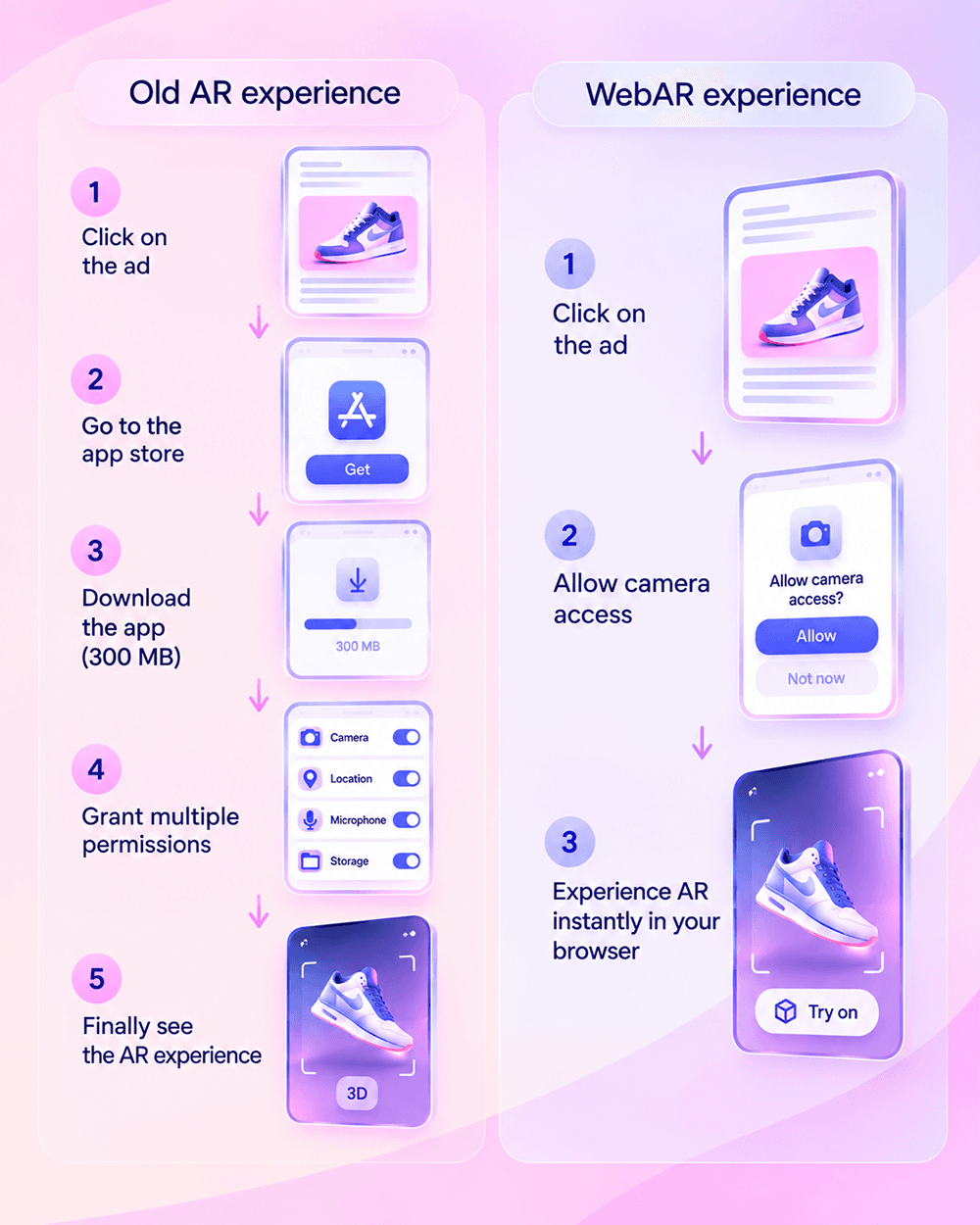
Imagine a user reading a lifestyle article on a premium publisher site. They scroll down and see a native widget for a new line of sunglasses. Instead of a static image, the widget contains a fully rendered 3D model that responds to their scrolling. If they want to try them on, they tap once. The browser requests instant camera access, and the AR experience happens right there on the page.
The user never leaves the editorial environment they originally trusted. This frictionless transition is why native AR is finally producing engagement numbers that justify the higher creative production costs. By simply removing the download barrier, you stop filtering out the impulse buyers.
The Immersive Formats Surviving the Performance Test
Although, not every 3D or AR concept translates into a profitable campaign. Many still fail because they prioritize visual spectacle over the sales funnel.
For performance marketers, an immersive format is only valuable if it accelerates the user's decision-making process. Right now, the data points to three specific interactive deployments that consistently deliver a positive return on ad spend.
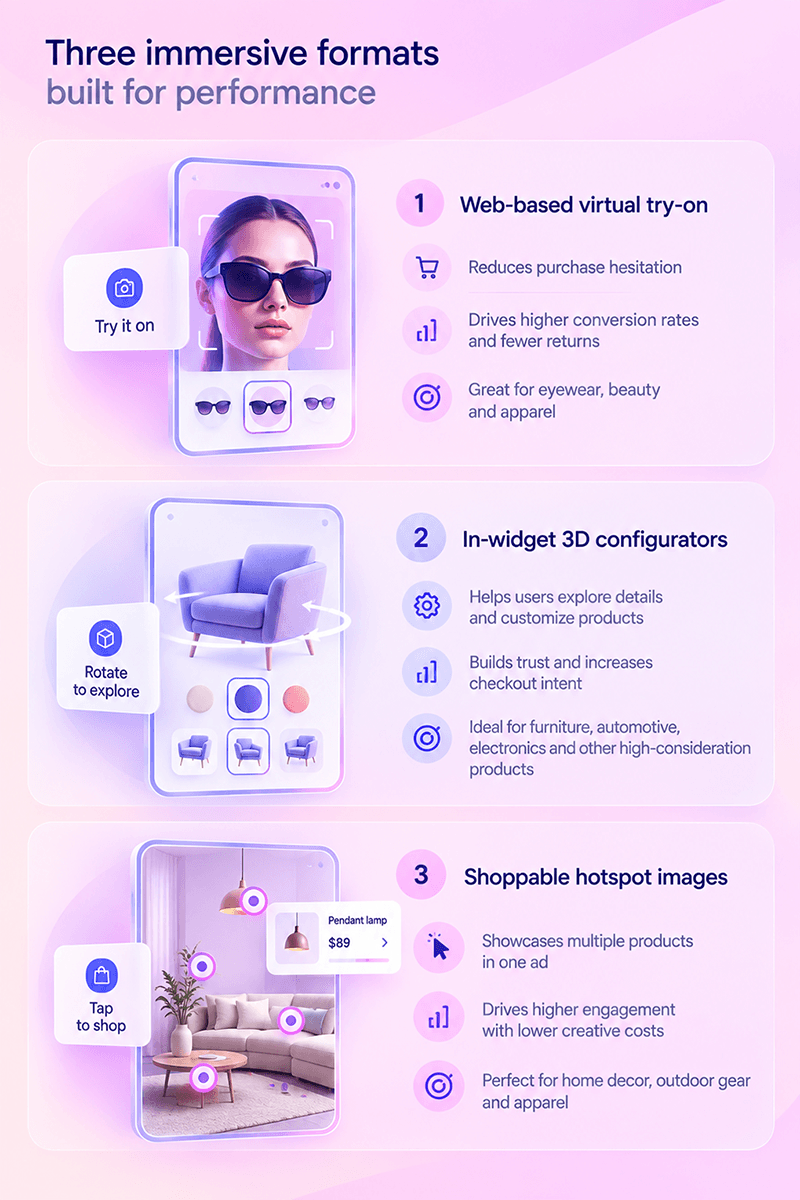
Web-Based Virtual Try-On (VTO)
What was once exclusive to massive cosmetic and luxury eyewear brands, Virtual Try-On is now accessible for mid-market direct-response campaigns.
The flow is incredibly straightforward. A user spots a native widget on a news publication recommending a specific pair of sunglasses or a skincare product. Clicking the ad takes them to a lightweight bridge page that instantly asks for camera access. Within seconds, they are looking at their own face with the product overlaid perfectly.
This specific interaction solves the biggest conversion killer in e-commerce: purchase hesitation. With static images, buyers have to guess how the product will look in reality. VTO removes that guesswork. It bridges the gap between digital discovery and physical ownership. Brands running these specific funnels are not only seeing higher initial conversion rates but also tracking significantly lower product return rates on the backend.
In-Widget 3D Configurators
Pushing a $1,500 custom couch or aftermarket car parts through a standard static banner rarely works. The buyer needs time to think. They want to see the details. A flat image just doesn't build enough trust to rationalize that kind of purchase.
That dynamic shifts entirely when you embed a configurator right into the publisher's feed. The user starts playing with the product immediately, spinning the 3D model around, zooming in on product texture and swapping out finishes.
Every single tap builds psychological investment. Someone who spends two minutes building a custom mechanical keyboard inside an ad unit is no longer “just browsing.” That active interaction drives checkout intent through the roof compared to passive scrolling.
Shoppable Hotspot Images
Sometimes you don't need a massive 3D rendering to get the click. Shoppable hotspots hit the sweet spot between lower creative costs and heavy user engagement.
Think about a native placement showing a fully furnished living room or a model wearing a layered winter outfit. With shoppable hotspots, you can drop interactive tags across the graphic. A quick hover pulls up the exact price of the coffee table. Another tap shows the sizing for the jacket.
Home decor, outdoor gear and apparel campaigns thrive on this setup. You manage to pack five or six different SKUs into one single ad impression. The user gets to poke around and find exactly what catches their eye. It essentially functions as a lightning-fast storefront right inside the article.
The Data Advantage: Tracking the Invisible Metrics
With standard display and native ads, you know if a user clicked or if they scrolled past, and that’s it. The performance data is entirely binary, and you have absolutely zero insight into what actually happened in their head during those crucial three seconds of exposure.
Immersive formats completely eliminate this blind spot. That is because when you run a 3D widget or a WebAR unit, you are acquiring deep behavioral data.
Every time a user engages with an interactive ad, the system records micro-interactions. We are talking about dwell time, rotation angles, zoom depth and feature toggles. If a visitor spends forty seconds zooming in on the stitching of a virtual leather jacket but abandons the widget before hitting the merchant page, that is not a cold lead. That is a highly qualified prospect who probably just needs a slight pricing nudge in your retargeting sequence.
Top-tier media buyers use this granular data to aggressively train their bidding algorithms. Instead of firing a standard pixel on a landing page view, they pass specific engagement thresholds back to the ad network using rigid Server-to-Server (S2S) postbacks. You can even instruct the traffic source to optimize your bids specifically for users who interact with a 3D model for more than ten seconds. This tactic aggressively weeds out accidental clicks and low-quality traffic. Because a bot might accidentally trigger a click, but it doesn't manually spin a custom modular couch around to inspect the back cushions.
Beyond immediate campaign optimization, this setup delivers free consumer research baked directly into your CPC costs. If your widget analytics reveal that 80% of the audience immediately swaps the default red paint on a product for a matte black finish, you know exactly what visual to push in your cheaper static retargeting campaigns. You stop guessing what the market wants and just let their swiping habits dictate your next creative angle.
Aligning the Funnel with the Immersive Experience
Getting a highly engaged click from a 3D widget is only the first step. Hooking someone with a buttery-smooth 3D try-on just to drop them onto a laggy merchant site is a rookie mistake. That instantly kills consumer trust. Your bridge page has to feel like a natural extension of the ad unit.
First, page speed is non-negotiable. A four-second delay will lose your lead immediately. So strip out heavy background scripts. Keep the landing page code exceptionally clean.
Second, you must maintain visual continuity. If a buyer spends a minute configuring a matte black desk inside your native ad, your landing page needs to dynamically load that exact matte black model. Forcing them to re-select their preferences once they reach the merchant site adds unnecessary friction. Smart buyers pass the user's customization data directly through the URL parameters. Cap the actual checkout flow at two clicks maximum once they exit the publisher feed.
The ROI Reality of 3D Formats
Forget the old PR stunts. Browsers can finally handle the heavy lifting required for real performance media buying. Running WebAR straight inside a native placement grabs traffic without the usual friction.
Yes, the upfront cost of 3D creative production is higher than a standard static banner. But media buying is about the total acquisition math. Add up the increased dwell time, the behavioral data you collect and the massive drop in refunds. That raw math explains why the final CPA consistently beats flat display banners.
AR is a direct-response weapon now. Let the audience play with the merchandise before they ever land on your site. The upfront investment pays off directly in your backend conversion numbers.