Of all the twelve months, August is the most misunderstood in performance marketing. Ask the average media buyer about their Q3 strategy, and they’ll tell you consumers are on vacation, B2B decision-makers are out of the office and conversion rates are hitting a seasonal wall. The default industry move is to slash daily budgets, pause testing and wait for September.
While everyone else goes to the beach, top-tier affiliates and performance agencies are quietly buying up the cheapest traffic of the entire year.
Treating August as a dead zone is a massive tactical error. The internet does not power down just because it is summer. People still scroll news feeds, read articles and buy products. What does change in August is the auction pressure. When massive corporate brands and cautious advertisers pull their spend, ad platforms are left with a massive surplus of unsold inventory.
If you know how to exploit this, August becomes the ultimate incubator for Q4 profits. Let's break down exactly why the auction clears out and what aggressive media buyers are doing right now while their competitors are offline.
The Economics of the August Auction
To capitalize on this month, you have to look at the raw mechanics of native and programmatic ad auctions. Traffic costs are dictated by demand, not supply. The amount of time users spend on publisher sites or scrolling mobile feeds is the supply, and even in late summer, it remains highly stable. Regardless of whether they are at the airport, a hotel or home, people are still glued to their phones.
The demand, however, collapses. Major corporate advertisers operate on rigid quarterly budgets. By the time August hits, Q3 budgets are often depleted, or corporate marketing teams intentionally pause campaigns because their legacy data dictates a "summer slowdown."
This mass exodus creates a vacuum. With fewer bidders fighting for the same ad placements, the base CPM drops. For direct-response marketers running Cost Per Action (CPA) campaigns, this is the perfect scenario. You get access to premium placements on top-tier publisher sites at a fraction of the cost you would pay in November.
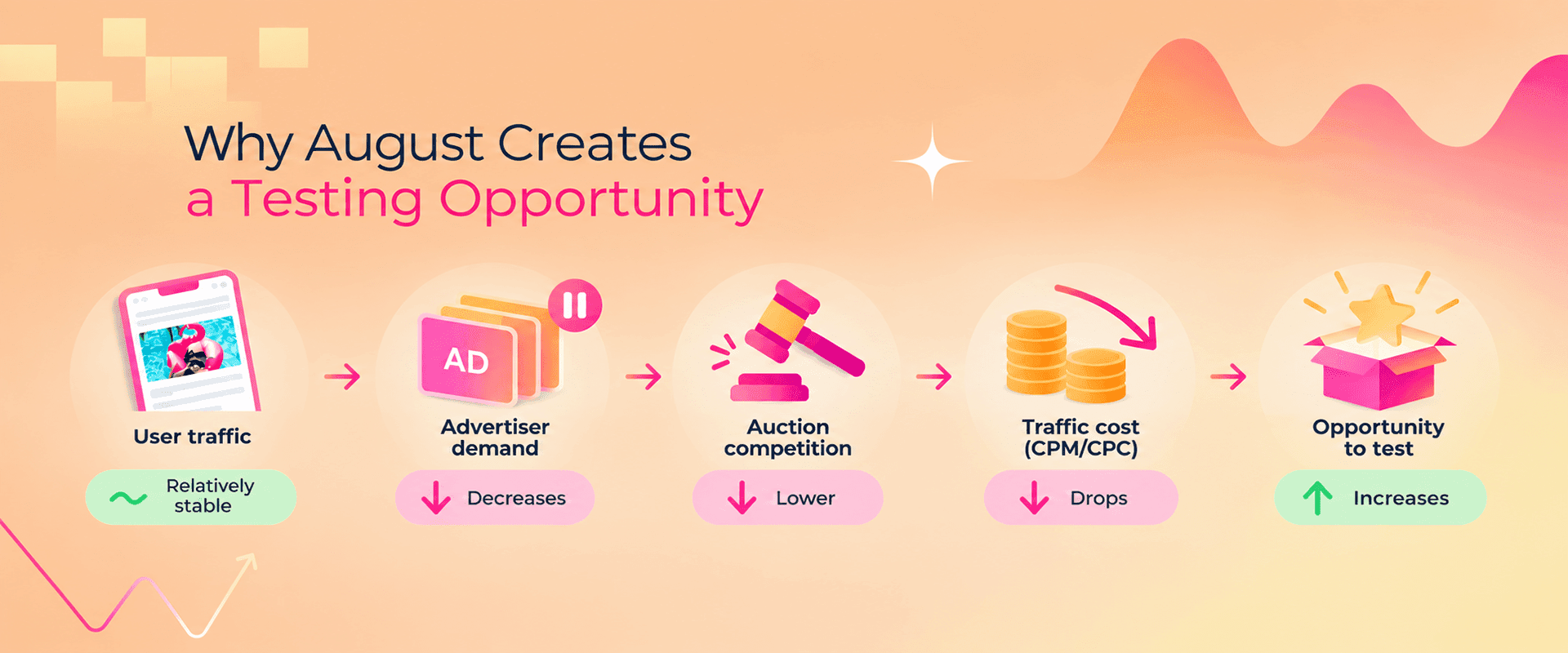
Novice affiliates see a drop in immediate conversion rates and panic-pause their campaigns. Top performers see the drop in CPCs and immediately increase their testing volume. They treat August as a massive, discounted testing ground.
If you wait until October to test your new advertorials, bridge pages or native creatives, you are going to pay peak Q4 holiday prices just to figure out your baseline conversion rates. That is how you drain a budget within 48 hours. Smart buyers secure their winning combinations now, at a discount, so they are ready to scale aggressively the moment the high-intent buying season starts.
The Verticals That Thrive in Late Summer
Let's put aside the idea that consumer spending completely halts in late summer. The reality is people just stop buying the exact same products they wanted in June. Strategic media buyers recognize the pivot. They track where the consumer's headspace is moving and leverage the softer auction to scale highly specific angles.
Here is where they redirect testing budgets during this window:
Nutra: The Post-Binge Detox
Think about consumer behavior over the last two months. People have been traveling, eating out and skipping the gym. By the third week of August, a massive segment of the audience feels physically drained. That collective exhaustion opens a highly profitable lane for CPA marketers.
Although, standard weight loss hooks don’t pack the same punch after July. The narrative needs to flip completely toward recovery. Pushing gut health, liver detox and energy reset offers work exceptionally well right now. Build headlines around wiping the slate clean before fall starts. It matches their current physical reality perfectly.
Financial Lead Gen & Debt Relief
Summer vacations hit personal budgets hard. The credit card statements from July road trips and international flights finally post in August, and the financial pressure is real and immediate.
This anxiety drives a hard spike in clicks for debt consolidation, balance transfer cards and personal loans. Because major retail banks operate on strict quarterly branding cycles and often slow down their media buying in late summer, the auction opens up. You can step in and buy Tier 1 financial leads on native placements at a significant discount.
The Hidden "Back-to-School" Markets
Thinking of back-to-school advertising as just pens and notebooks leaves money on the table. Late August triggers one of the biggest forced relocation periods of the year. Millions of college students, young professionals and families are moving or restructuring their daily routines.
Target the chaos of relocation. Compact furniture, noise-canceling headphones for shared spaces, meal-prep subscriptions and even auto insurance see huge bumps in intent. People are locking in completely new habits. If you build bridge pages around these specific life changes, your conversion rates will easily outpace traditional retail offers.
Local Home Improvement
Homeowners eventually look at the calendar and realize weather patterns are about to turn. August is the final realistic window to execute major exterior work before the cold sets in. Roofing, HVAC swaps, solar installations and window sealing take priority.
Since national brands often scale back their localized targeting during the summer holidays, regional native ad inventory gets notably cheaper. By aggressively bidding on local news sites, you can sweep up high-intent homeowner leads right before the September rush inflates CPCs across the board.
The August Playbook: Strategic Moves for Late Summer
Conventional media planning usually dictates a defensive approach in August. Many established agencies and brands naturally scale back their ad spend to conserve budgets for the upcoming holiday season. It is a logical, safe strategy based on historical retail cycles and team availability.
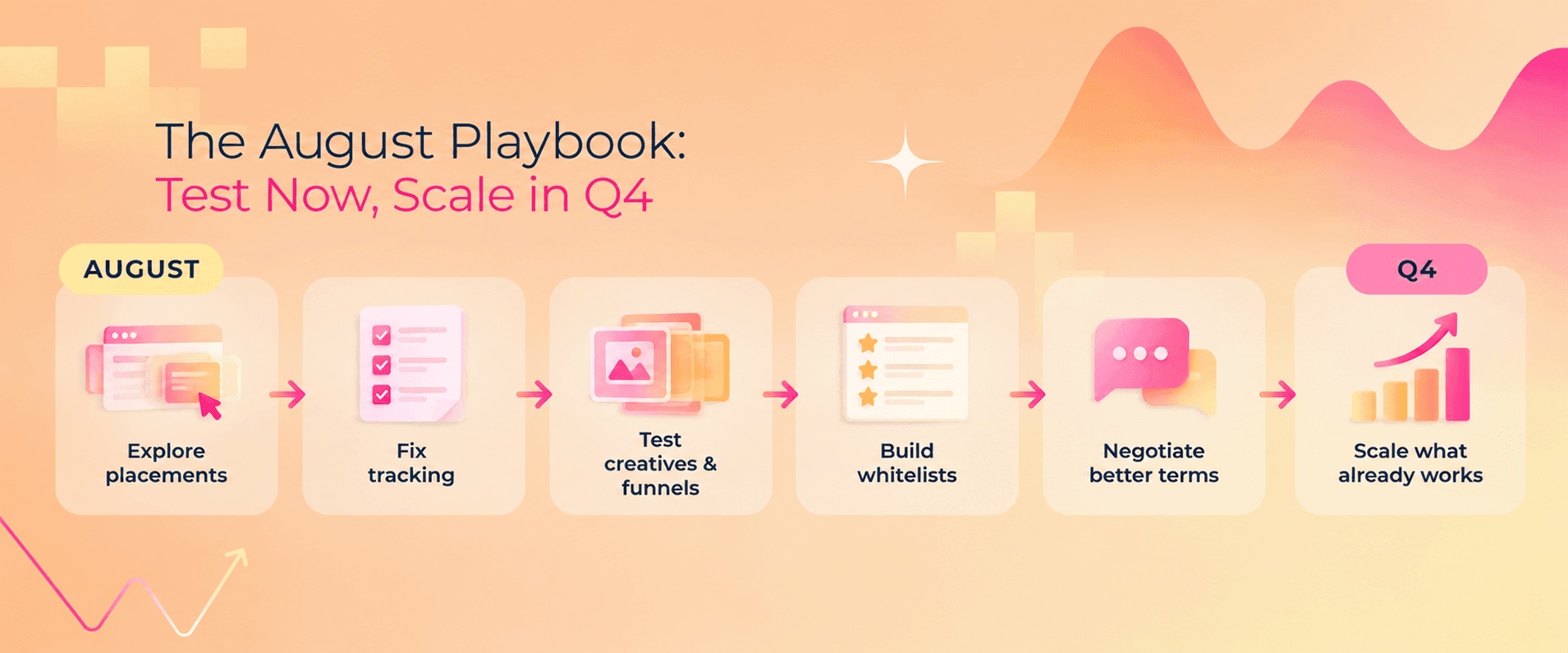
However, performance marketers, who are looking for an edge, view this temporary pullback as a strategic window. They use the shifting auction conditions to build the infrastructure they need for Q4. Here is how forward-thinking media buyers execute their late-summer playbook.
Buying Data Instead of Just Conversions
During peak holiday seasons, every click is expensive. In December, you simply cannot afford to run broad, untargeted campaigns, whereas August offers the exact opposite environment.
Because the base CPM is softer in the late summer, experienced buyers launch wide exploratory campaigns across native networks. The primary goal isn't always profits rather data acquisition. They want to identify exactly which publisher widgets, sub-IDs and geographic pockets deliver engaged users for their specific funnels. By letting the algorithms run and gather data cheaply now, they build massive, highly accurate whitelists. When November arrives, they only bid on proven placements, bypassing the expensive learning phase entirely.
Stress-Testing the Tracking Infrastructure
If a tracking setup fails on Black Friday, the revenue loss is catastrophic. You are optimizing blind during the most expensive auction of the year.
That is why late summer is the perfect time to overhaul technical setups. Top affiliates use this period to transition away from outdated client-side pixels, configuring S2S postbacks, integrating new ad trackers and ensuring hiccup-free communication with the traffic source. The goal is to find the data discrepancies now and patch them while the traffic is still affordable.
Creative Incubation
Finding a winning visual angle takes time. You might have to cycle through thirty different thumbnail and headline combinations before finding the one that actually hooks the reader.
Executing that kind of high-volume creative testing in Q4 will heavily dent your margins. Instead, successful marketers use August launch dozens of distinct bridge pages and let them battle it out in the less competitive summer auction. Once they identify the top-performing funnels, they pause them, waiting for the moment consumer spending spikes in the fall.
Securing Better Network Terms
When overall auction volume drops slightly, ad networks and affiliate programs are often more open to negotiation. Buyers who move consistent volume use August to reach out directly to their account managers. They negotiate custom CPA payouts, request access to premium traffic tiers and lock in dedicated support before the Q4 rush. Building those relationships when the market is quiet pays massive dividends when everything heats up.
Geo-Arbitrage: Shifting Budgets Across Borders
Buying traffic in August is not a uniform game across the map. The cultural dynamics between one country and the next are completely different, and top media buyers exploit this through seasonal geo-arbitrage.
Look at Southern Europe. In countries like Italy and France, August is virtually a national holiday month. People abandon their desktop computers entirely. Mobile traffic spikes heavily, but conversion intent for complex offers like B2B software for example, falls off a cliff. People are literally sitting on a beach in Sicily; they are not going to fill out a 10-step mortgage refinancing form.
Smart affiliates do not force campaigns where intent is dead. They pull their heavy lead-gen budgets out of the Mediterranean and route that spend elsewhere.
Where does the money go? LATAM and APAC. Markets like Brazil, Mexico and Southeast Asia do not share the same vacation culture. Their daily traffic volume stays incredibly flat, and the auction remains stable. Alternatively, look at Australia and New Zealand. It is the dead of winter there, so if you have home heating offers, winter apparel or specific seasonal Nutra products sitting idle in your network account, August is exactly when you run them in the Southern Hemisphere.
You shouldn’t fight the local vacation calendar. Instead, you move your daily spend to a time zone where people are actually sitting at their desks ready to buy.
Adapting the Funnel for Summer Browsing
Along with shifting GEOs, you have to look at device splits. Late summer traffic is overwhelmingly mobile-dominated. So, if your bridge page takes four seconds to load on a 4G connection, you are already dead. You will pay for the native click, but the user will bounce before your headline ever renders on their screen.
Top performers audit their entire funnel infrastructure in August, stripping their landing pages down to the absolute bare minimum. Heavy background videos get completely removed. Complex, script-heavy interactive quizzes get swapped out for simple HTML buttons that load instantly.
Also, the attention span in August is brutally short. Your funnel must reflect that. You have to get the user from the publisher widget to the affiliate checkout page in under three clicks. Keep the advertorial copy punchy and aggressive. Make the call-to-action buttons massive. You have to design the entire experience assuming the user is squinting at their phone in direct sunlight with a spotty cellular connection.
Managing the Late-August Auction Shift
As the month draws to a close, the auction dynamics begin to flutter. You can literally watch the baseline CPMs start to twitch in the final week of August as media agencies log back in and early Q4 budgets are approved.
This is where careful bid management separates the pros from the rest. If you leave your campaigns running on auto-pilot with the exact same low CPCs that worked perfectly on August 10th, your traffic volume will suddenly dry up by August 28th.
Experienced media buyers monitor network impression shares daily during this transition. As the returning competition starts driving prices up, veterans of media buying incrementally bump their bids on their proven publisher IDs. They don’t panic-raise their caps. The goal is to maintain their win rate on top-tier widgets without ruining the CPA they established earlier in the month.
Flipping the Switch for September
Then comes the actual market shift. The moment Labor Day passes and the major industry players return to full capacity, the fourth quarter essentially begins.
Advertisers who paused everything in August are now rushing to catch up. They are frantically launching untested landing pages, guessing at baseline bids and burning through their September budgets.
If you follow the late-summer playbook, you avoid all of that friction. You aren't testing anymore. Because you spent the last few weeks incubating your creatives and building strict publisher whitelists, your campaigns are already optimized.
This is when you unpause those winning funnels you held in reserve. You take the angles that showed a high click-through rate during the quiet weeks and allocate your heavy scaling budget behind them. Even as overall traffic costs rise in September, your CPA remains stable because your conversion rates are completely dialed in.
The Bottom Line: Prep Work Pays Off
Taking a breather during the summer is completely normal and healthy for any media buying team. The issue isn't taking a vacation; the issue is completely abandoning your position in the ad auction.
August provides a rare, highly forgiving environment. The audience is still actively reading and scrolling, but the aggressive bidding wars are temporarily paused. It is the single best time of the entire year to break your tracking, fix it, find fresh angles and negotiate better terms with your network representatives.
Treat the late summer as a strategic building block rather than a dead zone. If you do the heavy lifting while the auction is quiet, Q4 stops being a stressful guessing game. When the holiday rush finally hits, you won't be scrambling to build a strategy — you will just be executing the one you already proved.