Media buying in 2026 is not the same game it was three years ago. The era of launching a generic campaign on a massive social platform and printing cheap conversions is completely over. Today, hyper-saturated walled gardens, volatile algorithms and traffic costs silently eat away at profit margins.
When budgets get tight, the first question every media buyer asks is: Where is the cheap traffic?
The default answer for years was social media. Although, just like media buying that has changed, too. A direct comparison between native advertising and social traffic reveals a massive shift in how ad platforms price their inventory and how much you actually pay to acquire a converting user.
If you want to maintain a profitable CPA this year, you have to start looking at the raw economics of the open web versus social feeds.
The State of the Traffic Market in 2026
To understand where the cheap traffic is, you first have to understand why it disappeared from the usual places.
Social platforms operate as walled gardens. Meta, TikTok and Pinterest control the entire ecosystem — everything from user data and layout to auction pricing. Because the default for everyone is to buy social ads, the auction density is at an all-time high. You are no longer just competing against other affiliates in your vertical; you are bidding against massive enterprise brands with unlimited budgets who are perfectly happy to pay premium CPMs just for brand awareness.
This level of competition creates artificial inflation. You end up paying a premium simply for the privilege of participating in the auction, regardless of how good your creative is.
Native advertising operates on an entirely different infrastructure. It runs across the open web. They appear as recommended content on premium news sites, entertainment blogs and editorial platforms. Because the inventory is practically infinite (spanning thousands of publishers globally) the auction dynamics are much less hostile. There is simply more supply than demand, which suppresses the cost of an impression.
The Core Metric: CPC vs. CPM Focus
The biggest difference between social and open web channels comes down to their underlying pricing models. Social networks are heavily biased toward CPM (Cost Per Mille) pricing, even if you optimize for clicks or conversions.
They charge you every time the ad renders on a user's screen. If your CTR drops because of ad fatigue (which happens in days on platforms like TikTok), your cost per click skyrockets immediately because you are still paying the same high rate for the impressions. You pay for the exposure, not the intent.
Native platforms, on the other hand, heavily utilize true CPC (Cost Per Click) models. You pay for actual engagement. If a user scrolls past your native widget on a news article without clicking, you do not lose money. This fundamental difference means native traffic allows you to test angles and creatives with far less financial risk.
The Hard Numbers: CPM and CPC Benchmarks
To see where traffic is actually cheaper, we have to look at the metrics that are shaping media plans. While costs fluctuate based on the target vertical, landing page quality,and GEO, the broader market benchmarks show a clear gap between social feeds and the open web.
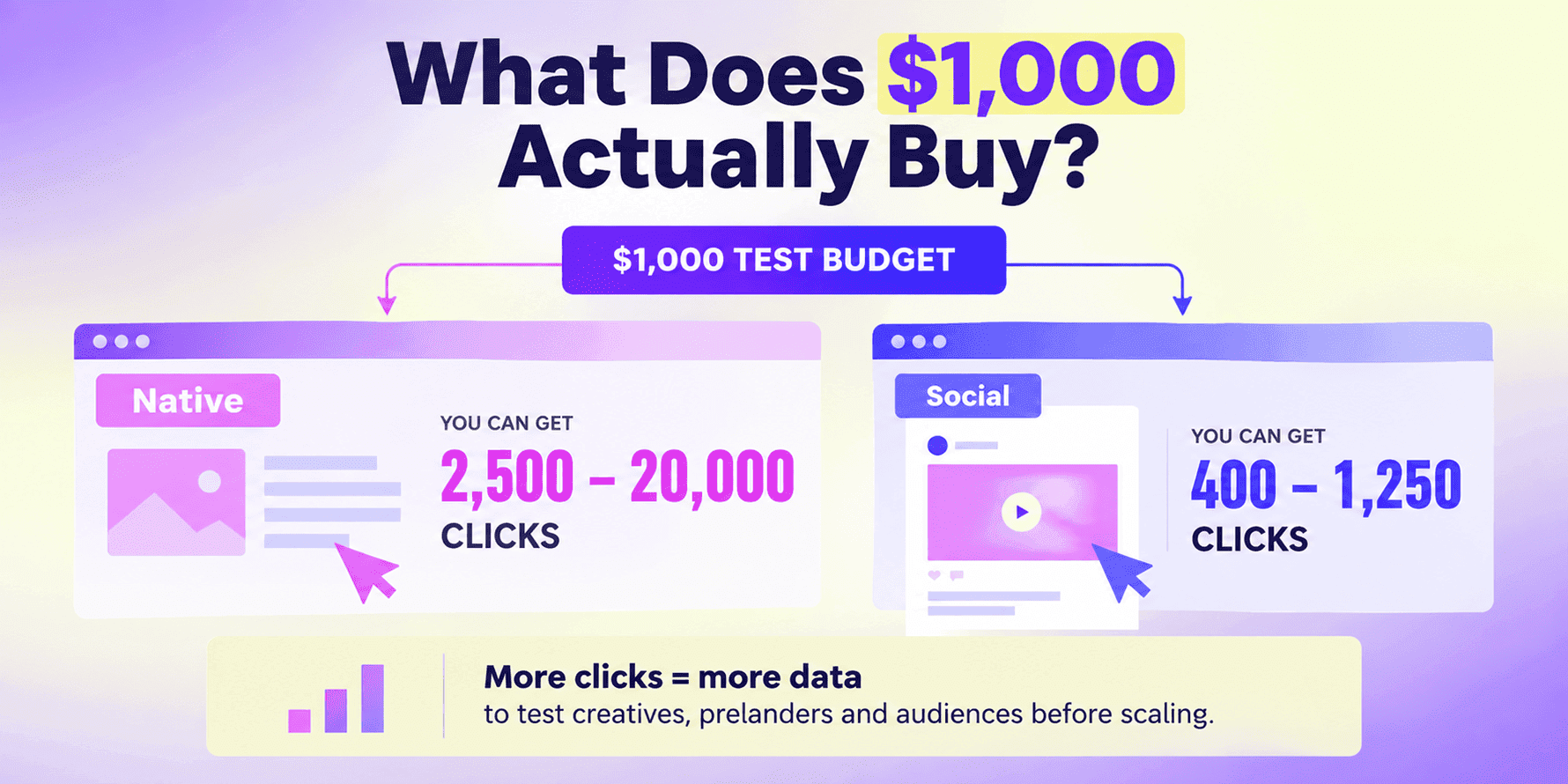
In competitive Tier 1 markets (such as the US, UK and Western Europe), social channels frequently see average CPMs ranging from $15 to $35. When translated down to click-through performance, a standard direct-response ad on social media often yields an effective CPC anywhere between $0.80 and $2.50.
Native advertising operates at a distinctly different price point. Since inventory on publisher websites is vast and continuously generated as users consume editorial content, native CPMs in Tier 1 GEOs typically sit between $1.50 and $6.00. This results in average CPCs ranging from $0.05 to $0.40.
When evaluated purely on raw volume, native traffic allows media buyers to purchase significantly more user visits. For campaigns testing new offers or gathering user intent data, this price difference provides a much larger margin for initial trial and error.
The Hidden Costs: Beyond the Dashboard CPC
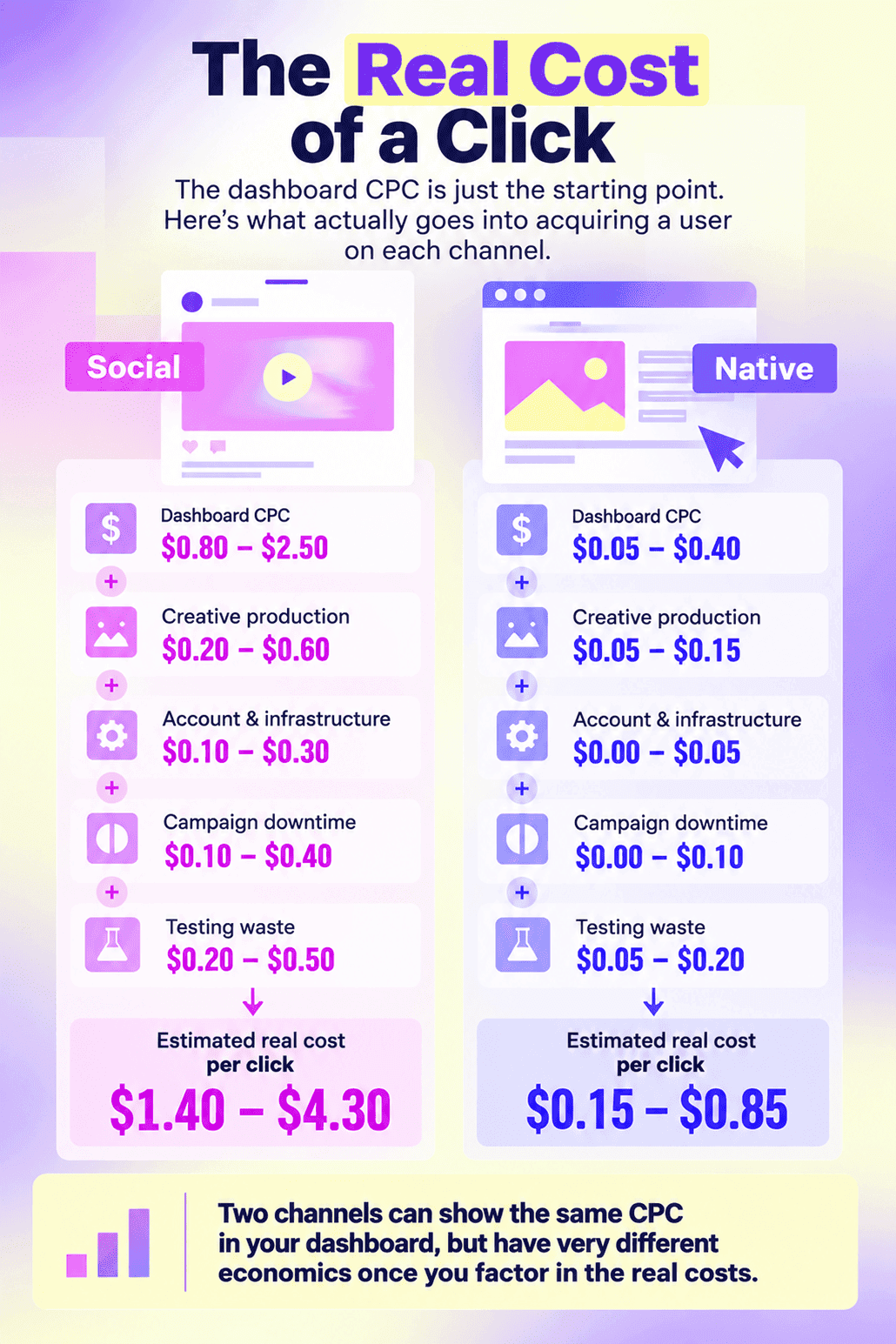
Evaluating traffic costs solely by looking at the cost-per-click column in your ad dashboard gives you an incomplete picture. The true cost of traffic includes the operational overhead required to keep that traffic flowing.
Social media marketing currently carries a noticeable operational tax:
- Infrastructure Overhead: Operating on strict social platforms often requires ongoing investment in contingency setups. Media buyers frequently pay extra for agency-level accounts, specialized anti-detect browsers, residential proxies and account warm-up processes to avoid campaign interruptions.
- Creative Fatigue: Social feeds consume content at a rapid pace. A high-performing social ad creative often sees its effectiveness decline within three to five days as the target audience reaches saturation. Maintaining campaign performance requires continuous creative production, which adds design and copywriting expenses to the overall campaign cost.
- Policy Friction: Unintended account pauses or temporary reviews on social platforms can stop traffic overnight, disrupting sales funnels and impacting revenue consistency.
Native advertising offers a much more stable environment. Because campaign guidelines on major native networks are clear and established, compliance is straightforward. A winning native creative and bridge page combination can often run steadily for several weeks or months without severe performance drops.
When you factor in lower infrastructure requirements and extended creative lifespans, the effective cost per conversion (eCPA) on native networks remains consistently competitive.
Matching the Vertical to the Cost Structure
Cheap traffic is only valuable if it converts. A low CPC means very little if the audience has zero interest in your offer, meaning matching the right vertical to the appropriate network.
Because social traffic is built around rapid, visual feed scrolling, it naturally favors short-form visual products. Physical eCommerce goods, trendy gadgets and branded offers often perform well on social feeds despite the higher CPMs. The visual nature of the feed supports quick impulse buying, which can offset the higher cost per click.
Native traffic, by contrast, shines across verticals that require narrative context or address broad consumer needs:
- Nutra and Health Solutions: Products that solve specific personal health concerns perform exceptionally well on native networks. Users reading news articles are already in a reading mindset, so they are more receptive to editorial-style prelanders and detailed product breakdowns.
- Personal Finance and Insurance: Lead generation for refinancing, credit services or insurance products benefits hugely from native’s contextual placements. Placing an ad alongside financial news builds immediate authority, driving high-intent leads at a fraction of social CPCs.
- Home Services and Utilities: Offers related to solar panels, roof repairs or local services rely on broad GEO targeting and high click volumes to gather leads, which aligns perfectly with native advertising’s pricing structure.
- Content Arbitrage and Publishing: For publishers buying traffic to monetize through on-site ad placements, low native CPCs are essential to maintaining positive yield margins.
Context and User Mindset: Reading vs. Scrolling
The environment where your ad appears fundamentally changes how the user interacts with it. This difference in user mindset explains why native clicks often produce higher engagement per dollar spent.
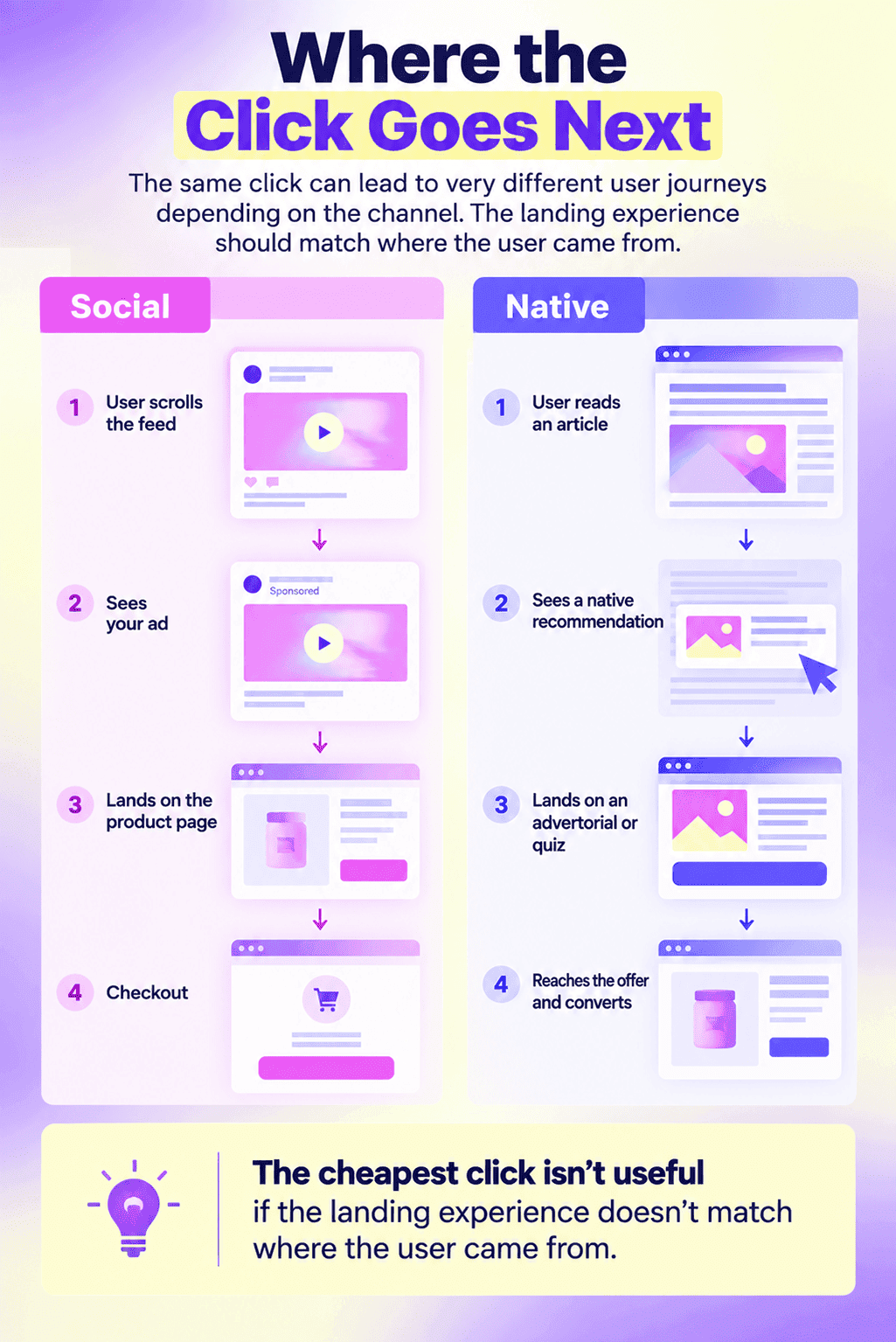
When a user opens a social media app, they are seeking social engagement or entertainment. An ad in this environment is an interruption. To catch their attention, your creative must be visually disruptive, and your message must be delivered within the first two seconds. If the user clicks, they expect a seamless, fast checkout experience.
When a user is on an editorial news site or niche blog, they are in a content consumption mindset. They are actively reading, processing information and seeking knowledge.
A native ad widget presents itself as recommended reading — an extension of the article they just finished.The transition from the publisher's site to your bridge page feels natural; therefore, the user is far more willing to read a detailed advertorial, participate in an interactive quiz or complete a multi-step form.
The more time spent on your landing page, the better the quality of the visitor. Even though you paid a significantly lower CPC for that click, the user’s willingness to engage with long-form prelanders often leads to higher average order values and stronger overall campaign performance.
How to Capitalize on Cheaper Native Traffic: Funnel Strategy
Buying lower-cost traffic is only half the battle. To turn a $0.15 native click into a profitable conversion, your funnel must align with the user’s expectation when they leave a publisher's site.
If you route native traffic directly to a hard-sell checkout page, your conversion rate will drop, negating the advantage of lower CPCs. Instead, successful campaigns build funnels designed around information and engagement.
1. The Prelander / Advertorial Model
Instead of pitching the product immediately, guide the visitor through an educational or storytelling piece. An advertorial mirrors the editorial design of the news site the user just left. It frames the product or service as a solution to a specific problem, building interest and trust before presenting a call to action.
2. Interactive Quizzes and Micro-Surveys
Quizzes are exceptionally effective for native traffic, particularly in verticals like insurance, financial services or personalized wellness. A quick three-step questionnaire engages the user passively, collects initial intent data and customizes the final offer. This interactive step significantly increases the likelihood of a conversion on the next page.
3. Server-Side Data Optimization
Because client-side tracking pixels face increasing restrictions across modern browsers, setting up reliable Server-to-Server (S2S) tracking is essential. Passing real conversion data directly back to your ad platform allows the network’s optimization algorithms to identify high-performing publisher widgets and automatically adjust bids to maximize ROI.
Native vs. Social: At-a-Glance Comparison
To help guide your media planning, here is how the two channels stack up across core operational metrics:
| Metric / Characteristic | Native Advertising (Open Web) | Social Media Advertising |
|---|---|---|
| Average CPM Range | $1.50 – $6.00 | $15.00 – $35.00+ |
| Average CPC Range | $0.05 – $0.40 | $0.80 – $2.50+ |
| User Mindset | Reading / Discovery | Fast Scrolling / Entertainment |
| Creative Lifespan | Long (Weeks to Months) | Short (Days) |
| Account & Compliance Risk | Low to Moderate | High |
| Best Page Format | Prelanders, Advertorials, Quizzes | Short-form Videos, Direct Product Pages |
| Primary Audience Reach | Open Web Publishers | App-based Feeds |
The Verdict: Strategic Choices for 2026
When evaluating where traffic is cheaper, the data points to native advertising on the open web. F baseline CPMs and CPCs to creative longevity and account stability, native networks provide significantly more user visits for every dollar spent.
This does not mean social media advertising lacks value. Social networks remain powerful tools for rapid brand building, retargeting and high-margin physical products where immediate visual demonstration is critical.
However, for performance marketers, media buyers and brand teams looking to protect their margins against rising ad costs, native advertising offers the scale and affordability needed to maintain a healthy CPA. By matching your campaign strategy to the mindset of the user, you can unlock massive volumes of high-intent traffic without overpaying for competitive social auctions.