Did you know that a campaign can generate zero clicks and still change how thousands of people feel about a brand? This is referred to as brand health, and understanding brand health metrics is paramount to effective brand building.
Clicks are easy to count as are conversions, sales and return on ad spend. However, these metrics only tell part of the advertising story. For instance, what if people see your ad but don't remember the brand behind it? Or a campaign generates no immediate sale, yet makes thousands of people more likely to choose the product next time?
While harder to see in a performance dashboard, these shifts matter. Brand health metrics help capture them by measuring awareness, recall, consideration, preference and purchase intent.
That's the balance more marketers are trying to strike now, considering short-term performance and long-term brand building. In this article, we’ll break down how to measure that shift, and where native advertising fits in.
- What Are Brand Health Metrics?
- Why Brand Health Metrics Matter
- Key Brand Health Metrics to Track
- How Native Advertising Impacts Brand Health Metrics
- How to Measure the Impact of Native Advertising on Brand Health
- Common Mistakes When Measuring Brand Health
- Brand Health vs. Performance Metrics: You Need Both
What Are Brand Health Metrics?
Think of brand health as a series of questions:
- Do people know your brand?
- Do they remember it?
- What do they associate it with?
- Would they consider buying from it?
- Would they choose it over a competitor?
- Are they likely to buy from it again?
No single metric can answer all of these questions. That’s why marketers usually look at several signals together, including awareness, recall, consideration, preference, purchase intent and loyalty.
Brand Health vs. Brand Lift
Brand health and brand lift are terms used almost interchangeably, but they're not the same thing.
Brand health is the bigger picture. It shows how your brand is doing and how that changes over time.
Brand lift measures a change in a particular brand metric, often in response to an advertising campaign.
Why Brand Health Metrics Matter
Brand health metrics illustrate what's happening between when a person saw the ad and when they made the purchase. More usefully, though, brand health tells you where a brand is quietly losing people along the way.
| What you see | What it could mean |
|---|---|
| High awareness, low consideration | People know the brand but don’t see a strong reason to buy |
| High consideration, low preference | You make the shortlist but competitors still win |
| Strong preference, low purchase intent | People like the brand but something may be stopping the purchase |
| Growing awareness and consideration | Brand-building efforts may be gaining traction |
Read this way, brand health points to exactly where the relationship with a customer is breaking down, whether that is awareness without a reason to buy, consideration without follow-through or preference that never turns into action.
Key Brand Health Metrics to Track
You don't need to track every brand metric that exists, but what metrics you do choose should answer how people move from being aware of your brand to actually choosing it.
1. Brand Awareness
Brand awareness measures how familiar people are with your brand and whether they recognize or remember it.
It sounds simple, but there are different levels of awareness:
- Aided awareness: Do people recognize your brand when they see its name?
- Unaided awareness: Can they name your brand without being prompted?
- Top-of-mind awareness: Is your brand the first one they think of in your category?
The difference matters. Recognizing a logo on a list of five brands is not the same as thinking of you first the moment you need new running shoes.
That’s why awareness is a useful starting point, but it rarely tells the whole story. A brand can be recognizable and still struggle to turn that familiarity into consideration or sales.
2. Brand Recall
Brand recall measures whether people can remember your brand after being exposed to it or when thinking about a particular product category.
In advertising, this often gets confused with ad recall, but the two don't always move together. Someone might remember a funny commercial vividly (ad recall) and still draw a blank on the name of the brand (brand recall). This is exactly what brand recall is designed to measure and catch.
3. Brand Consideration
Brand consideration measures how likely people are to consider a brand when they are thinking about making a purchase.
Awareness gets you into the room. Consideration gets you onto the shortlist.
A person may know dozens of brands in a category but seriously consider only two or three when it’s time to buy. That gap between “I know them” and “I’d buy from them” can tell marketers a lot.
For example, if awareness is growing but consideration stays flat, reaching more people won’t fix the issue. Instead, try adjusting the brand messaging to explain why it’s worth choosing.
4. Brand Preference
Brand preference measures whether consumers favor your brand over other options they are considering.
Consideration and preference sound similar, but they answer different questions. Someone planning a trip might consider Delta, United and American. If Delta is still the one they'd book first, all else being equal, Delta has the preference.
That distinction matters most in crowded categories. In those spaces, making the shortlist and being the name people reach for is the difference between winning the battle and winning the war.
5. Brand Perception and Sentiment
Brand perception measures the ideas, qualities and associations people connect with your brand, while brand sentiment looks at whether those feelings are generally positive, negative or neutral.
This is where brand health becomes more nuanced. For instance, people may see your brand as innovative but expensive; reliable but old-fashioned; affordable but low quality. Those associations can influence consideration and preference even when awareness is already high.
Marketers can measure perception through surveys and brand attribute studies, and sentiment often shows up in reviews, social conversations and other customer feedback.
While we know it's tempting to chase numbers that look "positive", the actual goal is accuracy. In that sense, are people seeing the brand the way you intend for it to be seen?
6. Purchase Intent
Purchase intent measures how likely someone says they are to buy a brand’s product or service in the future.
Purchase intent brings us closer to the bottom of the funnel. However, there’s one important distinction to be made: intent is not the same thing as a purchase.
People change their minds. Prices change. Competitors offer discounts. Products go out of stock. Someone who says they’re very likely to buy today may never convert.
Still, changes in purchase intent can be useful when evaluating whether a campaign moved people closer to taking action, especially when actual purchases happen much later.
7. Brand Loyalty and Advocacy
Brand loyalty measures whether customers continue choosing a brand over time, while advocacy reflects their willingness to recommend it to others.
Depending on the business, that might mean tracking repeat purchase rates, retention, churn or a recommendation score like NPS.
These metrics matter because the brand relationship doesn't end at checkout. Getting someone through the door is only half the job. Getting them to come back and bring a friend is where brand health actually compounds.
Brand Health Metrics at a Glance
Rather than looking at these metrics as a flat list, it helps to group them by where they sit in the customer decision journey:
| Stage | What it tells you | Key metrics |
|---|---|---|
| Getting noticed | Whether people know and remember your brand | Brand awareness, brand recall |
| Getting chosen | Whether your brand makes the shortlist, stands out from alternatives and moves people toward a purchase | Brand consideration, brand preference, brand perception and sentiment, purchase intent |
| Getting kept | Whether customers stay with your brand and recommend it to others | Brand loyalty, brand advocacy |
Together, these stages show how brand health develops from visibility and choice to an ongoing customer relationship. Looking at metrics this way can also make it easier to spot where momentum breaks down: a brand might be well known but struggle to get considered, or win plenty of first purchases without building lasting loyalty.
How Native Advertising Impacts Brand Health Metrics
Native advertising gives brands something many ad formats struggle to provide, and that is room for context. A sponsored article, video or other native format can explain an idea, demonstrate a product or connect the brand with a topic the audience already cares about.
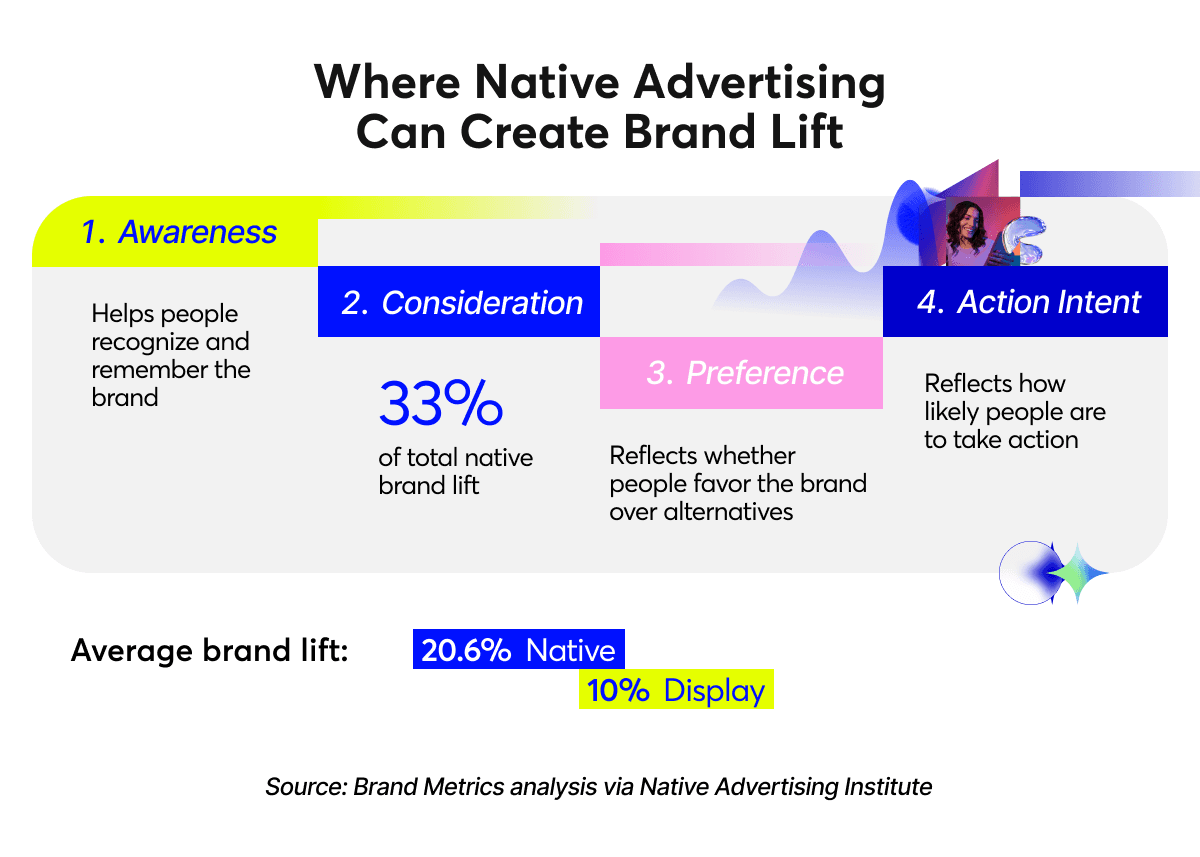
In fact, one large analysis by Brand Metrics looked at around 2,000 native campaigns and more than 500,000 survey responses. The campaigns generated an average 20.6% brand lift, compared with 10% for display advertising.
Native Has Room to Make the Case
For a standard display ad, it has a few seconds and a small banner to make their case. However, witihin native content, there is time to walk through a problem, show the product in use and even answer any questions a reader might have.
That breathing room pays off most in the middle of the funnel. In the Brand Metrics analysis, consideration accounted for 33% of the total brand lift generated by native campaigns, more than awareness, preference or action intent.
This doesn't mean every native campaign will suddenly make people run to the checkout page. Although, it does suggest that the format can be useful for closing the gap between “I know this brand” and “I might actually choose it.”
Context Can Change More Than Awareness
Sometimes getting noticed isn't the problem. People may already know the brand but don’t have the context to understand the brand benefits.
Native gives advertisers more space to work on those associations. A cybersecurity company can demonstrate expertise instead of simply claiming to be an expert. A food brand can show how its product fits into everyday cooking. A financial service can explain a confusing topic before introducing its own solution.
A Dynata study for Nativo puts a number on this. 74% of people exposed to one native campaign associated the advertised brand with keeping produce fresher for longer, compared with 46% in the control group.
That 28-point gap is useful because it illustrates how native campaigns can help connect the brand with a specific (and accurate) product benefit.
Native Shouldn't Mean Invisible
There is a trade-off here. Native advertising is supposed to fit naturally with the surrounding content , but sometimes, the brand can blend in too well. You can end up with an article people enjoyed and an advertiser nobody remembers.
The risk is real, but it's manageable. The same Dynata study found a 35 percentage point lift in unaided awareness and a 16-point lift in aided awareness among the exposed audience. People who engaged with the content were also four times more likely to recall the native editorial.
The takeaway is to make sure the brand has a clear role in the story. If you can remove the advertiser's name and the content remains the same, the connection may be too weak.
The Goal Depends on Where the Brand Starts
A lesser-known brand and a household name shouldn't expect the same thing from native advertising. Brand Metrics found that brands with more than 70% awareness had less room to generate additional awareness lift. For those brands, moving people further down the funnel through consideration or preference can be more valuable.
The key question is which part of brand health needs improving.
| Brand situation | A more useful campaign goal |
|---|---|
| Few people know the brand | Build awareness and recall |
| People know it but don't consider it | Explain relevance and benefits |
| The brand makes the shortlist but loses to competitors | Strengthen preference |
| People like the brand but hesitate to buy | Address barriers and build purchase intent |
Once the goal is clear, the next challenge is proving that the campaign actually moved it.
How to Measure the Impact of Native Advertising on Brand Health
Seeing a metric go up after a campaign feels like a good sign. While it is, the problem is that brands don't exist in a vacuum. For example, a competitor may have raised its pricing or people may simply be responding to something happening in the market.
So the real measurement challenge is determining how much of the observed change can reasonably be attributed to the advertising.
Start With a Brand Lift Study
One of the most common ways to do this is a brand lift study, which compares two similar groups:
- Exposed group: people who saw the campaign
- Control group: people who could have seen it but didn't
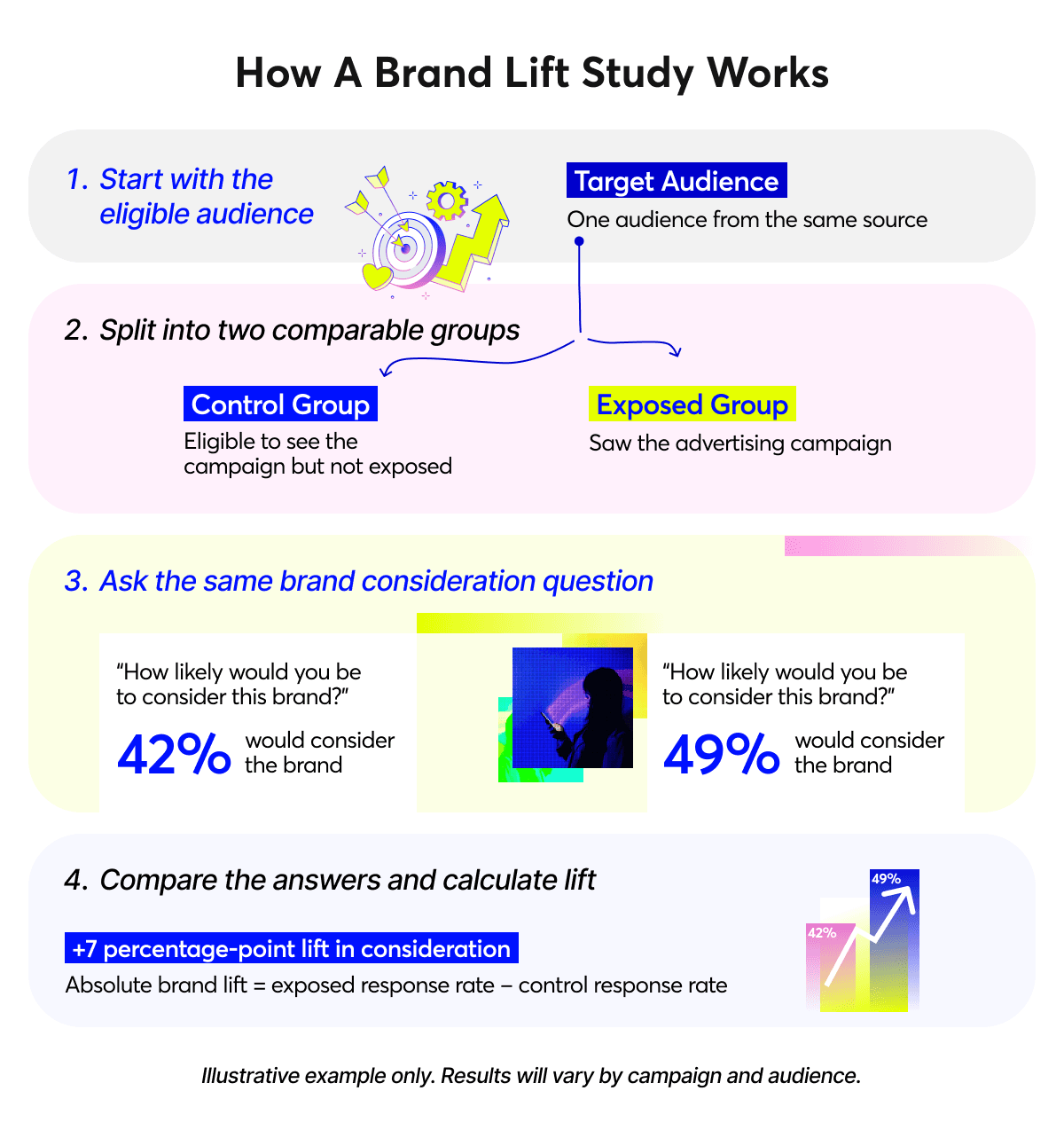
Both groups are then asked the same questions about the brand. Depending on the campaign goal, those questions might measure awareness, ad recall, consideration or purchase intent.
Google describes the same approach for its Brand Lift measurement, and Amazon Brand Lift also uses surveys across exposed and unexposed groups to measure changes in brand perception.
The simplest way to express the result is as an absolute lift:
If consideration is 42% in the control group and 49% in the exposed group, that's a 7 percentage point lift. That's what makes a control group worth the extra effort. Without one, it’s impossible to tell the difference between the people who liked the campaign and those whose interaction with the campaign changed how they saw the brand.
Choose the Metric Before Choosing the Success Story
It's easy to run a campaign, scroll through the results and celebrate whichever number moved the most. A better approach is deciding what change you're trying to create before the campaign starts: introduce the brand (watch awareness, recall), explain its relevance (consideration, perception), stand out from competitors (preference) or move people closer to buying (purchase intent).
Engagement metrics — time on page, shares, scroll depth — can support that story, but they're not a substitute for the brand outcome the campaign was actually built to influence.
Common Mistakes When Measuring Brand Health
Brand tracking can produce a lot of numbers, but that doesn't automatically mean it produces useful answers.
A few mistakes can make perfectly good data surprisingly easy to misread.
Tracking Everything Just Because You Can
More metrics don't automatically mean a clearer picture, often the opposite. Cram brand health, customer experience and campaign measurement into one giant tracker, and you end up with a spreadsheet nobody can actually read.
Kantar calls this a common problem in tracking studies and recommends starting with the decisions the research needs to inform, then choosing the metrics that support them.
For a native campaign, that might mean focusing on consideration and perception.
Looking at Your Brand Without Looking at Competitors
Imagine your consideration score rises from 30% to 34%. Now imagine your closest competitor jumps from 32% to 45% during the same period. While the first number hasn't changed, what it means certainly has.
Brand health is relative. Competitor benchmarks and category trends provide the context needed to tell whether a change is genuinely encouraging or simply reflects movement across the whole market. YouGov, for example, treats competitor and sector benchmarking as a core part of interpreting brand health data.
Assuming Every Change Came From the Campaign
This is the same trap mentioned earlier, and it bears repeating: correlation isn't causation. A lift right after a native campaign is worth investigating, but so is checking whether a competitor cut prices, a product launched or a news story broke that week.
Control groups and consistent, longer-term tracking are what separate an actual campaign effect from noise.
Treating Brand Health as a One-Time Checkup
A single measurement can only tell you where the brand is at one moment, not where it's going.
That difference matters because short-term movement can be noisy. YouGov recommends continuous, consistent tracking specifically to help distinguish short-lived campaign effects from longer-term changes in brand health.
What matters is measuring the right things consistently enough to tell when a change actually means something.
Brand Health vs. Performance Metrics: You Need Both
Brand health and performance metrics answer different questions about the same marketing effort.
Performance metrics show what people do: click, sign up, buy or convert. They also help marketers understand what those actions cost and what return the campaign generates.
Brand health metrics capture changes that may happen earlier in the decision process, such as remembering the brand, considering it or starting to prefer it.
| Performance metrics tell you... | Brand health metrics tell you... |
|---|---|
| Did people click? | Did people remember us? |
| Did they convert? | Would they consider us? |
| What did acquisition cost? | Are we becoming a stronger choice? |
| What was the ROAS? | Did the campaign change how people see the brand? |
The right combination depends on what the campaign is trying to achieve. For a native campaign, that might mean looking at:
- brand lift + content engagement to see whether attention came with a measurable brand effect
- consideration lift + qualified site visits to see whether growing interest carried beyond the content
- purchase intent + conversions to connect stated intent with actual behavior
- brand preference + CPA or ROAS to put longer-term brand movement alongside commercial results
This broader view is gaining attention across the ad industry. Digiday describes a renewed interest in brandformance, with marketers bringing brand and performance measurement closer together and looking at metrics such as brand lift and consideration alongside ROAS and CPA.
DSW is one example. The retailer has started using a brand health tracker twice a year to measure its performance against the category factors that influence how people shop for shoes. Kelly Ballou, VP of brand and creative at parent company Designer Brands, described brand health as a relatively new “muscle memory” for the business.
For native advertising, looking at both sides can reveal different parts of the same campaign effect. A reader may engage with the content, become more likely to consider the brand and eventually visit the site or convert. Following those signals together gives marketers a better idea of what the campaign contributed and where its impact was strongest.
What Happens After the Ad Is Over?
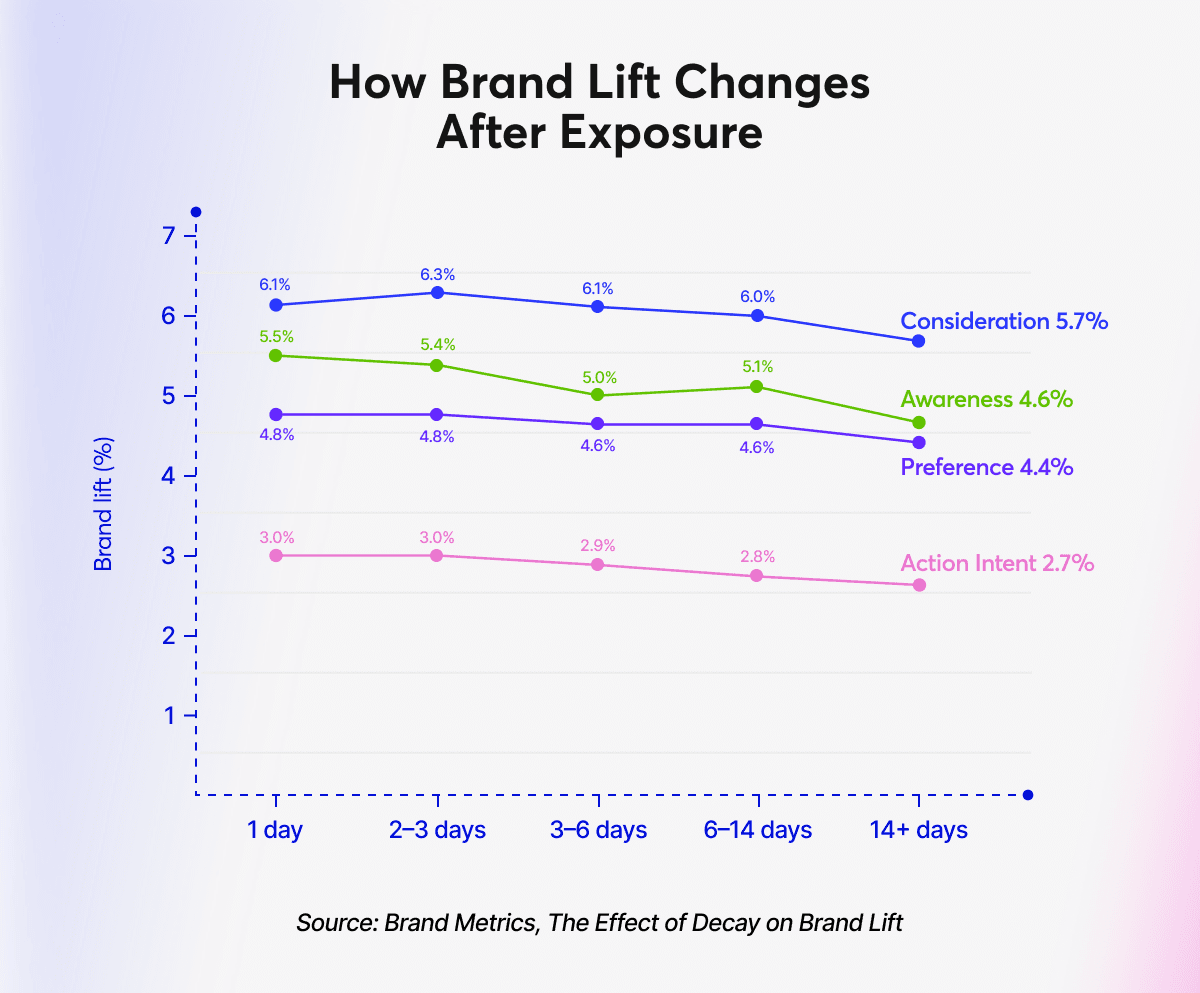
Advertising has an awkward habit of being easiest to measure when someone does something immediately. Human memory doesn't work like that.
A person can encounter a brand today and carry some small part of that experience into a decision weeks or months later. That influence is easy to overlook precisely because there may be no click, form fill or receipt attached to the moment it began.
Brand health measurement gives those quieter effects somewhere to show up. And for native advertising, where the idea, story and context often do much of the work, that matters.
The ad may be gone in seconds. What it leaves behind is the part worth measuring.