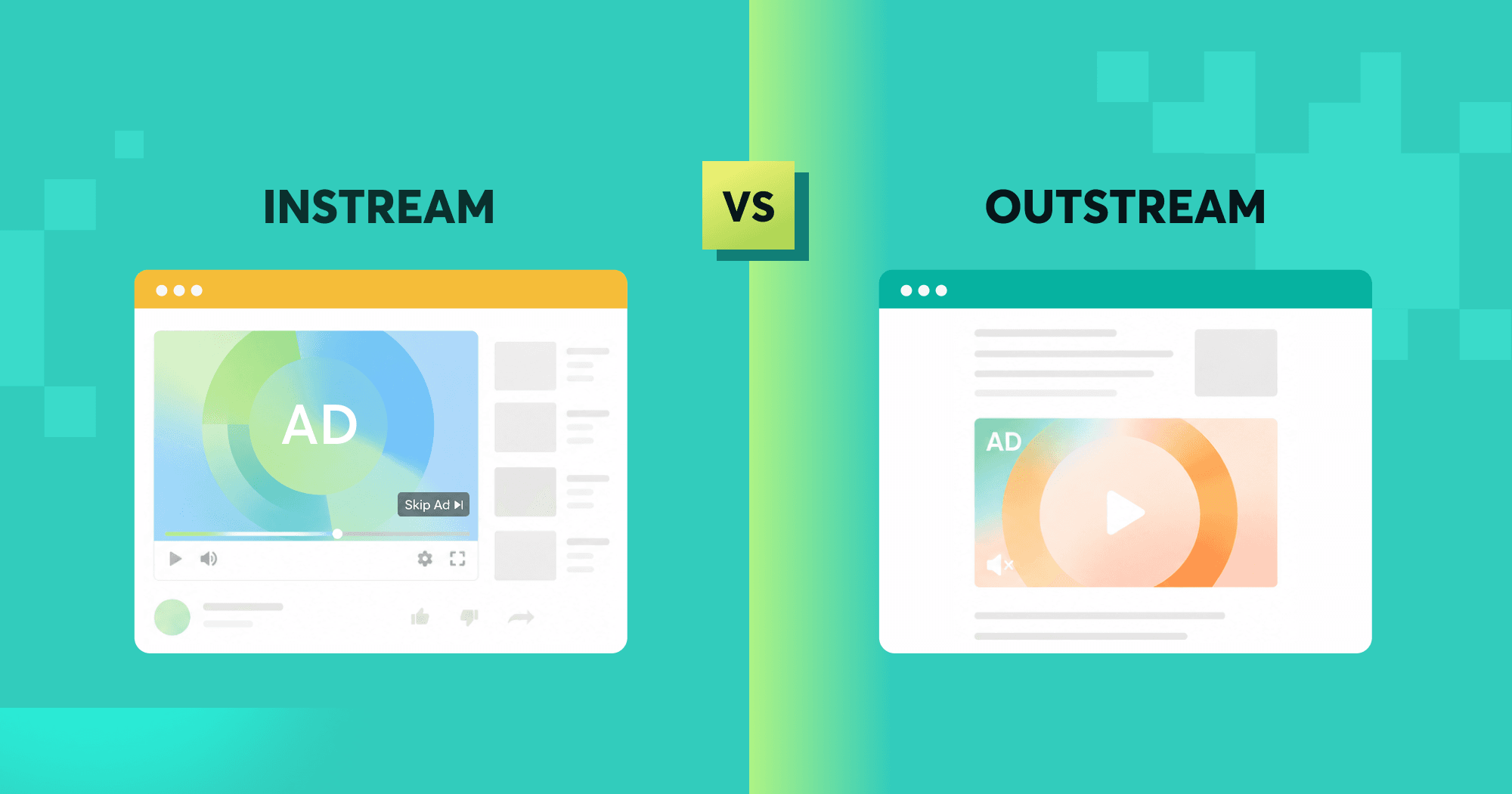
Instream and outstream ads may use the same video creative, but they deliver very different results. This guide explains the differences, strengths and best use cases of each format.
In the last several years, video advertising budgets have grown at unprecedented rates. In 2025 alone, global digital video ad spend reached $72.4 billion (up 14% from $63.8 billion in 2024) and is projected to rise to $82 billion in 2026. However, more budget in video doesn't automatically mean better results. In fact, much of it is wasted on the wrong format in the wrong environment.
Instream and outstream ads can use the same creative, but they work in entirely different ways. Instream runs inside a video player while the user is actively watching content. Outstream appears in articles, feeds and apps with no video player required. That one difference shapes everything from attention and CPM to metrics and benefits.
What Are Instream Ads?
The viewer is already in watch mode. The audio is usually on, and the user’s attention is anchored to the screen. In addition, skipping instream ads are either delayed or unavailable. That context is what makes instream formats consistently outperform other video placements on attention metrics.
In March 2023, the Interactive Advertising Bureau updated its video ad taxonomy. The new system splits what was broadly called instream into two categories:
- Primary instream includes ads with sound that run inside a video player when video content is the primary focus of the page and the main reason for the user's visit, such as on YouTube, streaming services or other OLV environments.
- Accompanying content includes ads served within a video player on pages where video supports the main content rather than being the primary attraction. A common example is an article page with an embedded video player, where users are primarily engaged with the text content.
Most DSPs have already adopted this classification, so it's worth knowing if you're buying or selling programmatically.
The three standard instream ad formats are:
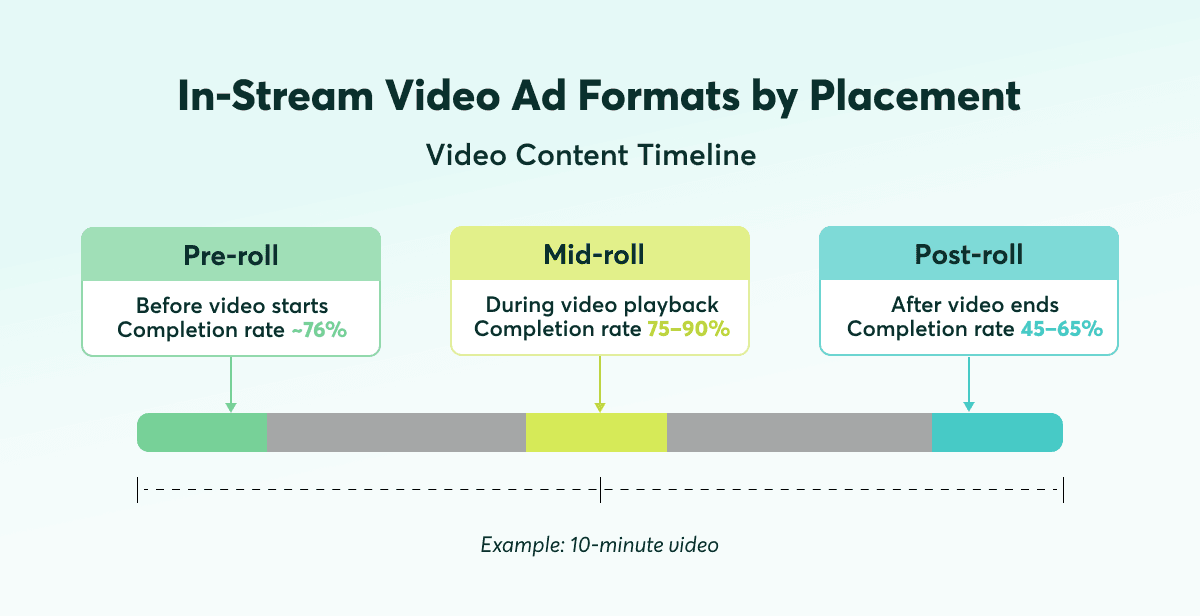
- Pre-roll ads play before the video begins and are effective at reaching viewers before they engage with the content. Completion rates generally range from 60% and 78%, with average performance around 76% across most platforms. Their strength lies in guaranteed exposure at the start of the viewing experience.
- Mid-roll ads ads are inserted during the video and typically achieve the highest completion rates, often ranging from 75–90%. Because viewers are already engaged with the content, they are more likely to continue watching after the ad break, making mid-rolls more effective than both pre-roll and post-roll formats. They work best in longer-form content where natural pauses allow for less disruptive ad insertion.
- Post-roll ads appear after the video has finished and generally generate completion rates of 45–65%. Because many viewers leave once the content ends, post-roll formats generally have the lowest completion rates and are therefore less commonly used in performance-focused campaigns.
Beyond the standard roll formats, instream inventory also has overlay ads (non-linear). These ads appear on top of the video without interrupting playback, usually as a banner or text unit at the bottom of the player. Also, there are companion ads that sit outside the player entirely and typically run in tandem with a linear format. Both are lower-attention formats; however, they do add an additional revenue layer for publishers.
What Are Outstream Ads?
Outstream ads are video ads that appear outside of a video player in articles, content feeds, mobile apps or display placements. Unlike instream ads, they do not require a video player or existing video inventory to run.
The format was originally developed for mobile, where video inventory was scarce but article traffic was abundant. Soon enough, it moved to desktop and is now standard across most programmatic exchanges.
Outstream units load and start playing, usually muted, when they enter the user's viewport. When the user scrolls past, the ad pauses. This viewport-triggered behavior is what defines outstream viewability measurement. The MRC standard counts an impression when at least 50% of the ad's pixels are visible for a minimum of 2 consecutive seconds. That's a much lower bar than instream, where impression measurement is determined by when the ad started, how long it played and whether it was completed.
The main outstream ad formats include:
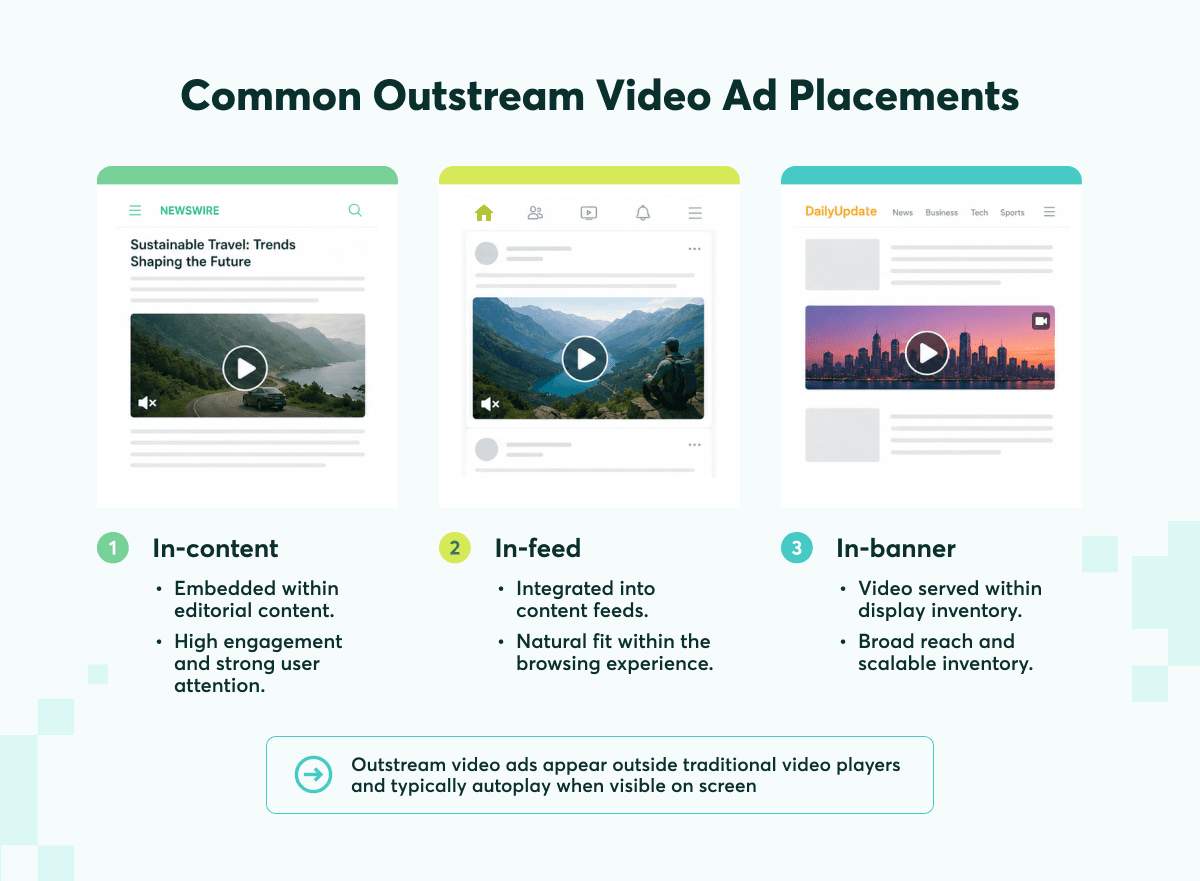
- In-content ads units are embedded between paragraphs of an article. They're the most common outstream placement and tend to get more attention than sidebar or banner positions because the user naturally scrolls through them.
- In-feed ads appear within social media or content recommendation feeds, blending with editorial content. Autoplay with sound off is the standard approach, allowing the ad to integrate seamlessly into the browsing experience.
- In-banner ads place video creative inside a standard display ad slot. Unlike in-content or in-feed formats, they do not require a dedicated video environment, making them easy to scale across large volumes of inventory. However, they generally deliver lower engagement and viewability than more immersive video placements.
In addition to the core formats, some publishers support sticky, overlay, interstitial and rewarded video ads, which are designed for specific user experiences and advertising goals.
For example, sticky or floating units anchor to a corner of the screen as the user scrolls, maximizing time-in-view at the cost of feeling more intrusive. Rewarded video gives users something in return for watching, unlocking content, in-game currency, etc.. Completion rates on rewarded outstream are high, but the format only makes sense in specific contexts like mobile games and gated content.
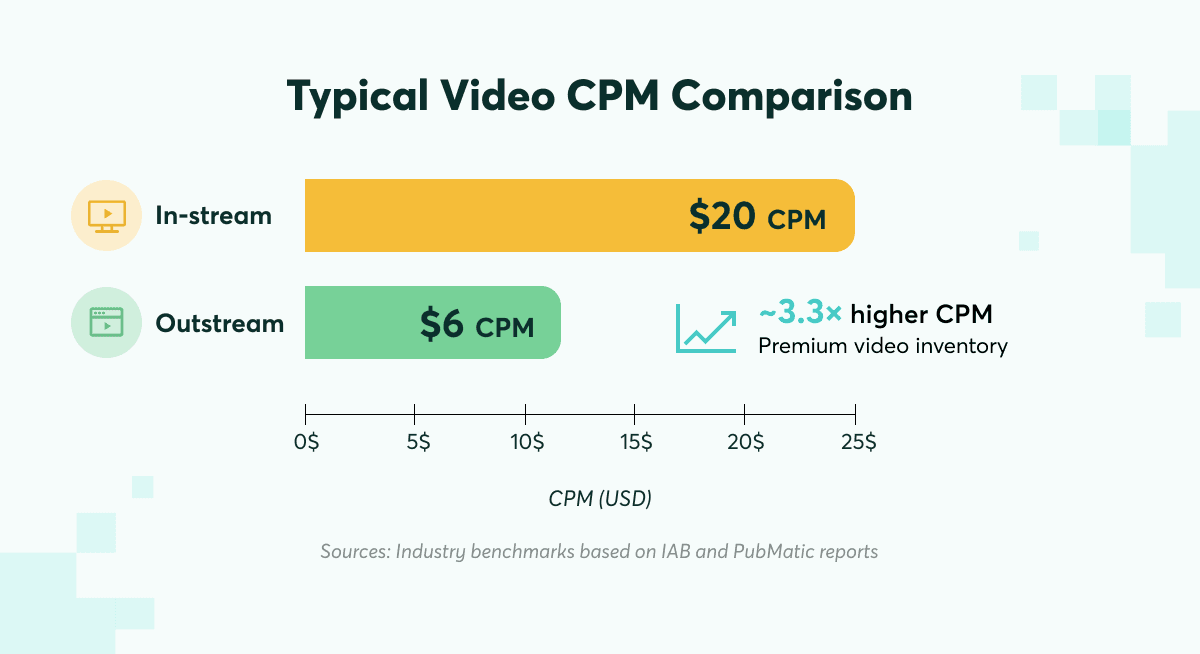
A text-based publisher, like a news site, a blog or a niche media brand, can't run instream ads if they have no video content. Outstream solves that. It lets any publisher add video monetization without producing a single video asset. The trade-off is lower CPMs ($3–10 on average vs. $10-30+ for premium instream), but the reach potential is much wider.
Instream vs. Outstream Ads: Key Differences
Although both formats use video creatives, they serve different purposes and create different user experiences.
The biggest difference comes down to context. Instream ads are shown while users are actively watching video content, whereas outstream ads appear while users are reading, browsing or scrolling.
| Factor | Instream ads | Outstream ads |
|---|---|---|
| Placement | Within video content | Outside video content |
| Content requirement | Requires a video player and video inventory | No video content required |
| User intent | Users are already in viewing mode | Users are primarily reading or browsing |
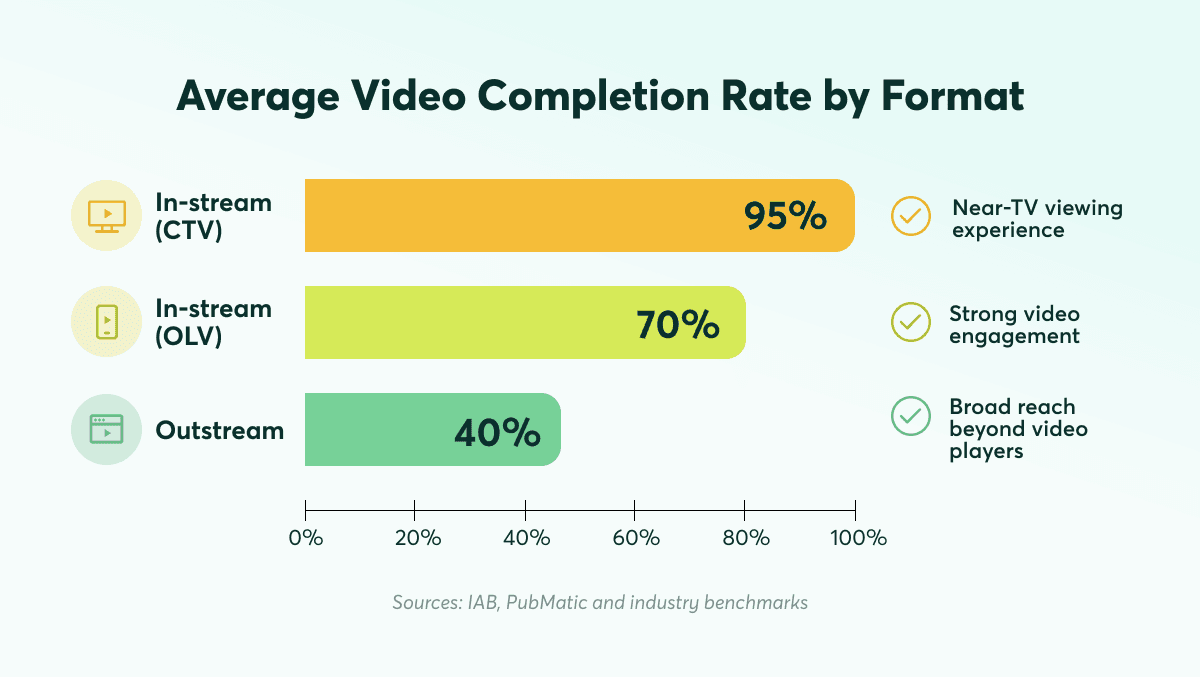
| Completion rate | 85–95% CTV / 60–80% OLV | 30–50%, depends on placement & scroll depth |
| Typical CPM | $10–30+ for premium inventory | $3–10, lower floor, wider scale |
| Measurement | Deterministic: based on player-reported signals such as starts, completions, duration and audio status | Inferred: estimated using viewability standards (e.g., MRC: 50% visible for 2 seconds) |
| Technical setup | VAST/VPAID integration with video player | Single JS tag with no player dependency |
| Reach | Limited to video environments | Can scale across websites, apps and feeds |
| Viewability | May be skipped depending on format | Plays only when visible on screen |
| User experience | Can interrupt content | Less disruptive when implemented correctly |
| Best for | Brand recall, storytelling, premium campaigns, CTV | Reach extension, text-heavy publishers, incremental inventory |
In simple terms, instream ads capture attention during video consumption, while outstream ads extend video reach across digital environments.
How To Measure Instream and Outstream Ads
Measurement is where these two formats diverge most sharply.
Instream: Deterministic Measurement
Because instream ads run inside a video player, the player itself tracks every event. Advertisers know exactly:
- when the ad impression fired;
- whether audio was on or off;
- what percentage of the video the viewer watched;
- whether the ad was completed.
The standard reporting framework uses quartile tracking, where 25%, 50%, 75% and 100% completion are each logged as separate events. This gives a full picture of where viewers drop off. Combined with Video Completion Rate (VCR) as the headline metric, instream campaigns produce data you can actually optimize against.
On CTV, measurement goes further: impressions are tied to household-level data and can feed into frequency management across devices.
Outstream: Probabilistic Measurement
Outstream doesn't have a player reporting events. Instead, viewability is measured using the MRC (Media Rating Council) standard. A video ad counts as a viewable impression when at least 50% of its pixels are visible on screen for a minimum of 2 consecutive seconds.
That's a much lower bar. Under MRC, an ad that plays for 2 seconds in the corner of a busy article page registers as a viewable impression, even if nobody watches it.
This doesn't mean outstream is unmeasurable, but it does mean you need to look at the right metrics:
- Time in view measures how long an ad remains visible on screen, providing a more nuanced indicator of exposure than simply meeting the minimum viewability threshold.
- Viewable completion rate measures ad completions only among impressions that were considered viewable, offering a more accurate assessment of performance than calculations based on all served impressions.
- Scroll depth correlation indicates whether users who were exposed to the ad also continued engaging with the surrounding content, helping advertisers better understand the quality of that engagement.
What This Means for Campaign Planning
Comparing VCR between instream and outstream directly is misleading because they're measuring different things: two different audiences, in two different contexts. Instead, set KPIs that match the format. Analyze VCR and quartile data for instream. For outstream, compare time in view and viewable completion rate. Mixing them up is one of the most common reasons campaign reports look confusing.
Which Format Works Best for Different Goals?
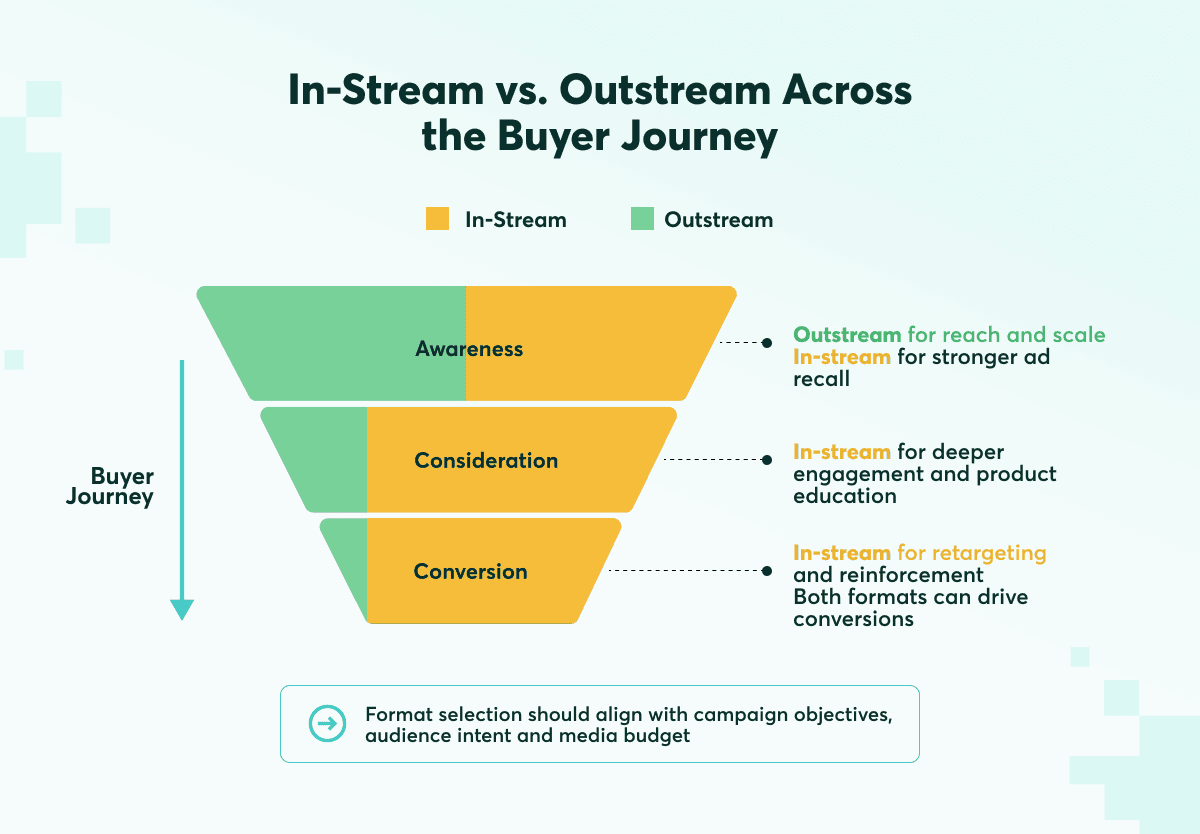
The funnel above reveals the overall pattern for these formats. Instream dominates where attention is the asset, whereas outstream extends reach where attention is partial. Here's how that plays out by objective.
Brand Awareness
Both formats work for brand awareness, but how they get there is different. Instream receives concentrated attention. Thiewer is already watching, the audio is on and the skip button is delayed. This environment is what drives brand recall. On the other hand, outstream trades some of that attention for volume. It can appear across any article, feed or app, which means exposure numbers are larger but shallower.
A typical approach would be to use instream on premium inventory to build recall, layer outstream across broader inventory to extend frequency.
Storytelling and Product Demos
For storytelling and product demonstrations, the best choice is instream. If your message needs 30 seconds to land, whether it is a product walkthrough, a brand film or a narrative, you need an environment where the viewer will sit through it. On outstream, users scroll past the moment the content doesn't immediately grab them.
Reach and Audience Expansion
Outstream is your best bet for reach and audience expansion. The ability to place video units across text-heavy sites, content feeds and mobile apps means you can reach audiences who never visit video-first platforms. According to IAB Europe and Pubmatic, 65% of advertisers direct the bulk of their video budget into instream, which means outstream inventory is less contested and often more cost-efficient for incremental reach.
Publisher Monetization
The success of publisher monetization for either format is entirely dependent on what content the publisher produces.
Publishers with a consistent video library, like a news broadcaster, a YouTube-style channel or a sports platform, monetize most effectively with instream. CPMs are higher ($10–30+ vs $3–10 for outstream) because the ad environment commands more attention and advertisers pay for it.
Publishers whose inventory is primarily editorial, meaning blogs, news articles or niche media, cannot run instream without video content. Outstream solves that with a single JavaScript tag and no video production requirements.
User Experience
Outstream, when implemented properly, does not detract from the user experience. An in-content unit that plays muted and pauses on scroll can be genuinely non-intrusive. By contrast, instream is inherently disruptive, which helps explain why ad blocker adoption is strongly correlated with video-heavy platforms such as YouTube.
However, the user experience depends heavily on execution. Outstream formats can be just as disruptive as instream when pages contain multiple autoplay units, sticky placements that cannot be dismissed or non-skippable ads in environments where users have little tolerance for interruption.
Instream on CTV: A Different League
Connected TV deserves its own mention because it changes the instream equation significantly.
On a desktop OLV placement, instream ads compete with browser tabs, notifications and anything else on the user's screen. On CTV, the screen is the only thing in the room. Users sit back, the content is full-screen and multitasking is minimal.
The completion rates on CTV instream inventory routinely hit 95%+, compared to 60–80% for OLV. Non-skippable formats are standard, audio is almost always on and the viewing environment is closer to linear TV than to web advertising.
What This Means Practically
CTV instream is the highest-attention digital video environment available. It's also the most expensive and has its own set of constraints: no click-throughs (you're watching TV and not browsing), household-level targeting rather than individual cookies and limited inventory as streaming platforms control their own supply.
For brand campaigns where recall and emotional resonance matter, CTV instream is as strong as it gets. For performance campaigns optimized toward clicks or conversions, the format doesn't translate.
The IAB 2023 classification reflects just this: primary Instream on CTV is treated as a distinct tier from OLV instream, with different pricing, measurement and creative requirements. A 30-second ad that works on CTV may need significant recutting to work as a skippable OLV pre-roll where 5 seconds is all you're guaranteed.
Instream vs. Outstream: Which Format Fits Your Situation
A quick rule of thumb is if the environment already has a video player and an audience in watch mode, instream is the natural fit. If not, outstream is a better fit for your situation.
Choose instream when:
- Your message needs more than 5–6 seconds to land. Mid-funnel storytelling, product demos and brand films all need time, and instream is the only format that reliably buys it.
- Completion rate is a core KPI. Instream is the only format where you can meaningfully optimize toward VCR and quartile data.
- You're running on CTV or premium OLV inventory, where CPMs are higher but attention quality justifies the price.
- You're launching something new. Product launches benefit from the combination of high attention and audio-on environments that instream provides.
Choose outstream when:
- You're a publisher without video content. Outstream is the only way to monetize non-video pages with video ad revenue: no player, no production and one script.
- You need reach beyond traditional video inventory. If your instream budget is spent and you're still short on frequency, outstream extends coverage across articles, apps and feeds.
- Your audience skews mobile and browsing-first. Outstream's viewport-triggered, muted autoplay fits naturally into scroll behavior on mobile.
- Brand safety in contextual environments matters. In-content outstream units placed between article paragraphs can be tightly controlled for content category in a way that broad OLV buying often can't.
One thing to avoid: Choosing the format based on CPM alone. Instream's higher CPMs reflect higher attention. A $25 CPM instream placement that gets 80% VCR may deliver better cost-per-recall than a $7 CPM outstream unit with 30% VCR and partial viewability. The math only makes sense when you use the right denominator.
✔️ Choose outstream for reach, publisher monetization and non-video inventory.
Can You Use Instream and Outstream Ads Together?
Yes, and for most advertisers with meaningful video budgets, the question isn't which format but how to divide the work between them.
The most common structure is to let instream carry the core message in high-attention environments, while outstream extends frequency across everywhere else. A user who sees a 30-second brand film as a YouTube pre-roll and then encounters a 6-second muted reminder while reading an article has had two very different interactions with the same campaign, and both contributed to the overall campaign objective by reinforcing brand awareness and increasing the likelihood of conversion.
For publishers, the split is even cleaner. Instream monetizes video pages at higher CPMs, outstream monetizes editorial pages that would otherwise generate zero video revenue. The two formats don't compete for the same inventory.
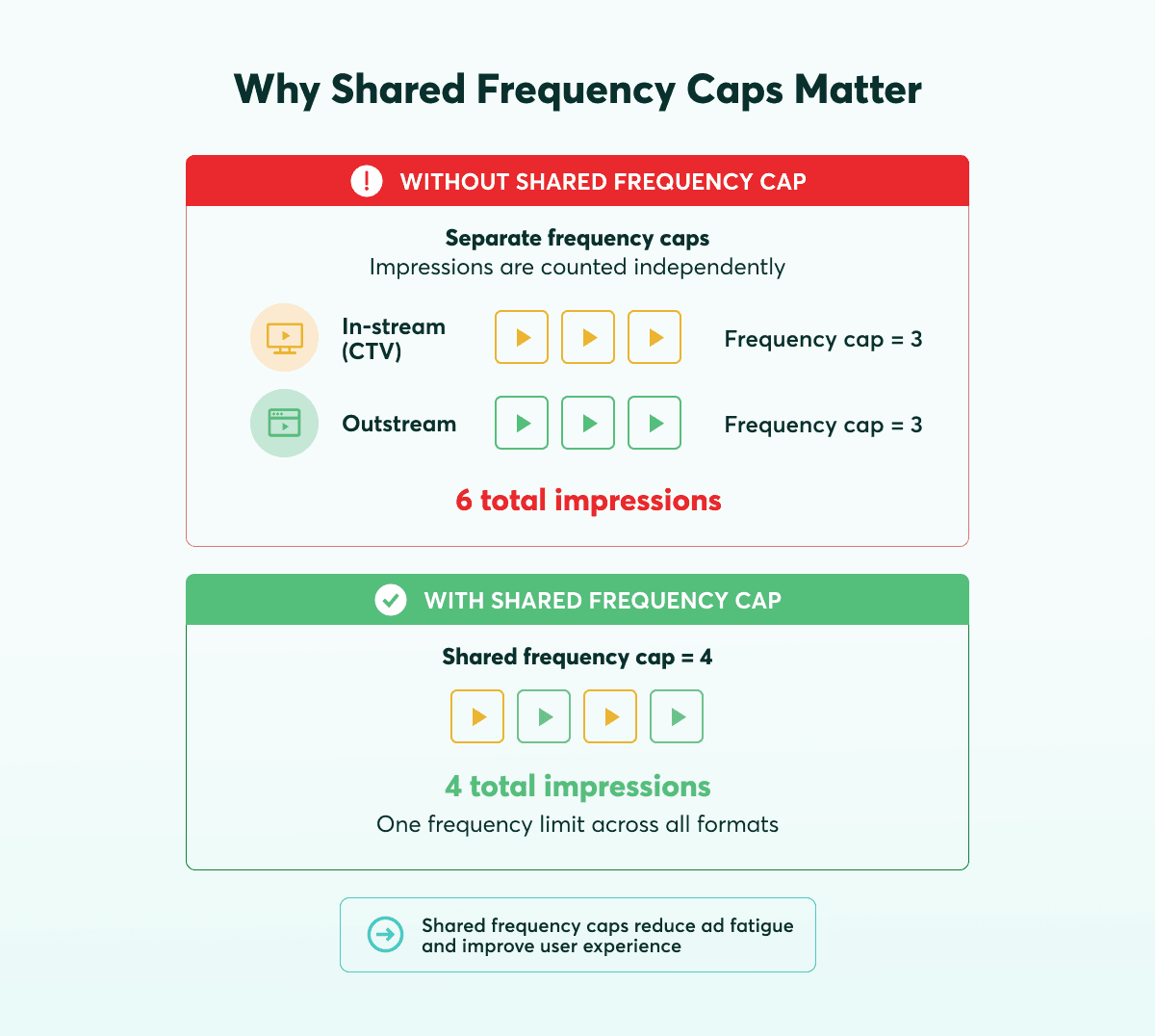
The main thing to manage when running both is frequency. Without cross-format capping, a user can be served instream and outstream units independently, and neither system knows about the other. That leads to overexposure, which drives both banner blindness and brand fatigue faster than either format would alone. Set frequency caps at the campaign level if your stack supports it.
Instream and Outstream Ads Mistakes & Best Practices
Even the right format can underperform if it is implemented incorrectly. Here are some of the most common mistakes advertisers and publishers make when working with instream and outstream ads and how to fix them.
Optimizing for the Wrong Metric
The most common mistake is comparing instream and outstream using the same KPI. VCR on outstream will almost always look worse than on instream because the environments are fundamentally different. A 40% VCR on an in-content outstream unit placed in a mid-article position is a solid result. Judging it against a 75% pre-roll VCR is like comparing open rates between a push notification and an email.
Set KPIs before launch. For instream, it’s VCR, quartile completion and brand recall lift. For outstream, it’s viewable completion rate (completions against viewable impressions only, not total served), time in view and reach.
Running the Same Creative in Both Formats
Instream and outstream are different viewing conditions. An instream ad can build a story over 30 seconds because the viewer is captive. An outstream unit has to communicate something meaningful before the user scrolls past, which on mobile typically means within 3 seconds, with no audio.
If your creative opens with 4 seconds of ambient music and a slow logo reveal, it will do nothing in outstream. At minimum, cut a version that opens on a strong visual or on-screen text, delivers the core message by second 5 and doesn't depend on audio.
Ignoring Frequency Across Formats
Most DSPs manage frequency at the placement level. A user can hit your instream frequency cap and still be served outstream units independently, and neither system flags it. The result is overexposure that accelerates fatigue without anyone noticing until brand lift studies come back flat.
If your stack supports cross-format frequency capping, use it. If it doesn't, keep your outstream and instream campaigns on separate schedules or in separate flights with coordinated pacing.
Overloading Outstream Placements per Page
A single well-placed in-content outstream unit that a user actually scrolls through is worth more than three units on the same page that compete for viewport time and collectively degrade the reading experience. Most SSPs will fill every placement you make available, but that doesn't mean you should make all of them available.
One unit per page is the standard starting point. Two can work if page length and content density justify it. More than that almost always hurts both UX and RPM as users develop scroll-past behavior faster. Publishers should expand placement density gradually and monitor viewability, engagement and RPM before introducing additional units.
Neglecting CTV Creative Specs
If you're running instream on CTV, the creative requirements are different from OLV. There are no clickable elements. Non-skippable formats are standard, so a weak first 5 seconds doesn't get forgiven. Audio is on by default. And 15-second spots often outperform 30-second spots on streaming platforms where mid-roll breaks are already disruptive.
Don't repurpose a digital-first ad to CTV without reviewing it against these conditions. A creative built around a CTA overlay and a final-frame URL will make no sense on a 65-inch screen. Instead, design CTV creatives around large-screen viewing, audio-on consumption and clear branding that can be understood without any clickable elements.
Conclusion
The choice between instream and outstream ads comes down to one question: where do you want to capture attention?
Instream ads perform best when users are actively watching video content, while outstream ads help extend video reach across non-video environments. Understanding the strengths of each format makes it easier to align placements, creative and KPIs with your campaign goals.
The most effective strategy is rarely about choosing the better format, but about using the right format for the right objective.
FAQ on Instream vs Outstream Ads
What is the IAB definition of outstream?
The IAB 2023 video taxonomy classifies outstream under No Content/Standalone: video ads that appear outside of a video player, in environments where video content is not the primary purpose of the page. This distinguishes it from Primary Instream (ads in a dedicated video player where video is the main content) and Accompanying Content (ads in a player where the video is secondary to the surrounding page).
What is the main difference between instream and outstream ads?
Instream ads run inside a video player while a user is watching video content. Outstream ads appear outside video players, like in articles, feeds and apps, with no video content required.
Which format generates higher engagement?
Instream consistently generates higher engagement. Users in watch mode are more likely to view ads to completion. CTV instream regularly exceeds 95% VCR; outstream typically lands between 30–50%, depending on placement quality and scroll depth.
Do outstream ads require video content to run?
No, that's the point of the format. A publisher with no video library can deploy outstream with a single JS tag and start generating video ad revenue from editorial pages immediately.
Do outstream ads work on mobile?
Yes, and they were originally designed for mobile. The viewport-triggered, muted autoplay behavior aligns naturally to how people scroll on phones. In-feed outstream on mobile is one of the most scalable video formats available.
Which format is better for publishers?
Publishers with consistent video content monetize it most effectively with instream with higher CPMs and premium inventory. Publishers without video content use outstream to generate video revenue from pages that would otherwise have none. Many publishers run both: instream on video pages, outstream on editorial pages.
Can instream and outstream ads be used together?
Yes. Use instream for the core message in high-attention environments and outstream to extend reach across editorial inventory. When running both, manage frequency at the campaign level.
Which format typically delivers higher CPMs?
Instream ads typically generate higher CPMs than outstream formats, with premium OLV inventory often selling for $10–30+ CPM and CTV inventory commanding even higher rates. Outstream CPMs are generally lower, around $3–10, reflecting their broader reach and lower attention levels compared to ads served directly within video content.