The highest-paying affiliate vertical isn't always the one that makes you the most money.
Affiliate marketers love comparing payouts, but a $500 commission means very little if the traffic is expensive, the offer is difficult to approve or the audience simply doesn't convert. Sometimes the less glamorous vertical is the one that leaves more money in your pocket.
That's why choosing a vertical is really about the whole equation: payout potential, traffic costs, competition, compliance and how well the offer fits the channel you know how to run. Get that combination wrong, and even a great offer can become expensive to learn.
In 2026, the choice is getting more interesting. Finance and Health & Beauty remain highly competitive, while AI Tools and Digital Finance are creating opportunities that barely existed a few years ago. Below, we'll compare where the strongest opportunities are now, which GEOs and traffic sources fit them best and what affiliates should expect when running these verticals on MGID.
- What Is a Vertical in Affiliate Marketing?
- Health & Beauty (Nutra)
- Finance
- Home Security & Home Improvement
- Travel
- Automotive
- eCommerce
- Emerging Affiliate Marketing Verticals in 2025–2026
- AI Tools
- Sustainable Products
- Digital Finance
- Affiliate Marketing Verticals by Payout
- Affiliate Marketing Verticals FAQ
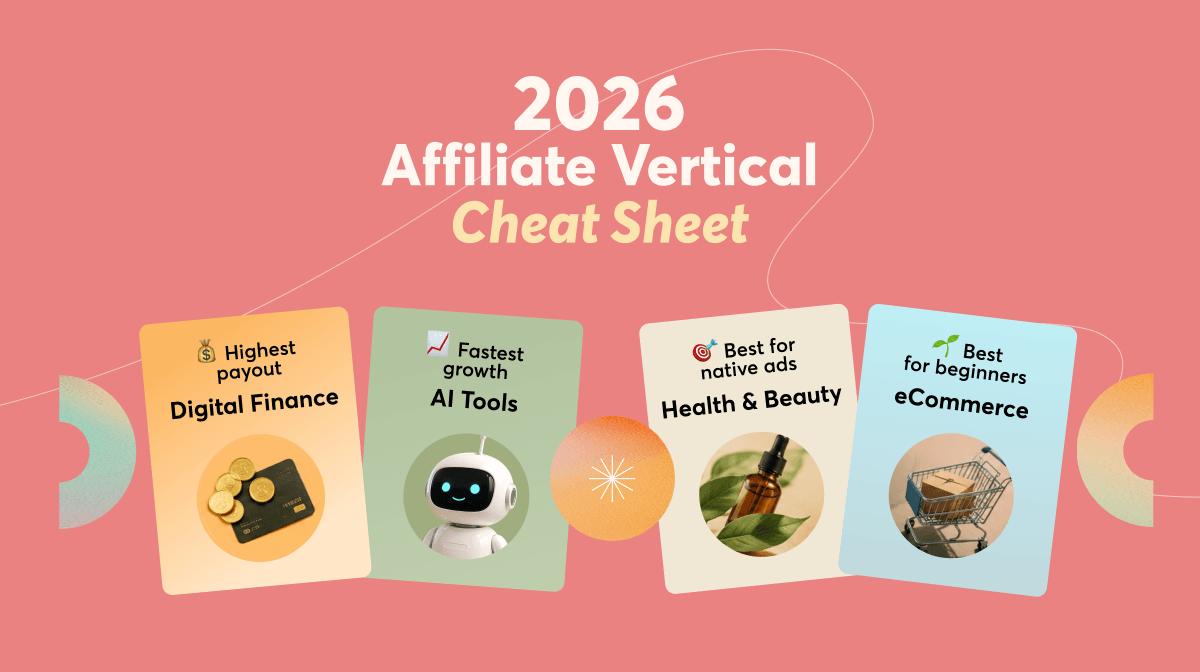
Affiliate Marketing Verticals List: Quick Comparison
| Vertical | Typical payout | Best GEOs | Best traffic sources | Competition level | Example offers |
|---|---|---|---|---|---|
| Health & Beauty (Nutra) | $20-$120 CPA | US, CA, AU, UK | Native, Social | High | Weight loss, skincare, supplements |
| Finance | $50-$300 CPA | US, UK, DE, FR | Native, SEO | Very high | Loans, credit cards, insurance |
| Home Security & Home Improvement | $20-$200 CPA | US, UK, CA | SEO, Native | Medium | Security systems, smart home devices |
| Travel | $5-$80 CPA | US, UK, EU | SEO, Native | Medium | Hotels, flights, travel insurance |
| Automotive | $15-$200 CPA | US, DE, UK | SEO, Native | Medium | Auto parts, car rentals |
| eCommerce | 3%-20% RevShare | Global | Social, Native | High | Consumer goods, marketplaces |
| AI Tools | $20-$300 CPA | US, UK, CA | SEO, Native | Growing | AI writing tools, AI image generators |
| Sustainable Products | 5%-20% RevShare | EU, US | Social, Native | Medium | Eco-friendly products |
| Digital Finance | $80-$500 CPA | US, LATAM, EU | Native, SEO | High | Neobanks, investing apps, BNPL |
What Is a Vertical in Affiliate Marketing?
It defines the type of products or services being promoted and shapes everything downstream: target audience, preferred traffic sources, payout models and compliance requirements.
Affiliate marketing verticals range from broad categories like Finance, Health & Beauty and eCommerce to specialized sub-verticals within those industries. There is no fixed classification system: any niche that attracts enough advertisers, affiliates and consumers can evolve into a standalone vertical over time.
Some verticals have stayed consistently profitable for years. Others emerge as technology, consumer behavior or regulations shift, which is why AI Tools, Sustainable Products and Digital Finance are drawing increasing attention in 2025–2026 alongside the established categories.
Health & Beauty (Nutra)
Health & Beauty works because the demand never really goes away. People buy skincare in recessions, order supplements during slow news cycles and discover new wellness products through content they weren't actively searching for, which makes native advertising a particularly strong fit for this vertical.
The category spans skincare, anti-aging, dietary supplements, weight-loss solutions, haircare and general wellness, with sub-verticals that behave quite differently from each other in terms of traffic costs, compliance requirements and conversion rates.
Popular Sub-Verticals
- Skincare: Cleansers, moisturizers, serums, anti-aging treatments and other products designed to improve skin health and appearance.
- Makeup: Cosmetics such as foundations, lipsticks, mascaras and eyeliners for different beauty routines and styles.
- Haircare: Shampoos, conditioners, styling products and treatments that support healthy hair.
- Wellness: Vitamins, supplements, fitness products and other solutions aimed at improving overall well-being.
- Fragrances: Perfumes and colognes for consumers looking to enhance their personal style and scent.
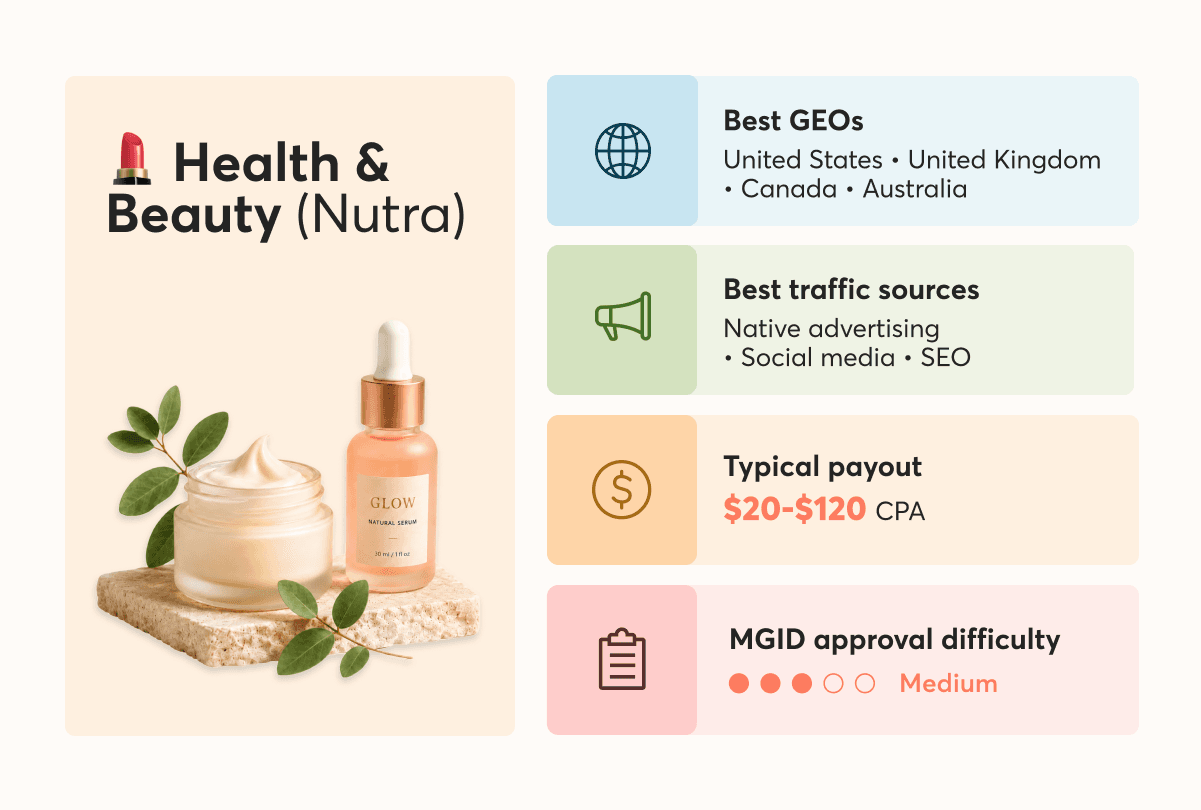
Best GEOs
Health & Beauty campaigns tend to perform best in markets where consumers actively spend on personal care, wellness, and self-improvement products.
- United States: High purchasing power and strong demand for skincare, supplements and anti-aging products.
- Canada: Similar consumer behavior to the US, with growing interest in wellness and natural products.
- United Kingdom: Strong market for beauty products, cosmetics and nutritional supplements.
- Australia: High acceptance of wellness and fitness-related offers.
- Germany and France: Mature beauty markets with demand for premium skincare and personal care products.
Recommended Traffic Sources
Health & Beauty is one of the most versatile affiliate marketing verticals and works across multiple acquisition channels:
- Native advertising: Particularly effective for advertorials, product reviews and educational content.
- Social media: Ideal for visually driven products such as cosmetics, skincare and haircare.
- SEO: Works well for product comparisons, reviews and informational content targeting high-intent users.
- Email marketing: Effective for repeat purchases and subscription-based wellness products.
Typical Payout Range
The payout depends on the product category, GEO, and compensation model.
- Supplements and Nutra offers: $20-$120 CPA
- Beauty and skincare products: 5%-20% revenue share or $10-$80 CPA
- Subscription-based wellness products: often offer higher lifetime value and recurring commissions
Approval Difficulty on MGID
Medium.
Health & Beauty is a well-established category on MGID. However, advertisers should avoid misleading health claims, exaggerated before-and-after results and unsupported medical statements. Creatives that focus on education and realistic outcomes generally perform better and face fewer compliance issues.
MGID Tips on Health & Beauty
To maximize campaign performance in the Health & Beauty vertical, consider the following recommendations:
- Lead with a specific problem: Creatives built around one clear pain point — wrinkles, hair loss, weight management, acne — consistently outperform generic wellness messaging because they speak to what the user is already thinking about.
- Use advertorial-style landing pages before sending traffic to the offer: Educational content that explains the problem and introduces the product as a solution converts better than direct promotional pages, particularly for supplement offers.
- Testimonials and before-and-after content work, but only when they feel authentic: Creator-led and user-generated formats tend to outperform polished ad-style visuals in this vertical.
- Localize beyond language: Beauty standards, preferred ingredients and wellness trends vary significantly between the US, Germany and Australia. Creatives that reflect local preferences consistently outperform translated versions of the same asset.
- Watch compliance per GEO before scaling: Claims that are acceptable in one market can trigger rejections or legal issues in another, particularly around medical language and weight loss outcomes.
MGID Success Story
Bedrop needed to bring down acquisition costs in the German wellness market, a competitive GEO where generic creatives rarely survive long. Within four weeks of switching to MGID's CPA Tune bidding strategy and running continuous creative optimization, the brand cut CPA by up to 76% and grew ROAS by up to 297%. The results came not from scaling budget, but from tightening what was already running.
Finance
Finance pays more per conversion than almost any other affiliate vertical, and that's not a coincidence. Financial products often have high customer lifetime values and margins, allowing advertisers to support significantly higher affiliate payouts than many consumer-focused verticals.
The catch is that this same economics attracts serious competition, and regulators watch financial advertising more closely than most other categories. Affiliates who do well here tend to invest heavily in compliance, content quality and audience targeting rather than trying to shortcut the funnel.
Popular Sub-Verticals
- Personal finance: Budgeting tools, savings accounts, credit cards and debt management solutions.
- Investing and wealth management: Trading platforms, robo-advisors, retirement products and investment services.
- Insurance: Life, health, auto, travel and property insurance products.
- Loans and credit: Personal loans, mortgages, student loans and credit card offers.
- Tax services: Tax filing software, tax preparation services and tax planning solutions.
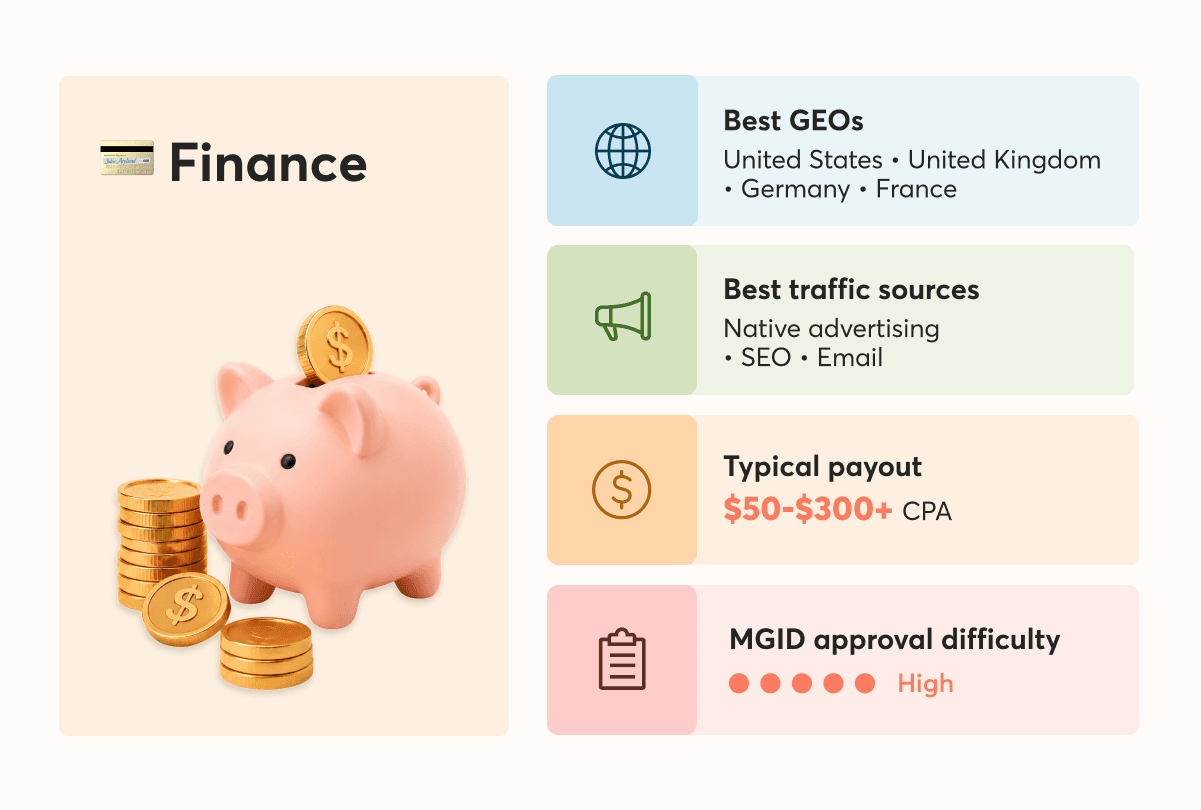
Best GEOs
Finance campaigns tend to perform best in markets with mature banking systems, high adoption of financial products and strong demand for lending, insurance, and investment solutions.
- United States: One of the largest affiliate finance markets, with strong demand for credit cards, loans, insurance and investing platforms.
- United Kingdom: A mature fintech ecosystem and high consumer interest in personal finance products.
- Canada: Stable demand for banking, insurance and wealth management services.
- Germany: Strong market for insurance, consumer lending and investment products.
- France: Growing opportunities in personal finance, insurance and digital banking solutions.
- Australia: High adoption of financial services and strong demand for comparison-based offers.
Recommended Traffic Sources
Finance offers can perform well across several acquisition channels, but success often depends on building trust and providing valuable information before asking users to convert.
- Native advertising: Effective for educational content, financial guides and comparison articles.
- SEO: One of the strongest channels for finance offers due to high-intent search traffic.
- Email marketing: Works well for nurturing leads and promoting recurring financial services.
- Social media: Can support awareness and lead generation, particularly for fintech products.
Typical Payout Range
Finance stands out for its high-value conversions, with many offers falling into high-ticket affiliate marketing, where a single successful referral can generate a substantial commission.
- Credit cards and banking products: $50-$250 CPA
- Insurance offers: $20-$200 CPA
- Loans and lending products: $50-$300+ CPA
- Investment and trading platforms: $100-$500+ CPA
Approval Difficulty on MGID
High
Finance campaigns often face stricter compliance requirements than most affiliate verticals. Advertisers should avoid misleading financial claims, unrealistic earnings promises and unsupported investment recommendations. Landing pages, disclosures and creatives should be fully aligned with local regulations.
MGID Tips on Finance & Insurance
Because financial products often require greater consideration before conversion, advertisers should focus on educating users and building credibility throughout the customer journey:
- Treat the landing page as part of the funnel: Long-form advertorials that explain the product, address common objections and guide users through the decision tend to outperform direct links to the advertiser's page, especially for loans, insurance and investment offers.
- Use interactive tools: They convert better than static content in this vertical. Calculators, comparison widgets and planning tools keep users engaged longer and generate higher-quality leads because they attract people who are actively evaluating options.
- Match the offer to a specific financial need rather than promoting broadly: Campaigns targeting users who are actively saving, borrowing, investing or comparing insurance plans consistently outperform generic financial messaging.
- Monitor lead quality downstream: Finance advertisers care about funded loans, activated accounts and paying customers; optimizing for form fills without tracking what happens after can quickly erode relationships with advertisers.
- Compliance is non-negotiable and varies by market: Claims that pass review in one country can violate regulations in another, particularly around investment returns, loan terms and insurance coverage. Build compliance checks into your workflow before scaling to new GEOs.
MGID Success Story
HSBC Bank needed to drive credit card applications in Indonesia, a market where generic financial messaging rarely builds enough trust to convert. By pairing localized creative with native ad formats on MGID, the campaign reached users in a context that felt editorial rather than promotional. The result was more than 74,000 clicks at an average CPC of $0.06 and a 1.5% conversion rate: strong numbers for a financial product that requires active user commitment to apply.
Home Security & Home Improvement
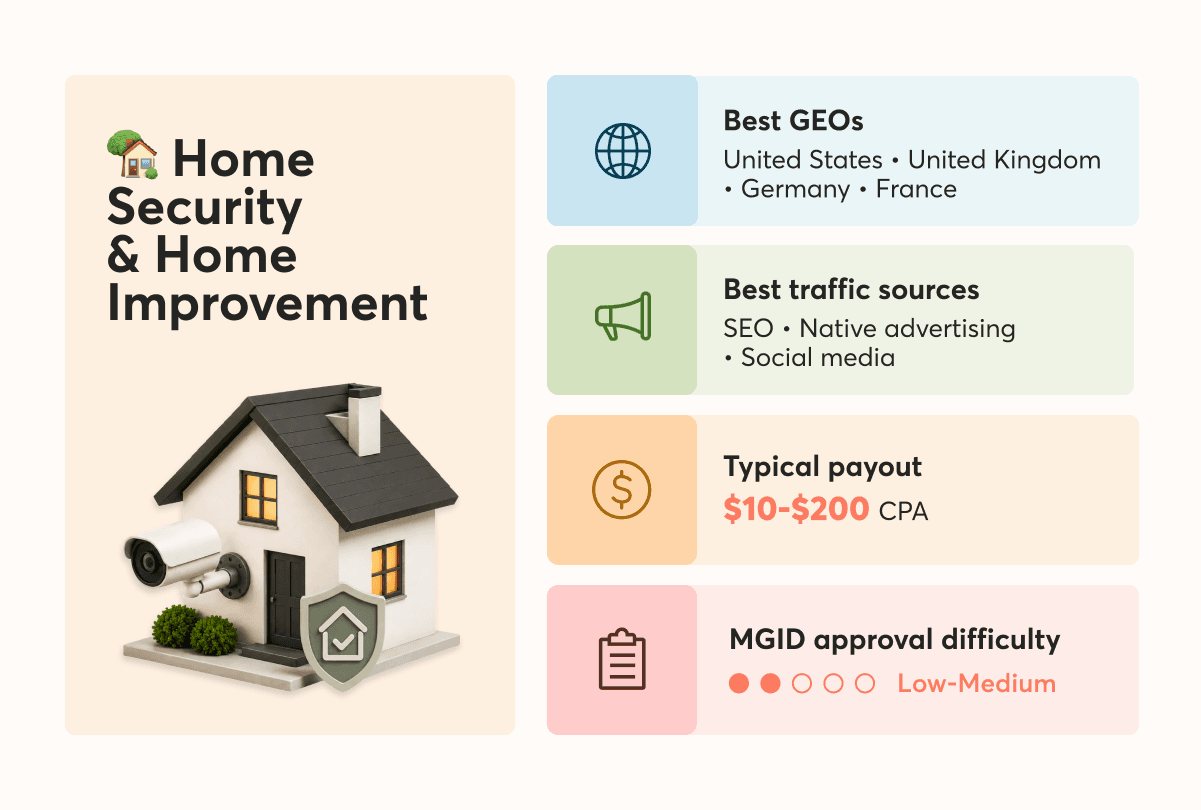
Home improvement purchases are rarely impulsive. A homeowner researching security cameras or solar panels typically spends days comparing options, reading reviews and checking installation costs before committing, which means affiliates who show up early in that research process with genuinely useful content have a real advantage.
The vertical covers everything from smart security systems and connected devices to renovation services and DIY solutions, and it benefits from the kind of high purchase intent that makes SEO and native advertising particularly effective here.
Popular Sub-Verticals
- Home security systems: Security cameras, alarm systems, motion sensors and smart doorbells designed to protect homes from intruders and burglaries.
- Smart home devices: Connected devices and gadgets that enable homeowners to monitor and control various aspects of their homes remotely, including lighting, temperature and security.
- DIY home improvement: Tools, equipment and materials for do-it-yourself home improvement projects, including painting, woodworking, plumbing and electrical work.
- Home renovation services: Professional services for home remodeling, renovations, repairs and upgrades, including kitchen remodeling, bathroom renovations and landscaping.
Best GEOs
Home Security & Home Improvement campaigns tend to perform best in markets with high homeownership rates and strong consumer spending on property upgrades and maintenance.
- United States: Large market for smart home devices, security systems and renovation services.
- Canada: Strong demand for home improvement products and energy-efficient solutions.
- United Kingdom: Mature market for home security, DIY projects and smart home technology.
- Germany: High interest in home automation, security and energy-saving upgrades.
- Australia: Growing adoption of smart home products and renovation services.
Recommended Traffic Sources
Home Security & Home Improvement campaigns can perform well across multiple acquisition channels, particularly when consumers are actively researching solutions and comparing products.
- Native advertising: Effective for product reviews, comparison articles and educational content.
- SEO: Strong channel for capturing high-intent users researching specific products or services.
- Social media: Works well for visual content, DIY projects and home transformation stories.
- Email marketing: Useful for nurturing leads and promoting seasonal offers.
Typical Payout Range
Payouts vary depending on the product category and compensation model.
- Home security systems: $20-$150 CPA
- Smart home devices: 5%-15% revenue share
- Home services and lead generation offers: $10-$100 CPL
- Renovation and installation services: $20-$200+ CPA
Approval Difficulty on MGID
Low to Medium
Most Home Security & Home Improvement offers are straightforward to promote. However, advertisers should ensure that claims related to security, energy savings, or cost reductions are accurate and supported by evidence.
MGID Tips on Home Security & Home Improvement
Consumers in this category often spend time researching options before making a purchase. The following practices can help improve campaign performance:
- Enter the research phase early with educational content: How-to guides, installation tutorials and troubleshooting articles attract users before they have decided what to buy, and affiliates who answer those early questions are better positioned to influence the final decision.
- Comparison content is the strongest converter in this vertical: Homeowners evaluating security systems or smart home devices want side-by-side breakdowns of features, pricing and installation requirements, not promotional messaging. Reviews that include real limitations alongside strengths consistently build more trust than purely positive ones.
- Lead with practical outcomes rather than product specifications: Safety, energy savings, reduced insurance premiums and increased property value resonate more than technical feature lists, particularly for audiences who are not enthusiast buyers.
- Localize for housing context: A campaign promoting smart thermostats performs differently in Germany, where energy costs are a primary concern, than in the US, where convenience and home automation tend to drive interest more.
- For lead generation offers, qualify traffic before sending it: Home renovation and installation services often have geographic restrictions and minimum project sizes; mismatched leads waste advertiser budget and damage campaign relationships quickly.
MGID Success Story
Checkfox was running solar panel lead generation in Germany with a single acquisition channel and needed to prove that native advertising could deliver leads at a competitive cost before committing budget to it. The campaign ran continuous A/B testing with regular creative refreshes, including AI-generated visuals, to find what resonated with German homeowners. MGID ended up delivering leads approximately 30% below the advertiser's target CPL, which meant native became a permanent part of the mix.
Travel
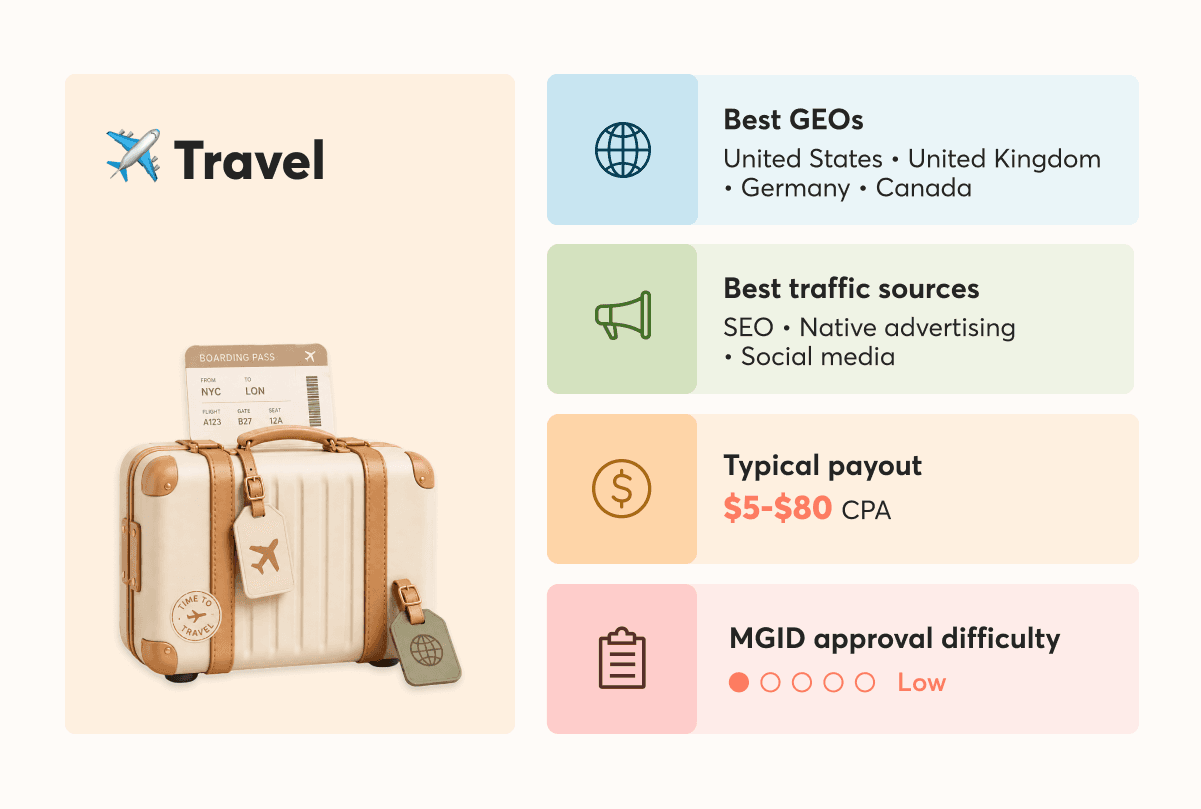
Travel is one of the few verticals where the content and the offer are essentially the same thing. A destination guide, a hotel comparison or a packing list all serve the reader directly and naturally lead to bookings, insurance purchases or gear recommendations without feeling like advertising.
That alignment between useful content and commercial intent is why SEO and native advertising work so well here, and why affiliates who invest in genuinely helpful travel content tend to build audiences that convert repeatedly over time.
Popular Sub-Verticals
- Travel booking platforms: Online travel agencies (OTAs) and booking websites that offer comprehensive listings of flights, hotels, vacation rentals, car rentals and activities
- Accommodations: Hotels, resorts, hostels, vacation rentals and bed-and-breakfast establishments catering to travelers seeking lodging options during their trips
- Transportation: Airlines, railways, bus companies, cruise lines and car rental agencies providing transportation services for travelers to reach their destinations
- Travel accessories and gear: Products such as luggage, travel bags, travel-sized toiletries, travel adapters and portable electronics designed to enhance the travel experience
- Travel insurance: Insurance policies and coverage plans tailored to protect travelers against unforeseen events, medical emergencies, trip cancellations and travel disruptions
Best GEOs
Travel campaigns tend to perform best in markets with high outbound travel demand and consumers who actively research and book trips online.
- United States: One of the largest travel markets, with strong demand for flights, hotels, travel insurance and vacation packages.
- United Kingdom: High international travel activity and strong adoption of online booking platforms.
- Germany: A mature travel market with consistent demand for package holidays and travel services.
- France: Strong interest in both domestic and international travel experiences.
- Canada: Growing demand for leisure travel, travel insurance and accommodation offers.
- Australia: High spending on international travel and travel-related services.
Recommended Traffic Sources
Travel campaigns can perform well across multiple acquisition channels, especially when users are actively planning trips and comparing destinations, accommodations, and experiences.
- Native advertising: Effective for destination guides, travel inspiration and booking-focused content.
- SEO: Strong channel for travel research, destination reviews and comparison searches.
- Social media: Ideal for visual storytelling, travel inspiration and user-generated content.
- Email marketing: Useful for promoting seasonal offers, discounts and personalized recommendations.
Typical Payout Range
Travel affiliate payouts vary depending on the offer type and compensation model.
- Hotel bookings: 3%-10% revenue share
- Flights and transportation: $1-$20 CPA
- Travel insurance: $10-$80 CPA
- Tours and activities: 5%-15% revenue share
- Travel booking platforms: $5-$50 CPA
Approval Difficulty on MGID
Low
Travel is generally one of the easier affiliate verticals to promote. Advertisers should ensure pricing, availability and promotional claims remain accurate and up to date, especially for time-sensitive offers.
MGID Tips on Travel
Travel decisions are often driven by inspiration, trust and timing. The following practices can help improve campaign performance:
- Segment by traveler type before building creatives: Families, solo travelers, business travelers and luxury audiences have fundamentally different priorities; an ad that works for one segment will actively underperform for another. Defining the audience first makes everything downstream easier to optimize.
- Align campaign timing with booking windows: Most travelers book flights and accommodation weeks or months in advance, so campaigns tied to seasonal peaks need to launch earlier than feels intuitive, particularly for summer and holiday periods.
- Reviews and comparisons convert better than inspirational content at the bottom of the funnel: Destination guides and travel stories work well for awareness, but users who are close to booking want specific information: pricing, cancellation policies, real guest experiences and direct comparisons between options.
- Travel insurance is one of the easiest upsells in the vertical and is often underutilized by affiliates: Users who have already committed to a trip are naturally receptive to insurance offers, so integrating them into booking-focused content adds revenue without requiring a separate campaign.
- For native advertising, lead with the destination rather than the deal: Creative that opens with an evocative location or experience drives significantly higher CTR than price-led messaging, even when the eventual offer is discount-focused.
MGID Success Story
Beach Park had a natural targeting opportunity that most advertisers overlook: people in São Paulo are most receptive to water park advertising on hot days, not on a fixed calendar schedule. The campaign used weather-based targeting on MGID to serve Rich Media ads precisely when that receptiveness was highest. In one month it generated more than 2.4 million impressions and a 19% engagement rate, and on premium publisher placements, Rich Media formats pushed that figure up to 47%, which speaks more to the targeting logic than to the creative alone.
Automotive
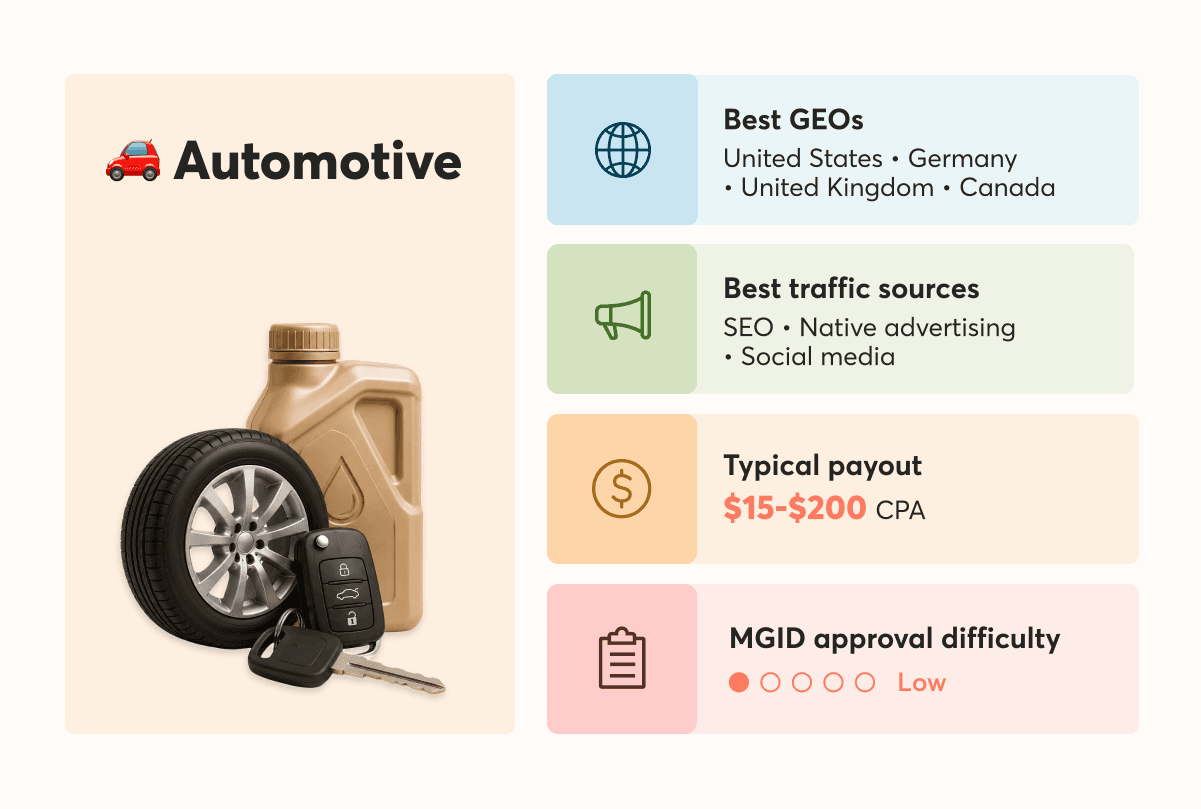
The automotive vertical splits into two very different buyer types, and knowing which one you are targeting changes everything about how you run campaigns. Enthusiast buyers — people researching performance upgrades, aftermarket parts or specific vehicle models — respond well to detailed technical content and community-driven recommendations. Practical buyers — people comparing insurance quotes, looking for maintenance services or evaluating car rentals — want straightforward comparisons and clear pricing information.
The vertical covers everything from auto parts and accessories to insurance, financing and vehicle marketplaces, but campaigns that try to speak to both audiences at once rarely perform as well as those built around one specific intent.
Popular Sub-Verticals
- Auto parts and accessories: Tires, batteries, brakes, filters, performance upgrades and vehicle accessories.
- Car care and maintenance: Oil changes, detailing products, car washes and maintenance services.
- Automotive tools and equipment: Diagnostic tools, repair equipment and accessories for professionals and DIY enthusiasts.
- Vehicle sales and rentals: Dealerships, car marketplaces, leasing programs and rental services.
- Automotive insurance and financing: Vehicle insurance, auto loans, warranties and financing solutions.
Best GEOs
Automotive campaigns tend to perform best in markets with high vehicle ownership rates and strong consumer spending on transportation, maintenance and vehicle upgrades.
- United States: One of the world's largest automotive markets, with strong demand for parts, accessories, insurance and vehicle services.
- Germany: A mature automotive market with high interest in performance upgrades, maintenance products, and vehicle financing.
- United Kingdom: Strong demand for car insurance, maintenance services and vehicle marketplaces.
- Canada: Consistent demand for automotive products, repair services and vehicle accessories.
- Australia: Large vehicle ownership base and growing interest in aftermarket products and upgrades.
Recommended Traffic Sources
Automotive campaigns can perform well across multiple acquisition channels, particularly when users are researching purchases, repairs or vehicle upgrades.
- Native advertising: Effective for product reviews, maintenance tips and comparison content.
- SEO: Strong channel for capturing users searching for parts, repairs, vehicle reviews and buying guides.
- Social media: Works well for visual content, car enthusiasts and vehicle-focused communities.
- Email marketing: Useful for promoting seasonal offers, maintenance reminders and repeat purchases.
Typical Payout Range
Automotive affiliate payouts vary depending on the product category and compensation model.
- Auto parts and accessories: 3%-12% revenue share
- Vehicle insurance: $20-$150 CPA
- Car rentals: $5-$50 CPA
- Vehicle financing and lead generation: $20-$200+ CPL/CPA
- Automotive services: $10-$100 CPA
Approval Difficulty on MGID
Low
Most automotive offers are straightforward to promote. Advertisers should ensure that pricing, performance claims and product specifications are accurate and clearly communicated.
MGID Tips on Automotive
When creating content for this vertical, focus on the following types:
- Build content around the two buyer types separately: Enthusiast content — model comparisons, performance upgrades, DIY maintenance guides — attracts high-intent users who spend time researching before buying. Practical buyer content — insurance comparisons, rental options, service cost breakdowns — needs to be concise and answer specific questions quickly. Mixing the two in one piece of content typically serves neither audience well.
- Compatibility and fitment details matter more in automotive than in almost any other vertical: Auto parts buyers need to know whether a product works with their specific make, model and year before they will consider purchasing; content that addresses this directly reduces bounce rates and increases conversion quality significantly.
- Seasonal timing drives predictable demand spikes: Tire and battery searches peak before winter in colder markets, car rental demand rises around holidays and insurance comparison traffic increases at policy renewal periods. Building a content calendar around these patterns is more reliable than reacting to them after they peak.
- For insurance and financing offers, lead generation quality matters more than volume: Automotive advertisers in these sub-verticals track approvals and funded applications downstream; sending high volumes of mismatched leads erodes the relationship faster than low volume with strong intent signals.
- Video outperforms static in this vertical more than most: Engine sounds, road test footage and installation walkthroughs communicate product quality in ways that images and text cannot, particularly for parts, accessories and vehicle reviews targeting enthusiast audiences.
MGID Success Story
Toyota Malaysia set concrete targets for a Corolla Cross HEV campaign: 4.6 million impressions and around 7,000 clicks over five weeks. MGID ran a two-stage approach, building awareness first and then pushing traffic, with multiple creative formats tested in parallel. Short-loop video creatives pulled ahead of static formats early in the campaign and drove the results that mattered: 10.5 million impressions, more than double the original target, and 13,600 clicks, nearly twice the KPI. For automotive campaigns promoting new models, the gap between video and static performance here is worth factoring into creative planning from the start.
eCommerce
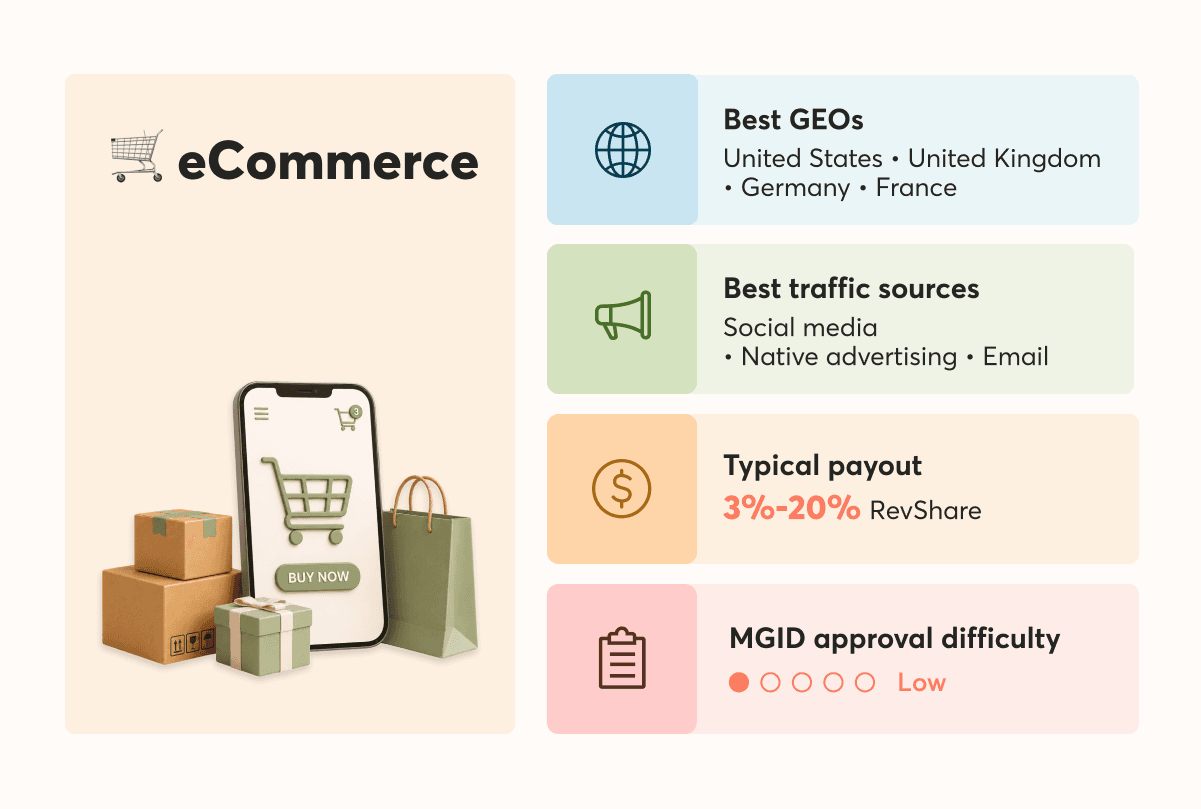
eCommerce is the most accessible affiliate vertical to enter and one of the hardest to scale profitably. Commission rates are lower than in Finance or Health & Beauty, competition for audience attention is intense, and consumers have more options than ever to compare prices before buying.
What makes it work is volume and precision: affiliates who identify specific product categories with strong demand, build content that captures purchase intent at the right moment and optimize consistently tend to do well here even with thin margins. The vertical covers everything from fashion and electronics to home goods, beauty and niche consumer products, across both global marketplaces and direct-to-consumer brands.
Popular Sub-Verticals
- Fashion and apparel: Clothing, footwear, accessories and luxury fashion brands.
- Consumer electronics: Smartphones, laptops, gaming devices, smart home products and accessories.
- Home and garden: Furniture, décor, kitchen products, gardening tools and household essentials.
- Beauty and personal care: Cosmetics, skincare, grooming products and wellness items.
- Specialty and niche products: Hobby, pet, fitness and other category-specific consumer products.
Best GEOs
eCommerce campaigns tend to perform best in markets with high online shopping adoption, strong digital payment infrastructure, and established consumer trust in online retailers.
- United States: One of the world's largest eCommerce markets, with demand across virtually every product category.
- United Kingdom: High online shopping penetration and strong affiliate ecosystem.
- Germany: Mature eCommerce market with strong consumer purchasing power.
- Canada: Consistent demand for online retail and subscription-based products.
- Australia: High adoption of online shopping and growing direct-to-consumer brands.
- France: Strong demand across fashion, beauty, electronics and home goods categories.
Recommended Traffic Sources
eCommerce campaigns can perform well across multiple acquisition channels, with the best-performing source often depending on the product category and audience intent.
- Native advertising: Effective for product recommendations, gift guides and comparison content.
- Social media: Ideal for visual products, impulse purchases and brand discovery.
- SEO: Strong channel for product reviews, buying guides and comparison searches.
- Email marketing: Particularly effective for promotions, abandoned cart recovery, product launches and repeat purchases.
Typical Payout Range
eCommerce affiliate payouts vary significantly by product category and commission structure.
- Consumer products: 3%-20% revenue share
- Fashion and apparel: 5%-20% revenue share
- Electronics: 1%-8% revenue share
- Subscription-based products: $5-$100+ CPA
- Direct-to-consumer brands: typically 5%-20% revenue share
Approval Difficulty on MGID
Low
Most eCommerce offers are straightforward to launch and scale. Advertisers should ensure product information, pricing, discounts, and promotional claims remain accurate and up to date.
MGID Tips on eCommerce
Competition in the eCommerce vertical is high, making creative differentiation especially important. The following practices can help improve campaign performance:
- Niche down before scaling up: Broad eCommerce campaigns competing across multiple product categories rarely outperform focused ones. Affiliates who build authority in a specific category, such as outdoor gear, pet products or home organization, tend to achieve better SEO rankings, stronger audience targeting and higher conversion rates than those promoting everything at once.
- Comparison and gift guide content converts better at the bottom of the funnel than product-focused ads: Users who are close to purchasing want to know how one product stacks up against alternatives, what real buyers experienced and whether the price is competitive; content that answers those questions directly captures intent more effectively than promotional messaging.
- Seasonal campaigns need earlier preparation than most affiliates plan for: Black Friday content that goes live in November is already too late for SEO, and even paid campaigns benefit from audience warming in the weeks before peak periods. Building a content and campaign calendar three to four months ahead of major shopping events consistently outperforms reactive approaches.
- Email automation is the highest-ROI channel in eCommerce and the most underutilized by affiliates: Welcome sequences, abandoned cart reminders and post-purchase flows generate revenue from traffic that has already been acquired; adding these to an existing campaign requires minimal incremental budget but meaningfully improves overall returns.
- For native advertising, lead with context rather than product: Creatives framed around a problem, a seasonal need or a specific use case consistently outperform straightforward product shots, particularly for impulse and discovery purchases where the user was not actively searching for the item.
MGID Success Story
Domino's goal in Indonesia was straightforward: move users from ad to online order with as little friction as possible. The campaign on MGID leaned into food imagery that made the product the immediate focus, paired with direct CTAs that skipped consideration entirely and pushed for action. At a market where digital ordering was still building consumer habit, the economics needed to work: the campaign delivered more than 160,700 clicks at an average CPC of $0.03 and a CTR of 0.71%, proving that native advertising could serve as a cost-efficient acquisition channel for a high-frequency, low-consideration purchase category.
Emerging Affiliate Marketing Verticals in 2025–2026
Established verticals are profitable but crowded. The affiliates who built authority in Finance or Health & Beauty five years ago had a structural advantage that is much harder to replicate today: higher traffic costs, more sophisticated competition and stricter compliance requirements have raised the barrier to entry significantly.
The three verticals below are at an earlier stage of that curve. Competition is lower, CPMs are more accessible and the content landscape has not yet been saturated by experienced players. The trade-off is less historical data to optimize against and, in some cases, offer availability that is still catching up with audience demand.
AI Tools
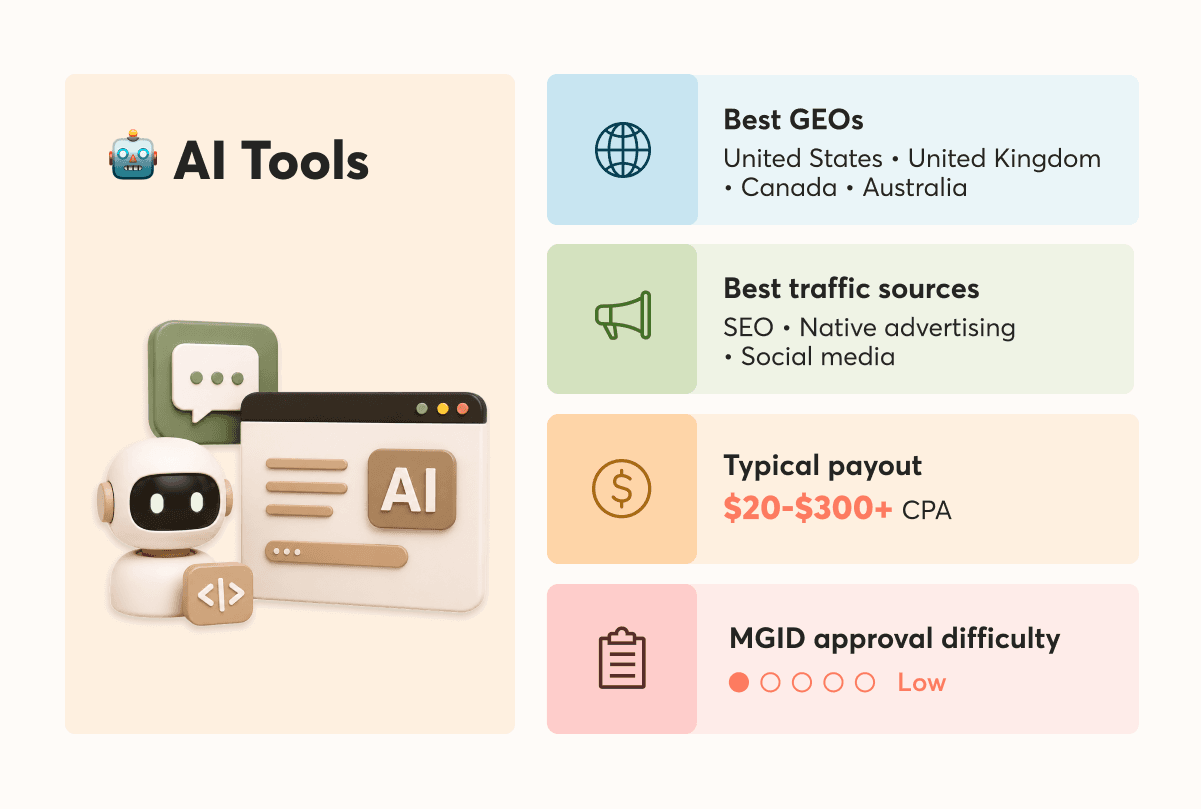
AI Tools is unusual among affiliate verticals because the product sells itself to an audience that is already actively looking for it. Most software buyers arrive with a specific problem — they need to write faster, generate images, automate a workflow or debug code — and are comparing options before they commit to a subscription. That makes review and comparison content exceptionally effective here, and it explains why SEO is the dominant acquisition channel in this vertical right now.
The challenge is that the landscape is moving fast: tools that led category searches six months ago are being displaced by newer entrants, which means content requires more frequent updating than in more stable verticals.
Popular Sub-Verticals
- AI writing tools: Content generation, copywriting and editing platforms.
- AI image and video generators: Creative tools for visual content production.
- AI productivity software: Meeting assistants, note-taking tools and workflow automation.
- AI coding assistants: Development and programming support platforms.
- AI business solutions: Customer service, analytics and enterprise automation tools.
Best GEOs
AI Tools campaigns tend to perform best in markets with high digital adoption and strong demand for productivity and business software.
- United States: Largest market for AI software adoption across both B2C and B2B segments.
- United Kingdom: Strong demand for productivity and automation solutions.
- Canada: Growing adoption of AI-powered business tools.
- Australia: High acceptance of SaaS and subscription-based software.
- Germany: Increasing investment in AI solutions for business efficiency.
Recommended Traffic Sources
AI Tools campaigns can perform well across multiple acquisition channels, particularly when users are actively researching solutions and comparing software options.
- SEO: Highly effective for software reviews, comparisons and educational content.
- Native advertising: Works well for product explainers, use cases and industry insights.
- Social media: Effective for demonstrating product capabilities through short-form content.
- Email marketing: Useful for nurturing leads and promoting free trials.
Typical Payout Range
- SaaS subscriptions: 20%-50% revenue share
- Free trial signups: $5-$50 CPA
- Premium software subscriptions: $20-$300+ CPA
Approval Difficulty on MGID
Low
AI Tools are generally easy to launch and scale on MGID, particularly when promoting legitimate software products and SaaS solutions. Advertisers should ensure that claims around automation, performance improvements or cost savings are realistic and supported by the product's actual capabilities.
MGID Tips on AI Tools
AI buyers are typically looking for efficiency, cost savings or improved productivity. Consider the following recommendations:
- Build content around specific use cases, not product features: A reader searching for an AI writing tool wants to know whether it can draft a product description in their brand voice, not how many parameters the model has. Tutorials and workflow demonstrations that show the tool solving a real problem convert significantly better than feature-focused overviews.
- Comparison content is the highest-intent format in this vertical: Users evaluating AI tools almost always search for head-to-head comparisons before committing to a paid plan. Articles that directly compare two or three tools on specific criteria consistently capture that traffic and convert it at higher rates than single-product reviews.
- Free trial and freemium offers reduce friction enough to meaningfully change conversion rates: Most AI tools offer some form of free access, and leading with that in creatives and CTAs lowers the commitment threshold for users who are still evaluating options.
- Plan for faster content decay than in other verticals: AI tools update pricing, features and free tier limits frequently, and new entrants can displace established tools in category searches within months. Content that was accurate six months ago may now be sending traffic to outdated comparisons, which damages both conversion rates and credibility.
- Monitor for free alternatives that emerge after you build content around a paid tool: The AI tools market regularly produces capable free or open-source alternatives to established paid products. When that happens, conversion rates on existing content drop quickly and the content angle needs to shift to address the new competitive reality.
Sustainable Products
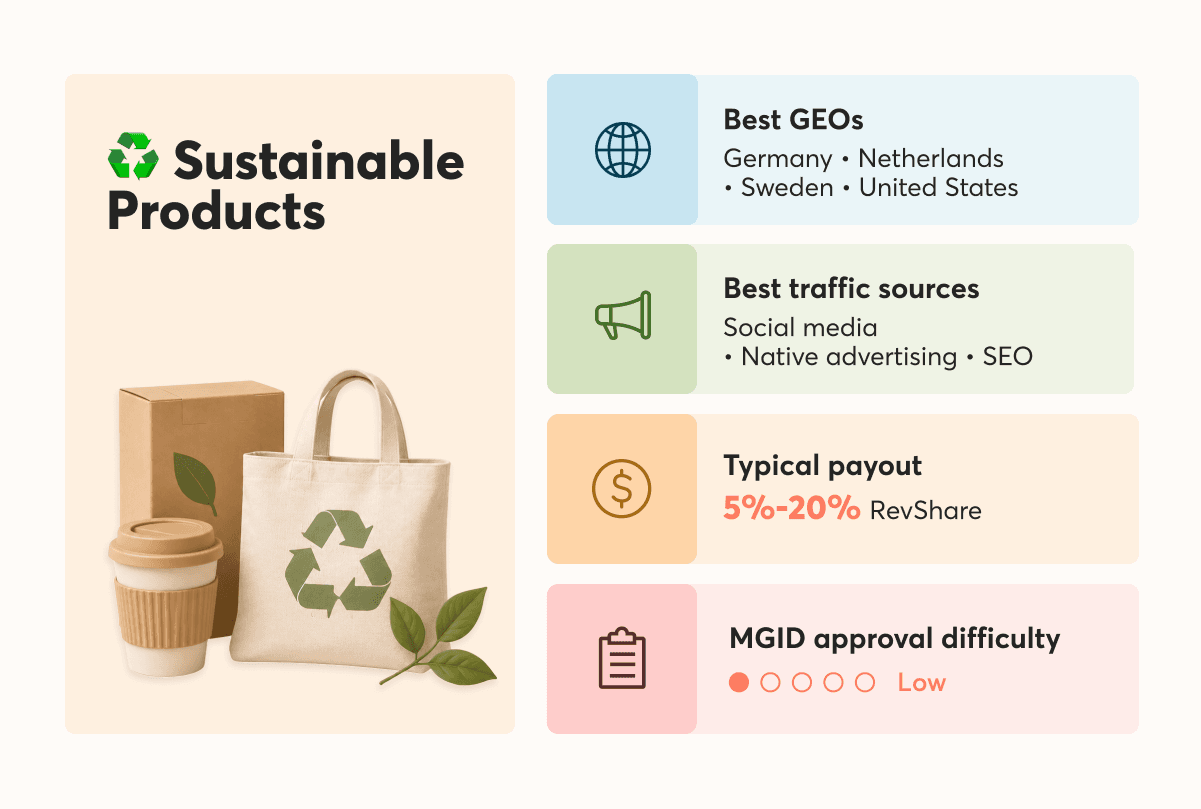
Sustainable Products is a vertical where audience trust is harder to earn and easier to lose than almost anywhere else. Consumers who actively seek out eco-friendly products tend to research brands carefully, scrutinize environmental claims and respond negatively to anything that reads as greenwashing, which means the usual affiliate playbook of bold claims and urgency-driven CTAs actively backfires here.
What works instead is transparent, educational content that helps buyers understand what they are actually getting and why it matters. The vertical spans eco-friendly household products, sustainable fashion, energy-efficient solutions, zero-waste alternatives and natural personal care, with strongest demand in Northern Europe and growing interest in the US market.
Popular Sub-Verticals
- Eco-Friendly Household Products: Reusable kitchen items, cleaning products and sustainable home essentials.
- Sustainable Fashion: Ethically sourced clothing, footwear and accessories.
- Energy-Efficient Solutions: Smart thermostats, solar products and energy-saving devices.
- Reusable and Zero-Waste Products: Refillable containers, reusable bottles and waste-reduction solutions.
- Eco-Friendly Personal Care: Natural skincare, cosmetics and personal hygiene products.
Best GEOs
Sustainable Products campaigns tend to perform best in markets where environmental awareness influences purchasing decisions and consumers are willing to pay a premium for eco-friendly alternatives.
- Germany: One of Europe's strongest sustainability-focused consumer markets.
- Netherlands: High adoption of environmentally conscious products and services.
- Sweden: Strong consumer preference for sustainable brands and ethical sourcing.
- Denmark: High awareness of environmental issues and green consumption.
- United Kingdom: Growing demand for eco-friendly alternatives across multiple product categories.
- United States: Large and diverse market with increasing interest in sustainable living.
Recommended Traffic Sources
Sustainable Products campaigns can perform well across multiple acquisition channels, particularly when consumers are researching product quality, environmental impact and long-term value.
- Native advertising: Effective for educational content, product comparisons and sustainability-focused storytelling.
- Social media: Ideal for visually showcasing products and communicating brand values.
- SEO: Strong channel for buyers researching eco-friendly alternatives and sustainable lifestyles.
- Email marketing: Useful for building brand loyalty and promoting repeat purchases.
Typical Payout Range
Compensation models vary by product category and merchant program.
- Sustainable consumer products: 5%-20% revenue share
- Eco-friendly subscriptions: $10-$75 CPA
- Energy-efficient solutions: $20-$150 CPA
- Premium sustainable brands: typically 5%-15% revenue share
Approval Difficulty on MGID
Low
Most Sustainable Products offers are straightforward to promote on MGID. Advertisers should ensure that environmental claims are accurate and supported by evidence, avoiding exaggerated or misleading statements about sustainability benefits.
MGID Tips on Sustainable Products
Consumers interested in sustainability often research products carefully before purchasing. The following practices can help improve campaign performance:
- Lead with specific, verifiable claims rather than broad environmental language: Phrases like "eco-friendly" and "sustainable" have been so overused that they no longer move buyers in this vertical. Concrete statements about materials, manufacturing processes, certifications and measurable environmental impact do. Content that explains exactly how a product reduces waste or saves energy consistently outperforms content built around generic green messaging.
- Certifications and third-party verification are more persuasive than brand claims alone: Buyers in this vertical actively look for evidence that environmental claims are legitimate. Highlighting recognized certifications, ethical sourcing standards and transparent supply chain information builds the kind of credibility that generic sustainability language cannot.
- Compare sustainable alternatives directly against conventional products on total cost of ownership, not just purchase price: Many eco-friendly products cost more upfront but deliver savings over time through durability, reduced consumption or lower operating costs. Content that makes this calculation explicit addresses the most common objection before the buyer raises it.
- Greenwashing accusations can damage campaign performance quickly: If a brand's environmental claims are contested or exaggerated, user comments, social sharing and review content will reflect that, and affiliates promoting those offers inherit the credibility problem. Vetting the brands you promote in this vertical matters more than in most others.
- Tailor messaging to what sustainability means in each market: German and Dutch consumers tend to prioritize measurable environmental impact and product lifecycle. US audiences more often respond to health, safety and ingredient transparency angles. Scandinavian markets respond strongly to ethical sourcing and fair trade narratives. The same product needs different content framing across these GEOs to perform well.
Digital Finance
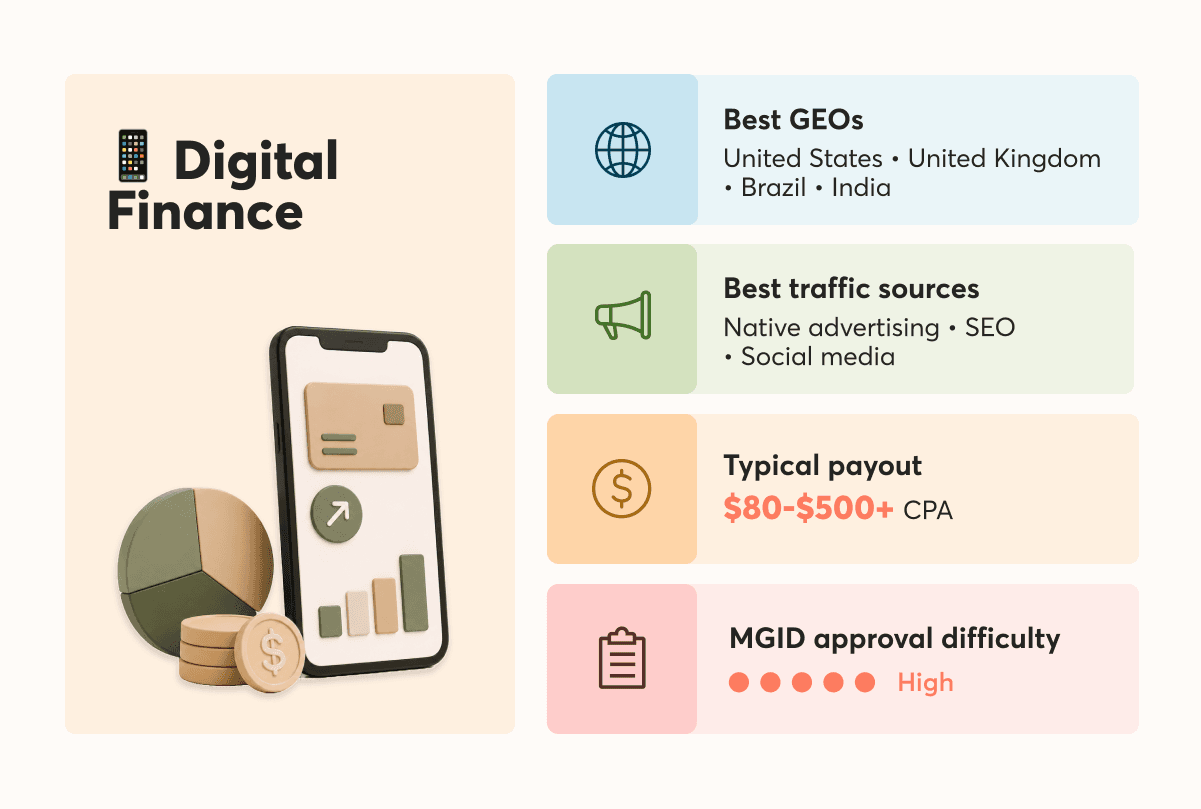
Digital Finance and traditional Finance cover similar products but attract meaningfully different audiences, and that difference shapes everything about how campaigns need to be built. Traditional finance buyers tend to be older, more deliberate and more responsive to credibility signals like brand recognition and regulatory backing.
Digital Finance audiences skew younger and mobile-first, make faster decisions and respond better to convenience, speed and peer recommendations than to institutional authority. That audience profile means social and native advertising work particularly well here, and it also means that trust needs to be built differently, through transparency about fees, security and user experience rather than through brand heritage or regulatory credentials.
Popular Sub-Verticals
- Neobanks: Digital-first banking platforms offering checking accounts, debit cards and financial management tools.
- Investment apps: Stock trading, robo-advisors and wealth management platforms.
- Digital wallets and payments: Mobile payment apps and online payment solutions.
- Buy now, pay later (BNPL): Flexible payment services for online and offline purchases.
- Personal finance apps: Budgeting, expense tracking and financial planning tools.
Best GEOs
Digital Finance campaigns tend to perform best in markets with high fintech adoption, strong digital infrastructure, and consumers who are comfortable managing finances online.
- United States: One of the largest fintech markets globally, with strong adoption of digital banking and investing platforms.
- United Kingdom: A mature fintech ecosystem with high demand for digital financial services.
- Germany: Growing adoption of digital banking and investment solutions.
- Brazil: Rapid growth in fintech and mobile banking usage.
- Mexico: Expanding digital payments ecosystem and growing fintech sector.
- India: Large mobile-first population driving adoption of digital financial products.
Recommended Traffic Sources
Digital Finance campaigns can perform well across multiple acquisition channels, particularly when users are actively researching financial solutions and comparing available options.
- Native advertising: Effective for educational content, comparisons and product explainers.
- SEO: Strong channel for high-intent users researching financial products and services.
- Social media: Particularly effective for fintech brands targeting younger audiences.
- Email marketing: Useful for nurturing leads and promoting long-term engagement.
Typical Payout Range
Digital Finance is among the highest-paying affiliate verticals.
- Digital banking products: $50-$250 CPA
- Investment platforms: $100-$500+ CPA
- Fintech apps: $20-$150 CPA
- BNPL and payment services: $20-$100 CPA
Approval Difficulty on MGID
High
Digital Finance campaigns are subject to many of the same compliance requirements as traditional financial products. Advertisers should ensure that claims regarding savings, earnings, investing outcomes or financial benefits are accurate, transparent, and compliant with local regulations.
MGID Tips on Digital Finance
Trust and transparency are critical in the Digital Finance vertical. The following practices can help improve campaign performance:
- Lead with fees, limits and real user experience rather than product benefits: Digital Finance audiences are skeptical of promotional messaging and will check independent reviews before signing up. Content that addresses the questions users actually ask, including hidden fees, withdrawal limits and customer support quality, builds more trust than benefit-focused advertising.
- Comparison content needs to go deeper than feature lists: Neobank and investing app buyers want to know how products perform under specific conditions: what happens when you dispute a transaction, how long withdrawals actually take, whether the app works reliably during high-traffic periods. Content that answers those questions captures high-intent users that generic comparisons miss.
- Referral programs and signup bonuses are unusually strong conversion drivers in this vertical: Many Digital Finance products offer cash bonuses, fee waivers or premium features for new account openings. Leading with these incentives in creatives and CTAs consistently outperforms benefit-focused messaging for cold audiences.
- App store ratings and user reviews influence conversion more in Digital Finance than in traditional finance: Younger audiences check ratings before downloading financial apps as a matter of habit. If the product you are promoting has significant negative review patterns, that will surface in user research and affect downstream conversion rates regardless of how strong your content is.
- Compliance requirements mirror traditional Finance, but the enforcement landscape is evolving faster: Regulations around BNPL disclosures, crypto-adjacent products and investment app marketing are actively changing in most major markets. Building a compliance review step into your workflow before launching in a new GEO is not optional in this vertical.
Affiliate Marketing Verticals by Payout
While payout potential shouldn't be the only factor when choosing a vertical, it remains one of the most important considerations for affiliates. The chart below compares the typical payout ranges across the most popular affiliate marketing verticals.
| Vertical | Typical payout |
|---|---|
| Digital Finance | $80-$500 CPA |
| Finance | $50-$300 CPA |
| AI Tools | $20-$300 CPA |
| Health & Beauty | $20-$120 CPA |
| Home Security & Home Improvement | $20-$200 CPA |
| Automotive | $15-$200 CPA |
| Travel | $5-$80 CPA |
| Sustainable Products | 5%-20% RevShare |
| eCommerce | 3%-20% RevShare |
As expected, Finance and Digital Finance tend to offer the highest payouts, while eCommerce and Travel often compensate for lower commissions with broader audiences and higher conversion potential.
Affiliate Marketing Verticals FAQ
What are the best affiliate marketing verticals in 2026?
Finance and Digital Finance lead on payout per conversion. eCommerce and Travel offer broader audiences with lower compliance friction. AI Tools and Digital Finance are still early enough that content authority can be built before the vertical saturates.
Which affiliate marketing vertical makes the most money?
Finance and Digital Finance pay the most per conversion: investment platforms and loan offers regularly reach $100–$500 CPA. That said, traffic costs and compliance overhead are also the highest of any vertical, so raw payout figures do not tell the full profitability story.
What is the easiest affiliate marketing vertical for beginners?
eCommerce has the lowest barrier to entry: approvals are straightforward, offers are widely available and most traffic sources work depending on the product. Travel is a strong second option for affiliates who already create destination or experience content, because the content and the offer align naturally.
What affiliate marketing vertical works best with native advertising?
Health & Beauty, Finance, Home Improvement and Digital Finance are the most proven fits for native. All four reward educational and comparison content, which is exactly what the format does best. Travel also performs well when creatives lead with destination rather than price.
How do I choose the right affiliate marketing vertical?
Start with your traffic source, not the vertical. SEO favors Finance, AI Tools and Travel. Native advertising works best for Health & Beauty, Finance and Home Improvement. Social aligns most naturally with eCommerce and Sustainable Products. Matching a vertical to a channel you already know how to run is a faster path than the reverse.
Conclusion
There’s no universally “best” affiliate vertical. The one that works for you is the one where the pieces line up: a traffic source you understand, an offer people actually want and economics that leave enough room to test, learn and scale.
That might mean taking on the complexity of Finance, starting with the accessibility of eCommerce or moving early in AI Tools before the space gets more crowded. What matters is not chasing the vertical that looks best on a comparison table, but finding the one you can actually execute well.
If you're running campaigns on MGID, use the GEOs, traffic approaches and vertical insights above as a starting point, then put them to the test. Pick a vertical, get it in front of real traffic and let the data tell you whether you've found your opportunity.