Updated: September 2026
An affiliate link can disappear in a scroll. A good email gives people a reason to come back to it.
Affiliate email marketing gives you time to develop interest in an offer across several touchpoints. Someone can join your list for a useful resource, learn from the next few emails and encounter the affiliate recommendation when it actually fits the conversation.
Making that journey work takes more than a persuasive pitch. You need relevant subscribers, smart segmentation, useful content and a sequence that moves naturally toward the offer — all while staying within the rules of your affiliate program and email provider.
- What Is Affiliate Email Marketing?
- How Does Affiliate Email Marketing Work?
- Before You Promote an Affiliate Offer by Email, Check These Five Things
- Affiliate Email Marketing Compliance: Permission and Disclosure
- How to Build an Email List for Affiliate Marketing
- Segment Your Affiliate Email List
- A Five-Email Affiliate Marketing Sequence Example
- How to Write Affiliate Emails People Actually Want to Read
- How Often Should You Send Affiliate Emails?
- Affiliate Email Deliverability in 2026
- How to Measure Affiliate Email Marketing Performance
- What About Email Marketing Affiliate Programs?
- Affiliate Email Copy Review Checklist
- Affiliate Email Marketing FAQ
What Is Affiliate Email Marketing?
There is one distinction worth making early. Affiliate email marketing is not the same as joining an email marketing software affiliate program. The first means using email to promote affiliate offers as part of a broader affiliate marketing strategy. The second means referring customers to platforms such as GetResponse or other email tools and earning a commission from the software company. This article is about the first.
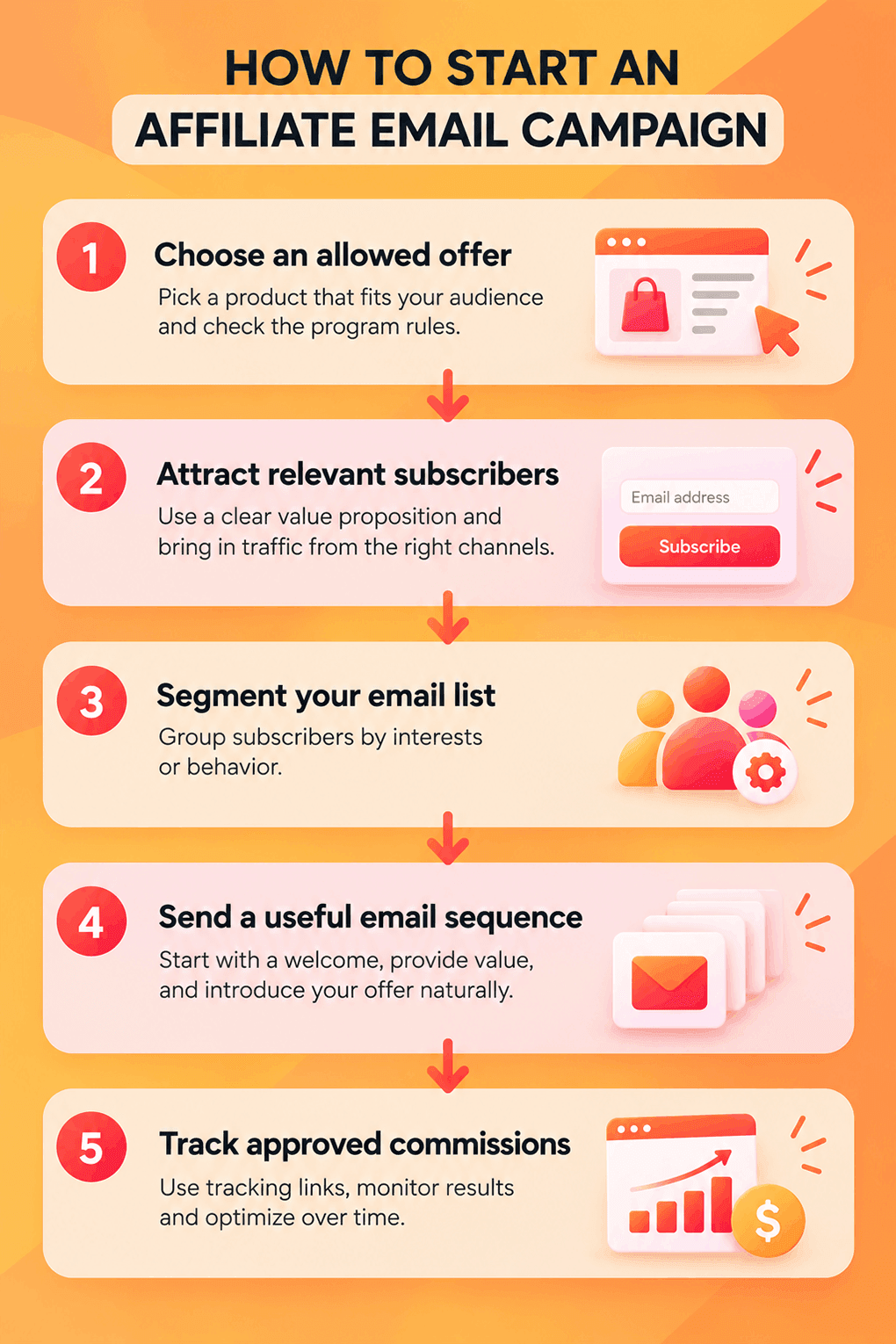
Starting an affiliate email marketing campaign comes down to five basic steps:
- Choose an offer you can promote by email: Check the affiliate terms before building a campaign around it. Finding out after the third email that your traffic source is prohibited is not an exciting plot twist.
- Attract relevant subscribers: Give people a reason to opt in instead of treating an email address as permission by default.
- Segment the list: Signup source, interests and previous behavior can tell you far more than simply knowing that someone is “a subscriber.”
- Send useful content: Build toward the recommendation with information that helps people understand the problem, the options and where the offer fits.
- Measure approved commissions: A reported sale is not necessarily money earned. Track approvals and reversals alongside clicks and conversions to see what the campaign actually produced.
That sounds simple enough. The interesting part is what happens between finding the audience and getting a commission — and where email actually enters the picture.
How Does Affiliate Email Marketing Work?
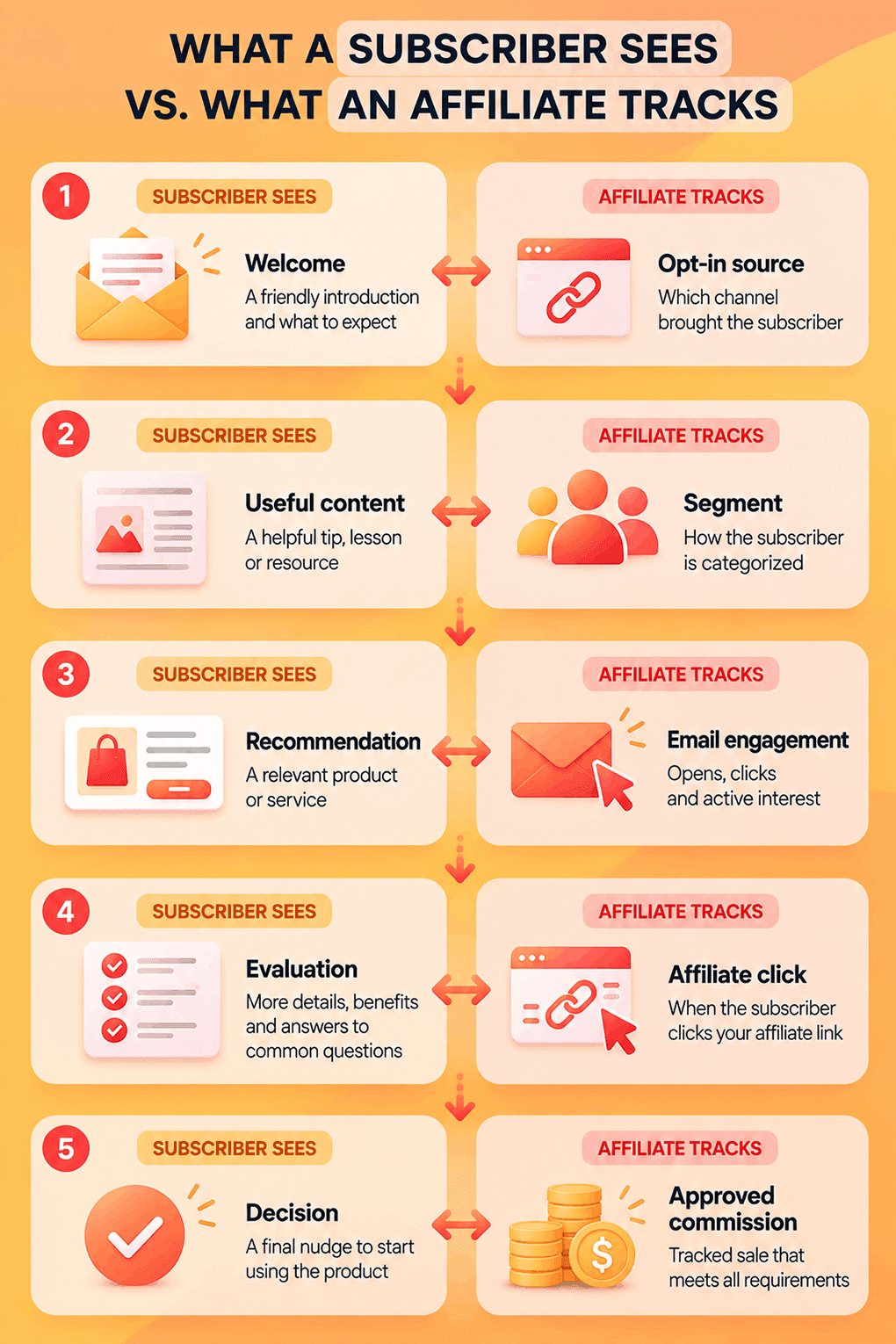
Affiliate email marketing rarely starts in the inbox. First, someone has to find you, have a reason to share their email address and actively join your list. Only then does email take over.
The path usually looks like this:
Traffic can come from search, social media, paid ads, a blog or other channels where you promote affiliate links. Instead of asking every visitor to buy immediately, you can direct them to a relevant landing page, useful resource or newsletter and give them the option to subscribe.
From there, each email has a job. One may deliver the resource that brought the subscriber in, another can help solve a related problem and a later message can introduce an affiliate product when there is a genuine reason to recommend it. Dropping the same link into every email is technically a sequence too, just not a particularly clever one.
The funnel does not quite end at the sale notification either. Refunds, cancellations and program rules can still affect the payout, which is why we’ll ultimately measure approved commission rather than just recorded conversions.
Before You Promote an Affiliate Offer by Email, Check These Five Things
Finding an offer that looks good is the easy part. Before writing a sequence around it, make sure you can actually promote it to this audience, through this email provider and under the affiliate program’s rules.
| Check | What to verify |
|---|---|
| 1. Email promotion is allowed | Check whether the affiliate program permits links or promotions in email. Some programs restrict specific traffic sources or require additional approval. |
| 2. Your email provider allows the content | Affiliate links may be permitted under certain conditions without giving you free rein to build an entire account around affiliate promotions. Check the provider’s current policy. |
| 3. The offer fits the audience | Look at why people joined your list and what they expected to receive. A technically permitted offer can still be a spectacularly bad recommendation. |
| 4. You understand payout eligibility | Check which actions qualify for commission, how attribution works and when a conversion becomes approved. |
| 5. You know the exclusions | Look for restrictions involving GEOs, products, promotional methods, coupons, paid traffic or other sources before launching the campaign. |
Having a list of email addresses does not automatically mean you have permission to market to them.
The same caution applies to your email service provider. Do not assume that because an affiliate program allows email, your provider will accept every type of affiliate campaign. For example, Kit explains how affiliate links can be used under its Acceptable Use Policy, while MailerLite distinguishes affiliate links from affiliate marketing in its Terms of Service.
Read both the affiliate program and provider rules before sending, preferably before spending an afternoon writing five emails for a campaign you cannot launch.
Once the offer and provider rules check out, there is one more thing to settle before building the list: are you actually allowed to market to the people on it?
Affiliate Email Marketing Compliance: Permission and Disclosure
Affiliate email marketing comes with two separate responsibilities that are easy to throw into one vague “stay compliant” bucket: you need a valid basis for sending the email, and readers need to understand when you may benefit financially from the recommendation.
Get Permission Before You Send
The exact requirements depend on where your subscribers are located and which laws apply. An opt-in gives people a clear choice to hear from you and gives you a much stronger foundation for affiliate email marketing than addresses collected, scraped or purchased elsewhere.
Your signup process should make it clear what people are subscribing to, and marketing emails should include an easy way to unsubscribe. Keep records of consent where applicable, especially when your campaigns cover multiple markets.
A purchased list deserves extra caution. Paying for a database does not automatically transfer the recipients’ permission to you.
Make the Affiliate Relationship Obvious
If you may earn a commission from a recommendation, disclose that relationship clearly. The disclosure should be easy to understand and placed close enough to the recommendation or affiliate link that readers can immediately understand the relationship.
Plain language is enough:
- I may earn a commission if you purchase through this link.
- This email contains affiliate links. I may receive a commission from qualifying purchases.
- I’m an affiliate for [Brand], so I may earn a commission if you sign up through my link.
Where applicable, follow the disclosure requirements of the relevant regulator and affiliate program.
Compliance rules vary by jurisdiction. Check the requirements that apply to the markets you actually email rather than assuming one set of rules covers everyone. Our guide to data privacy and compliance in affiliate marketing takes a closer look at consent, data handling and the rules affiliates need to consider.
With the permissions and disclosure side covered, you can start building the audience itself.
How to Build an Email List for Affiliate Marketing
A useful affiliate email list is not simply a large collection of addresses. What matters is why those people subscribed in the first place. If someone joins for meal-planning tips, a kitchen-related offer has context. A random business software deal probably does not, however generous the commission looks.
A useful opt-in naturally leads somewhere:
| Opt-in | What it tells you | Natural direction for future offers |
|---|---|---|
| Checklist or guide | The subscriber is trying to solve a specific problem | Tools or products that help with the next step |
| Newsletter | They want ongoing information about a topic | Relevant products introduced within regular content |
| Free course | They are willing to spend time learning a skill | Software, services or resources used in the process |
| Template or tool | They want to complete a particular task | Products that make that task easier or more advanced |
| Community access | They have sustained interest in the niche | Offers closely connected to common community needs |
Where Do the Subscribers Come From?
Search, social media, an existing website and paid traffic for affiliate marketing can all feed the same opt-in funnel. Native advertising can also bring relevant audiences to a landing page or lead magnet, particularly when the goal is to introduce the topic before asking for an email address.
The important part is the hand-off:
Once subscribers are coming in, resist the temptation to treat them as one giant audience. The next step is deciding who should receive what.
Segment Your Affiliate Email List
Two people can join the same email list and have very different reasons for being there. One downloaded a beginner’s guide yesterday. Another has been reading your emails for six months and already clicked on several product recommendations. Sending them the same affiliate pitch ignores quite a lot of useful information.
For affiliate email marketing, the most useful segments are often based on intent and behavior, such as:
- Signup source: which page, lead magnet or campaign brought the subscriber in;
- Topic interest: what they signed up to learn about;
- Email engagement: which messages they open and click;
- Product interest: which categories, reviews or offers they have explored;
- Purchase history: whether they are new prospects or existing buyers.
You do not need twenty micro-segments before sending your first sequence. Start with distinctions that can genuinely change the message or offer. If two groups would receive exactly the same email anyway, creating separate labels for them is mostly database decoration.
Segmentation becomes particularly useful when the affiliate offer enters the sequence. A recommendation connected to something the subscriber has already shown interest in needs far less explaining and gives you a much better starting point for the emails themselves.
A Five-Email Affiliate Marketing Sequence Example
So what does an affiliate email sequence actually look like when every message has a reason to exist?
Imagine you run a newsletter for freelance designers. Subscribers joined after downloading your guide to managing client projects, and you want to promote an affiliate project-management tool you genuinely use. We’ll call it ProjectFlow. The offer permits email promotion, your email provider allows this type of affiliate content and the relationship is clearly disclosed once the recommendation enters the sequence.
Email 1: Welcome
Purpose: Deliver what the subscriber asked for and establish what your emails will be useful for.
Hi Maya,
Here’s the project checklist you requested.
One thing worth watching as you use it: most project chaos starts surprisingly early. A deadline lives in one document, feedback arrives in email and the latest file is apparently called FINAL_v7_really-final.pdf.
Over the next few emails, I’ll share a few ways to make that process less painful.
Download the checklist →There is no reason to smuggle the product into the welcome email just because you eventually want to sell it. The subscriber asked for a checklist. Give them the checklist.
Email 2: Useful Lesson
Purpose: Solve a small problem related to the eventual offer without turning the lesson into a sales pitch.
A project rarely becomes messy all at once. Usually, information starts leaking across three places: tasks, feedback and files.
A simple fix is to give each project one home. Keep the brief, deadlines, feedback and latest assets together, then decide where communication happens before the project starts.
I use the same setup for every new client. Here’s the short version you can copy.
See the workflow →The second email earns attention rather than cashing it in immediately. More importantly, it introduces the exact problem the eventual recommendation will need to solve.
Email 3: Product Evaluation
Purpose: Introduce the affiliate offer and help the subscriber judge whether it actually fits.
If your current system works, there is no prize for replacing it.
Once several clients are active at the same time, I find ProjectFlow useful for keeping deadlines, files and feedback in one place. The biggest advantage for me is the client view: clients can see what needs approval without digging through old email threads.
It will probably be overkill if you manage one small project at a time. For several overlapping projects, it’s worth a look.
See how ProjectFlow works →Disclosure: I’m a ProjectFlow affiliate, so I may earn a commission if you sign up through my link, at no extra cost to you.
The product finally appears in Email 3, along with a reason to consider it and a reason not to. Useful recommendations have edges. “Perfect for everyone” usually tells the reader very little.
Email 4: Objection Handling
Purpose: Address the question that may be stopping an interested subscriber from acting.
Possibly not.
If a spreadsheet and your inbox are handling the workload comfortably, keep them. The point is not to collect software subscriptions.
Where I started struggling was with three or four projects running simultaneously. I was spending more time finding feedback and checking which file was current than the tool eventually cost me.
If that sounds familiar, compare ProjectFlow with the system you use now. Look at the price, the features you would actually use and how much admin it could realistically remove.
Compare the plans →Disclosure: This email contains my affiliate link to ProjectFlow. I may receive a commission from qualifying purchases.
This email does not need another parade of benefits. The reader already knows what the product does. Now the useful question is whether the problem is expensive or annoying enough to justify paying for the solution.
Email 5: Follow-Up
Purpose: Give interested subscribers a simple next step without inventing a fake countdown clock.
A few people asked where to start if they want to try the setup from the previous emails.
I’d begin with one active client project rather than moving everything at once. Add the brief, next deadline and current files, then invite the client only when the workspace makes sense to you.
You’ll know fairly quickly whether it makes the work easier or simply gives you another tab to keep open.
Try ProjectFlow →Disclosure: If you decide to use ProjectFlow through my affiliate link, I may earn a commission at no additional cost to you.
Across five emails, the job changes from welcome → teach → evaluate → answer doubts → follow up. The CTA should change with it. “Download,” “see,” “compare” and “try” ask for different levels of commitment, which is more useful than pasting the same Buy now button under every message.
How to Write Affiliate Emails People Actually Want to Read
The easiest way to make an affiliate email sound like an affiliate email is to become suspiciously enthusiastic about everything. Suddenly every tool is a game-changer, every feature is incredible and every reader apparently needs to act right now.
Good affiliate email copy is more selective. It gives the reader enough information to understand what the product does, why it is relevant and whether it fits their situation. The commission should never require the recommendation to sound more certain than the evidence allows.
A few rules keep the copy grounded:
- Give each email one main job: Teaching, reviewing a product and handling an objection can belong to the same sequence without being squeezed into the same message.
- Start with the reader’s situation: “Managing feedback across five client projects gets messy” gives you somewhere useful to go. “I found an amazing tool!” mostly tells us that you found an amazing tool.
- Use specific claims you can support: Features, pricing, trial conditions and performance claims can change, so verify them before turning them into selling points.
- Explain who the offer is for: A recommendation becomes more credible when readers can also tell who probably does not need it.
- Make the next step obvious: The CTA should answer “what should I do now?” without asking for a bigger commitment than the email has earned.
For example:
Instead of:
ProjectFlow is an amazing tool that will completely transform the way you manage projects. Don’t miss out — try it today!
Try:
If client feedback keeps disappearing between email threads and shared docs, ProjectFlow puts the files, comments and deadlines in one workspace. It makes the most sense once you’re juggling several active projects.
The second version is still promotional. It simply gives the reader something useful to judge the product by.
The CTA deserves the same treatment. A reader who has just learned about a product may be ready to see how it works, while someone who has already compared the options may be ready to start a trial. Same offer, different moment, different ask.
And before clever copy gets too clever, read it once without thinking about conversions. If the email would sound ridiculous coming from a person you trust, another exclamation mark probably will not save it.
How Often Should You Send Affiliate Emails?
There is no magic number of days between affiliate emails. A five-email welcome sequence, a weekly newsletter and a three-day promotion are doing different jobs, so forcing them into the same schedule makes little sense.
For an Automated Sequence
Let the timing follow the reader’s journey. A welcome email can arrive immediately, while educational and product-focused messages need enough space for subscribers to read, click and consider what came before.
For an Ongoing Newsletter
Stick reasonably close to what people signed up for. Someone expecting a weekly newsletter should not discover that “weekly” somehow means four product recommendations before Friday.
For a Time-Sensitive Promotion
A shorter interval can make sense when there is a real deadline, such as an offer expiring or registration closing. The deadline should come from the offer itself, not from a countdown timer that miraculously resets tomorrow.
Whatever the cadence, watch what happens after you send. Falling engagement, rising unsubscribes and spam complaints can all signal that subscribers are hearing from you too often or that promotional emails are starting to crowd out the content they joined for.
Affiliate Email Deliverability in 2026
The clever subject line, perfectly timed offer and beautifully written CTA all become rather theoretical if the email lands in spam.
Deliverability deserves particular attention in 2026 because major mailbox providers have tightened sender requirements. For affiliate marketers, that makes a clean sending setup and a healthy list part of campaign performance, not background IT housekeeping.
Get the Technical Basics Right
At minimum, pay attention to:
- Email authentication: Set up SPF and DKIM for your sending domain, with DMARC required in some high-volume sending scenarios.
- Easy unsubscribing: Give people a clear way to leave the list. Making the unsubscribe link a treasure hunt is more likely to earn a spam complaint than save a subscriber.
- List quality: Remove invalid addresses and pay attention to chronically inactive subscribers instead of treating list size as a trophy.
- Complaint rates: A spike in spam reports is a warning about your sending practices, targeting or content.
- Consistent expectations: If people joined for design tutorials, a sudden stream of unrelated affiliate offers is a deliverability problem waiting to happen.
Google, for example, requires authentication for mail sent to personal Gmail accounts, with additional requirements for senders that send more than 5,000 messages per day to Gmail addresses. Bulk senders need SPF, DKIM and DMARC authentication and one-click unsubscribe for marketing messages. Google also recommends keeping user-reported spam rates below 0.1% and avoiding 0.3% or higher.
Deliverability Is Also an Audience Problem
Technical setup cannot rescue a list that never wanted the emails in the first place. Engagement, complaints and unsubscribes are influenced by who joined, what they expected and what you subsequently send them.
That brings the process back to the beginning: relevant acquisition, explicit opt-in and sensible segmentation are not separate from email performance. They help determine whether there is an audience willing to keep receiving the sequence at all.
How to Measure Affiliate Email Marketing Performance
Clicks are useful. Sales are better. Approved sales are what eventually pay you.
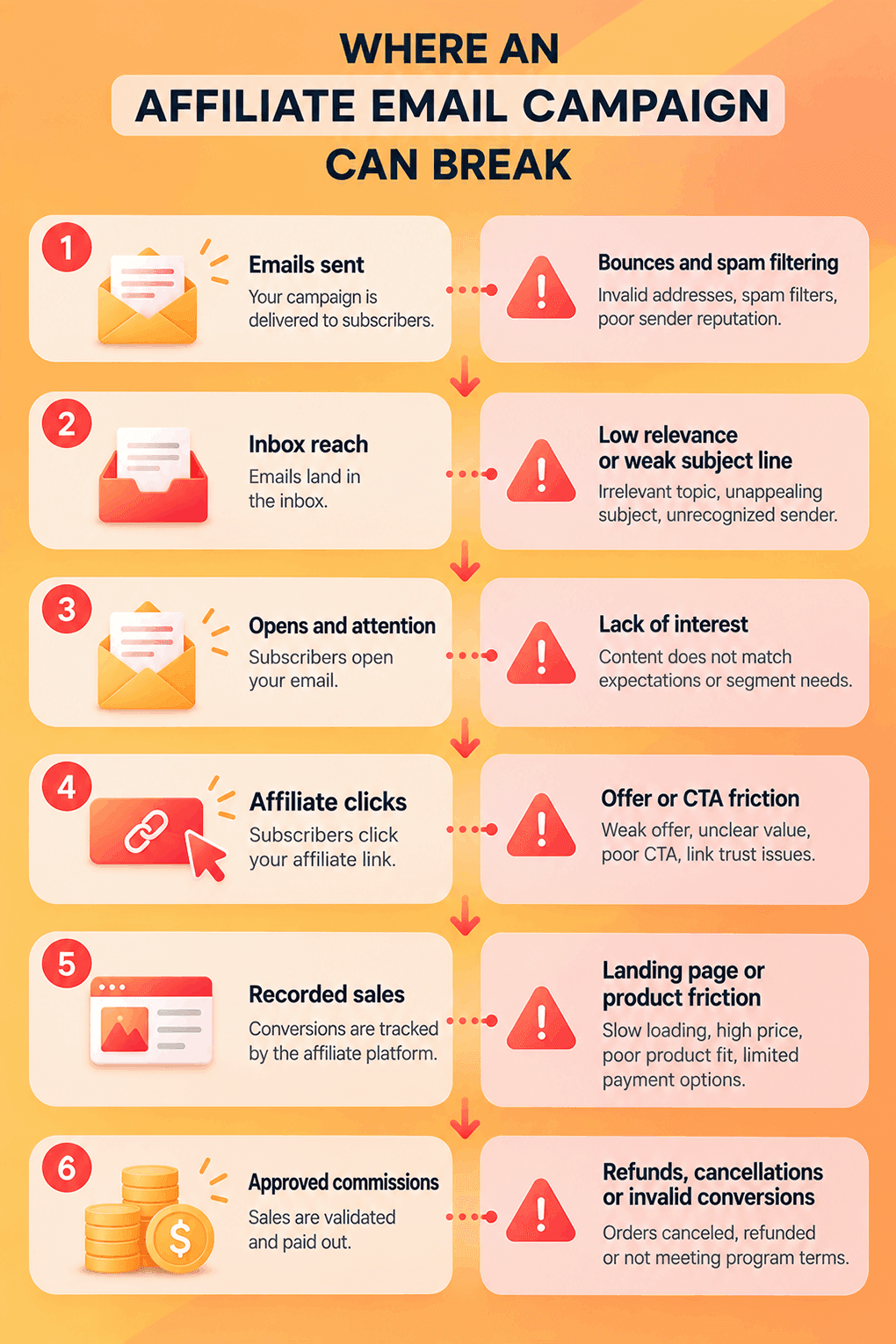
That distinction matters in affiliate email marketing because a conversion can appear in your reporting and later be reversed due to a refund, cancellation, invalid transaction or the affiliate program’s own approval rules. Looking only at clicks or recorded sales can therefore make a sequence look healthier than the final payout suggests.
A Worked Affiliate Email Reporting Example
Suppose one email sequence produces the following results. All figures below are illustrative.
- Delivered emails: 48,000
- Unique affiliate clicks: 2,400
- Recorded sales: 120
- Reversed sales: 10
- Approved sales: 110
- Commission per approved sale: $30
- Net commission: $3,300
Now the useful calculations become:
Unique click rate
2,400 ÷ 48,000 × 100 = 5%
This tells you how many delivered emails generated a unique click.
Click-to-approved-sale rate
110 ÷ 2,400 × 100 = 4.6%
This connects traffic from the email to the conversions that actually survived approval.
Reversal rate
10 ÷ 120 × 100 = 8.3%
A high reversal rate deserves investigation. More recorded sales will not help much if too many disappear before payout.
Net commission per delivered email
$3,300 ÷ 48,000 ≈ $0.07
This gives you a useful efficiency metric for comparing sequences, segments or offers without being distracted by list size alone.
Read the Numbers as a Funnel
The interesting part is not whether one metric is “good” in isolation. It is where the sequence starts leaking.
Low clicks may point toward the offer, copy, CTA or audience match. Plenty of clicks but few approved sales shift attention further down the funnel. Strong recorded sales followed by heavy reversals raises a different question entirely.
That is why affiliate reporting should connect email performance with affiliate-platform data. An inbox metric can tell you what happened before the click. It cannot tell you whether the commission survived afterward. The same principle applies across the campaign, which is why it helps to track the right affiliate marketing KPIs from traffic through to revenue.
What About Email Marketing Affiliate Programs?
There is another meaning hiding behind searches for “email marketing affiliate programs”: earning commission by referring customers to email marketing software itself.
That is a separate model from the one we have been discussing. Here, the email platform is the affiliate offer. GetResponse, Kit and beehiiv are current examples, but the same rule applies as with any other offer: audience fit matters more than an attractive percentage on the affiliate page.
GetResponse is a useful example of why checking current terms matters. Its affiliate program changed in 2026, so older articles citing a 120-day cookie and 33% lifetime recurring commission are now outdated. The current GetResponse affiliate program lists a 90-day referral window and commissions paid for the first 12 months:
- 40% at the starting tier;
- 50% after reaching 50 sales within 12 months;
- 60% after reaching 100 paying customers within 12 months.
Other platforms use different models: Kit (formerly ConvertKit) and beehiiv also run affiliate programs, with their own eligibility and commission rules.
The exact percentages are less important here than the habit: check the official affiliate terms before building a campaign around the payout. Cookie windows, eligibility rules and commission structures have an inconvenient tendency to change while old blog posts remain confidently online.
Affiliate Email Copy Review Checklist
Before an affiliate email goes out, give it one final read from the subscriber’s side of the inbox. By this point, another round of adjective polishing matters less than catching a mismatched offer, an unsupported claim or a CTA that asks the reader to do three things at once.
One final test is surprisingly effective: remove the affiliate link and read the email again. If the message becomes completely pointless without the possibility of earning a commission, it probably needs more value before it needs more optimization.
Affiliate Email Marketing FAQ
Can you put affiliate links in emails?
Yes, if both the affiliate program and your email service provider allow them. Check both policies and disclose the affiliate relationship clearly.
Do you need a website for affiliate email marketing?
No. You need a legitimate way to attract subscribers and collect opt-ins, which can come from a landing page, social media, paid traffic or other channels. See more options in our guide to affiliate marketing without a website.
Can you use a purchased email list for affiliate marketing?
Buying a list does not automatically give you permission to market to those addresses. An opt-in list gives you a clearer starting point because subscribers have actively chosen to hear from you.
How many emails should an affiliate sequence include?
There is no fixed number. A five-email sequence is a useful starting framework, but every message should have a distinct purpose.
How do you disclose affiliate links in an email?
State clearly that you may earn a commission if someone purchases through your link. Keep the disclosure close to the recommendation rather than burying it elsewhere.
What metrics should you track in affiliate email marketing?
Track delivered emails and unique clicks alongside recorded sales, approved sales, reversals and net commission. Together, they show where the funnel is working and where revenue is being lost.
Can paid traffic help build an affiliate email list?
Yes. Paid traffic can bring relevant audiences to a landing page or lead magnet where they can choose to opt in, after which email takes over the relationship.
Turn Traffic Into an Email Audience
A good affiliate email sequence does not need to chase the sale in every message. It needs to keep earning the next open, the next click and eventually the recommendation itself. Email gives you more than one chance to be useful before asking someone to buy.
Of course, even the smartest sequence is rather lonely without subscribers. MGID can bring relevant audiences to your landing page or lead magnet, where interested visitors can opt in and enter the journey you have built.
From there, the inbox is yours. Give people a reason to keep opening it — and when you’re ready to bring more of the right people into the funnel, launch your campaign with MGID.