You don’t need millions of pageviews to make money from a blog. What you do need is a monetization strategy that makes sense for the audience you have now and can grow with you.
I’ve worked with enough blogs to notice a funny pattern: publishers often start thinking seriously about monetization either too early or too late. One is wondering which ad network to join at 800 monthly visitors. Another has 100,000 and is still relying on the same affiliate links they added three years ago.
Both are really asking the wrong question. It’s less about finding the best way to monetize a blog and more about knowing what makes sense at your current scale and when it’s time to add the next revenue stream.
That matters even more in 2026, when getting another 50,000 visits from search is hardly something you can take for granted. So, let’s look at what you can actually do with the traffic you have.
- How Much Traffic Do You Need to Monetize a Blog?
- 8 Ways to Monetize a Blog Compared
- How to Monetize a Blog With Under 1,000 Monthly Visitors
- How to Monetize a Blog With 1,000–10,000 Monthly Visitors
- How to Monetize a Blog With 10,000–100,000 Monthly Visitors
- How to Monetize a Blog With 100,000+ Monthly Visitors
- How to Monetize a Blog When Search Traffic Is Declining
- Don’t Pick One Method: Build a Blog Monetization Stack
- Where Does Native Advertising Fit?
- How Long Does It Take to Monetize a Blog?
- Blog Monetization FAQ
How Much Traffic Do You Need to Monetize a Blog?
Bloggers often assume there’s a certain traffic threshold they need to hit before they can start making money. But whenever someone asks me about that number, my first question is: monetize it how?
A small niche blog with 1,000 highly interested readers can already make money from affiliate links or a well-matched digital product. The same 1,000 visitors probably won’t produce exciting ad revenue. And a potential sponsor may care less about your raw traffic than about who those people are and how much they trust you.
So, there is no magic traffic number. But there is a point at which certain monetization methods start making more sense.
A useful way to think about it is:
- Under 1,000 monthly visitors — validate: Test affiliate offers, products or services and start building an email audience.
- 1,000–10,000 — diversify: Keep what works and begin testing more scalable revenue streams.
- 10,000–100,000 — scale: Advertising, sponsorships, newsletters and recurring revenue become much more interesting.
- 100,000+ — optimize: At this point, the bigger opportunity is often earning more from each visitor rather than simply chasing more of them.
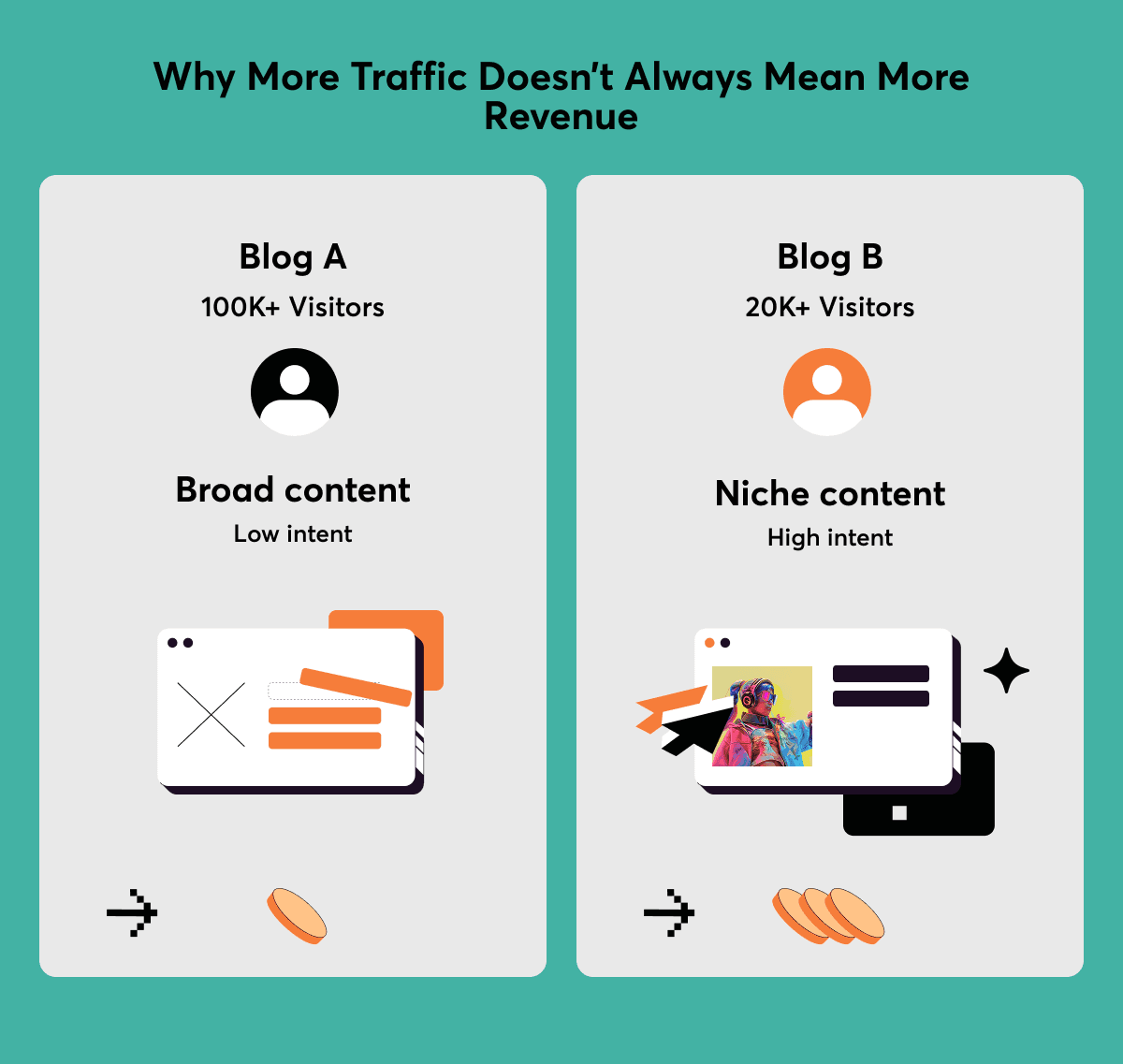
Treat these traffic levels as a roadmap rather than eligibility requirements. Your blog doesn’t suddenly become “monetizable” when Google Analytics ticks over from 9,999 to 10,000 visitors.
What changes with scale is the number of revenue options worth your time. And that makes the next question much easier: which ones should you actually choose?
8 Ways to Monetize a Blog Compared
Here’s where things get more practical. Some website monetization methods can work with a tiny but well-matched audience; others become worth the effort only once there’s enough traffic or enough audience loyalty behind them.
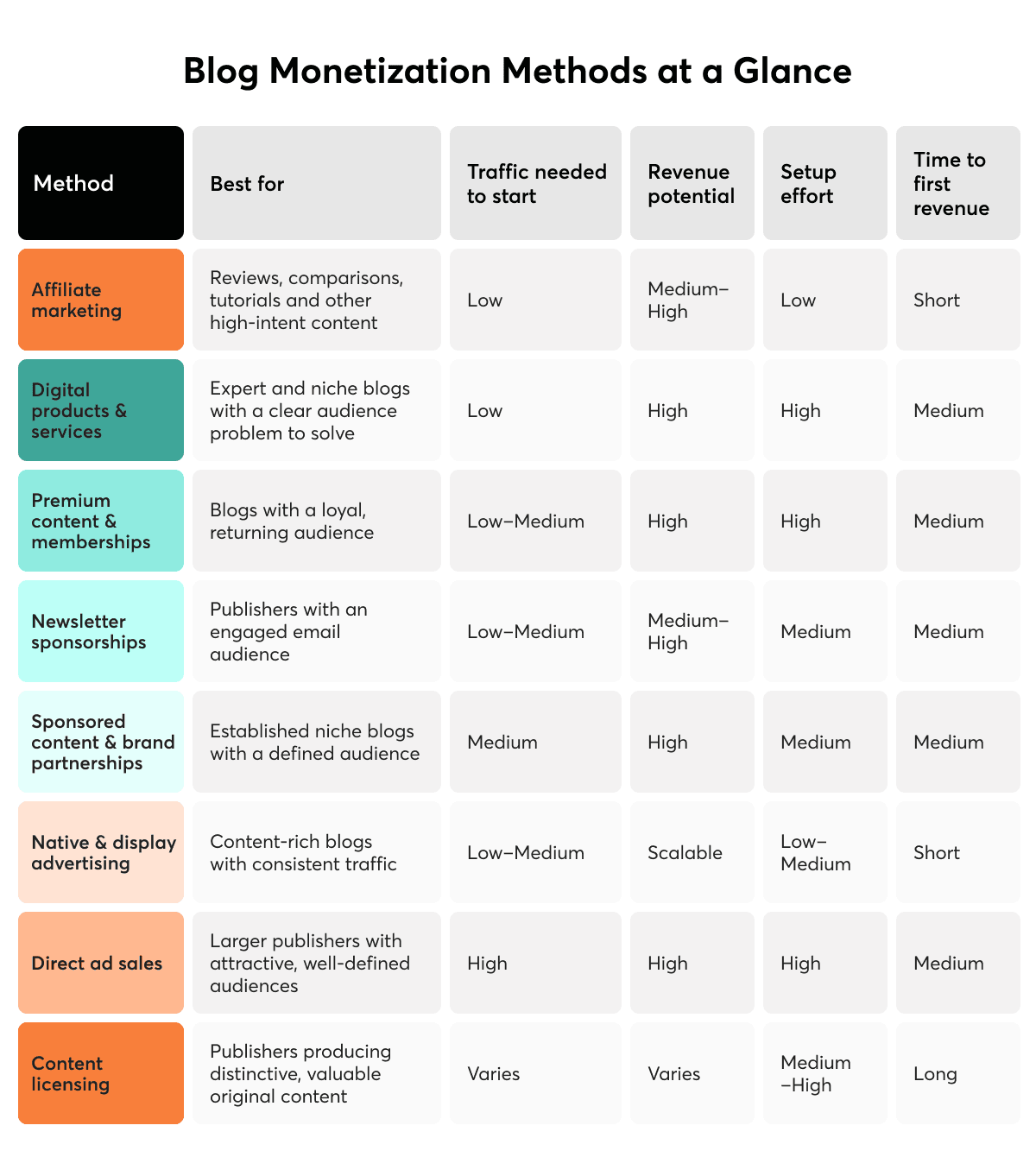
Compare blog monetization methods
| Method | Best for | Traffic needed to start | Revenue potential | Setup effort | Time to first revenue | Revenue model | Main advantage | Main challenge |
|---|---|---|---|---|---|---|---|---|
| Affiliate marketing | Reviews, comparisons, tutorials and other high-intent content | Low | Medium–High | Low | Short | Commission per sale or lead | Easy to start and scale | Requires strong purchase intent |
| Digital products & services | Expert and niche blogs with a clear audience problem to solve | Low | High | High | Medium | Direct sales | High margins and control | Requires product creation and expertise |
| Premium content & memberships | Blogs with a loyal, returning audience | Low–Medium | High | High | Medium | Recurring subscriptions | Predictable recurring revenue | Requires ongoing audience engagement |
| Newsletter sponsorships | Publishers with an engaged email audience | Low–Medium | Medium–High | Medium | Medium | Sponsored placements | Monetizes an owned audience | Requires an engaged email list |
| Sponsored content & brand partnerships | Established niche blogs with a defined audience | Medium | High | Medium | Medium | Sponsorship fees | High revenue per partnership | Requires credibility and brand relationships |
| Native & display advertising | Content-rich blogs with consistent traffic | Low–Medium | Scalable | Low–Medium | Short | CPM, CPC or revenue share | Easy to automate and scale with traffic | Lower earnings at small traffic volumes |
| Direct ad sales | Larger publishers with attractive, well-defined audiences | High | High | High | Medium | Negotiated ad rates | More control and higher rates | Requires active sales and account management |
| Content licensing | Publishers producing distinctive, valuable original content | Varies | Varies | Medium–High | Long | Licensing fees or royalties | Monetizes existing content in new channels | Finding buyers can take time |
Don’t read this as a ranking. A method with “high” revenue potential isn’t automatically the better choice. I’ve seen publishers spend weeks creating a product their audience never asked for, while a much less glamorous affiliate setup quietly made money every month. Fit beats theoretical upside surprisingly often.
There’s another useful distinction here: some revenue grows with traffic, while some grows with trust.
Advertising is the obvious example of the first. More quality impressions generally create more inventory to monetize. Memberships, products and sponsorships are different. A smaller audience that knows exactly why it keeps coming back can sometimes be worth considerably more than a large but casual one.
Which combination fits your blog? Choose the options below to get a starting monetization mix based on your traffic, audience and reader loyalty.
Now we can make this much more specific. Let’s start at the stage where traffic is still small and every visitor feels slightly precious.
How to Monetize a Blog With Under 1,000 Monthly Visitors
Your first 1,000 visitors are not there to make you rich. They’re there to tell you what might eventually make you money.
At this stage, squeezing revenue out of every pageview shouldn’t be the priority. What matters more is looking for signals:
- Which articles attract people with buying intent?
- What do readers click?
- What questions keep coming up?
- Would anyone actually pay for a solution you recommend or create?
That makes three things particularly worth your attention.
Start With Affiliate Marketing
Affiliate marketing has one big advantage for a small blog: it rewards intent more than volume.
A post read by 300 people researching which accounting tool to buy can be commercially stronger than an entertaining article that gets 3,000 drive-by visits. That’s why reviews, comparisons, tutorials, “best X for Y” articles and resource pages tend to be the obvious places to start.
You don’t need to turn every paragraph into a sales pitch. Start with products or services you would comfortably recommend without a commission attached.
Pageviews can be misleading here, too. Look at the job the reader came to do. Someone searching “best CRM for a small agency” is much closer to spending money than someone reading “what is a CRM?”
Sell Something Small Before Building Something Big
A digital product can work surprisingly early because you don’t need thousands of buyers. You need a small number of the right buyers.
Templates, checklists, niche guides, spreadsheets, mini-courses or paid consultations can all work. But there’s a trap here I’ve seen more than once: spending three months creating an impressive 80-page ebook before finding out whether anyone wanted it.
Try the reverse: validate → create → improve.
Ask readers what they struggle with. Look at the questions arriving through comments, email or social. Test a small paid solution first. If people buy it, then make it bigger.
Build an Email List Even If It Feels Ridiculously Small
At 500 monthly visitors, collecting 20 email addresses may not feel like much of an achievement. Six months later, you may be very glad you did.
A search visitor can disappear forever after one article. An email subscriber gives you another chance to bring that person back: to a new post, an affiliate recommendation, a product or a paid membership.
And in a world where search referrals are becoming less predictable, that direct connection is increasingly valuable.
Below 1K monthly visitors, the goal is to find proof that your monetization strategy can work.
- Can your content attract people with commercial intent?
- Will readers click recommendations?
- Will anyone give you their email address?
- Is there something they would pay you for?
If the answers start becoming “yes,” you have something much more useful than your first few dollars: you know which direction to scale.
How to Monetize a Blog With 1,000–10,000 Monthly Visitors
This is where monetization gets more interesting. You have enough traffic to spot patterns, but probably not enough to throw five revenue streams at the site and expect all of them to work. And that’s fine. The goal at this stage is to take whatever showed promise in your first 1,000 visitors and add one or two revenue streams around it.
In other words, start building a stack.
Keep What’s Already Making Money and Make It Better
If affiliate marketing is generating sales, resist the temptation to immediately go hunting for something more sophisticated. First, find out why it’s working.
- Which pages convert?
- Which products get clicks but no sales?
- Which topics bring visitors with obvious commercial intent?
Sometimes the easiest revenue growth is sitting in content you published months ago. Updating a comparison, adding a genuinely useful recommendation or improving internal links to a high-converting page can do more than launching an entirely new monetization channel.
One niche review blog I worked with had grown to around 6,000 monthly visitors, yet nearly 70% of its affiliate revenue still came from a single comparison post published 18 months earlier. We refreshed the page, updated prices, added a missing competitor and fixed outdated affiliate links. The following month, revenue from that page rose by roughly 35%.
Test Premium Content or Memberships
By now, you may have something that matters more than raw traffic: repeat readers.
If people regularly come back for your analysis, expertise, resources or recommendations, test whether some of that value can sit behind a paid layer.
That could mean:
- a members-only section;
- a paid community such as a forum, Discord or Slack space;
- premium articles or research;
- templates, tools or resource libraries;
- a paid newsletter;
- workshops or other subscriber benefits.
Don't build an elaborate membership ecosystem on day one. A small paid offer is enough to answer the first question: will anyone subscribe?
Your Newsletter Can Start Making Money Too
Remember that email list you started building when it looked painfully small? This is where it can begin doing more work.
Newsletter sponsorships don't necessarily require a huge list. A tightly defined audience can be attractive to the right advertiser, especially in a valuable niche.
A list of 2,000 people interested in cybersecurity procurement, for example, tells a potential sponsor much more than “20,000 assorted subscribers.”
Audience specificity is an asset. Use it.
Start Testing Advertising, but Keep Your Expectations Sensible
At this traffic level, advertising becomes a legitimate addition to the mix. It just shouldn't automatically become the whole strategy.
Native and display ads can give you something affiliate links and products don't: revenue from visitors who aren't ready to buy anything from you. That makes advertising a useful baseline layer in the stack.
But don't plaster every available pixel with an ad because you've finally reached a few thousand visitors. Test ad placements, watch user experience and measure what the extra revenue is actually worth.
Match monetization to reader intent. Product-focused articles can support affiliate links, while high-traffic informational posts may earn through ads. Content that brings readers back regularly can help grow an email list or sell your own products. You don’t need every monetization method on every page.
At 1,000–10,000 monthly visitors, that's the real milestone: you're no longer proving that the blog can make money. You're starting to learn which combination makes the most sense for it.
How to Monetize a Blog With 10,000–100,000 Monthly Visitors
Somewhere in this range, the monetization question changes. You’re no longer asking, “Can this blog make money?” You already know it can. The more useful question is: are you making enough from the traffic you already have?
I’ve seen growing blogs become slightly obsessed with the next traffic milestone — 20K, 50K, 100K — while barely touching the monetization setup that got them to 10K. More visitors can hide an inefficient revenue model surprisingly well.
So, before chasing the next 10,000 sessions, look at what each existing visitor is worth.
Make Advertising Work Harder
With consistent traffic, native and display advertising can become a meaningful, scalable part of your revenue rather than a small experiment.
But this is also where optimization starts to matter. Look beyond total ad revenue and pay attention to things like revenue per thousand impressions (RPM), viewability, engagement, mobile performance and the effect ads have on the reading experience.
More ad units aren't automatically the answer. Sometimes a better format or placement is worth more than another rectangle squeezed between two paragraphs.
Track revenue per visitor alongside total revenue. If traffic grows 40% while revenue grows only 10%, dig into where that growth came from. New visitors may be landing on lower-value pages, coming from less commercial traffic sources, or simply not seeing the right monetization offers.
Add Sponsored Content and Brand Partnerships
At this size, it may finally be worth picking up the phone — metaphorically, at least — and talking to brands directly.
That opens the door to sponsored articles, newsletter placements, content partnerships and other direct brand deals.
And don't undersell niche authority. A specialist blog with 30,000 monthly visitors may be much more attractive to the right advertiser than a general-interest site several times its size.
When pitching advertisers, focus on audience fit rather than traffic alone. Show how many of your visitors match the customers they want to reach.
Turn Your Newsletter Into a Revenue Channel
By now, email should be doing more than sending people back to new posts.
You can test sponsorships, affiliate offers, premium editions or use the newsletter to sell your own products. More importantly, email gives you a revenue channel that isn't directly tied to whether a search engine decides to send you traffic that week.
Add Recurring Revenue Where It Makes Sense
Products, affiliate commissions and sponsorships can be profitable, but they often start from zero again next month. Memberships, paid newsletters and subscriptions behave differently, giving part of your revenue a recurring base.
That doesn't mean every 50K-visitor food blog suddenly needs a paywall. Recurring revenue works when there is a reason to keep paying: exclusive expertise, useful tools, ongoing research, a strong community or consistently valuable premium content.
A quick reality check before launching a subscription:
- Do people already return without being reminded?
- Is there something valuable you can provide repeatedly?
- Would readers notice if that benefit disappeared?
- Can you realistically keep delivering it six months from now?
If those answers are shaky, build loyalty first. A subscription button can't manufacture it.
At this stage, a healthy monetization setup might already have three or four layers: advertising for scale, affiliate revenue for intent, sponsorships for audience value and recurring revenue for loyalty.
You don't need every layer. You do want to avoid reaching 100,000 visitors while still depending on only one.
How to Monetize a Blog With 100,000+ Monthly Visitors
Reaching 100,000 monthly visitors is exciting. It can also be expensive if your monetization setup is still running on autopilot.
At this scale, small improvements start producing real numbers. A better-performing ad setup, a stronger direct deal or a modest increase in revenue per visitor gets multiplied across a six-figure audience.
The next revenue opportunity may already be hiding in your existing setup. The job is to find it.
Optimize Your Advertising Mix
Advertising is usually much more interesting at this scale simply because you have enough inventory to work with.
Before adding more ads, look at how your existing placements perform. Compare revenue across ad formats, pages, audience segments and devices, then prioritize the combinations that generate the most value.
This is also where combining formats can make sense. Display can provide broad coverage, native advertising can fit more naturally into the content experience and video may add another revenue layer where the site and audience support it.
Explore Direct Ad Sales
Ad networks are convenient because they do much of the selling for you. At 100K+ visitors, however, you may have enough scale and audience data to start selling selected inventory directly.
The appeal is straightforward: more control over pricing, formats, advertisers and longer-term partnerships.
The downside is equally straightforward: someone has to sell it.
Direct sales mean outreach, negotiation, campaign management, reporting and advertiser relationships. Higher revenue potential comes with higher operational effort, so this route makes the most sense when your audience is valuable enough to justify it.
Put Your First-Party Audience to Work
At this point, I'd be slightly nervous if a large publisher knew everything about its Google traffic and almost nothing about its actual readers.
Your newsletter subscribers, registered users, members and repeat visitors are more than retention metrics. They create monetization opportunities that aren't dependent on acquiring the same reader again and again.
That can mean:
- newsletter sponsorships;
- paid subscriptions or memberships;
- premium products;
- affiliate campaigns;
- exclusive brand partnerships.
More importantly, you have a direct route back to those people.
Consider Licensing What You've Already Built
A large blog isn't just a collection of pageviews. Over time, it may also become a valuable archive of original reporting, specialist analysis, images, data, research or other proprietary content.
That creates another possible revenue stream: licensing.
Traditional syndication and content partnerships aren't new, but AI has opened up a new conversation about licensing publisher content and archives. The headline deals between AI companies and major news organizations are mostly a big-publisher game — not something the average independent blog can realistically negotiate. More relevant at a smaller scale are emerging licensing marketplaces that let publishers make content available and set terms without negotiating directly with every buyer.
This still isn't a “switch it on and get paid” model. But if you're producing distinctive original reporting, research, data or other valuable material, it's worth knowing exactly what you own, what access you're granting and whether you're already giving some of it away under your current terms.
Don't Let One Revenue Stream Become the Business
Here's the situation I'd want to avoid: a blog reaches 100,000, 300,000 or even a million visitors, but 80% of its income still disappears if one ad partner, affiliate program or traffic source changes its rules.
Scale makes revenue bigger. It doesn't automatically make it safer.
At 100K+, the strongest monetization strategy is usually less about discovering another clever way to make money and more about balancing the ones you already have: scalable advertising, high-value partnerships, direct audience revenue and selected commerce or licensing opportunities.
And that becomes especially important when the traffic feeding the whole system is changing.
How to Monetize a Blog When Search Traffic Is Declining
For years, the default growth plan for a blog was wonderfully simple: publish more, rank for more keywords, get more search traffic, monetize the extra pageviews.
I wouldn't build a business plan around that assumption today.
Search still matters — a lot. But referrals are becoming less predictable as AI-generated answers, changing search interfaces and new discovery habits give people more ways to get information without necessarily clicking through to the original site.
For publishers, that changes the math. If getting 30% more traffic is becoming harder, making more from the traffic you already have becomes much more important.
Don't Make Search Your Only Way In
Build enough diversity into your traffic sources to reduce the impact of future ranking changes.
Depending on the blog, that might mean building traffic through:
- newsletters;
- social and video platforms;
- referral partnerships;
- communities;
- direct and returning visitors.
Not every channel deserves your attention. A finance publisher and a recipe blogger probably shouldn't have identical distribution strategies. Go where your audience already has a reason to find you.
Turn Borrowed Traffic Into an Audience You Can Reach Again
Here's a metric I wish more publishers watched: how many first-time visitors give you a way to reach them a second time?
A search visit is useful. A search visitor who subscribes to your newsletter is much more useful.
That doesn't mean throwing three pop-ups at everyone who lands on an article. Give people an actual reason to stay connected: a useful newsletter, saved resources, exclusive analysis, tools, alerts or a community they would want to return to.
A visitor’s value doesn’t end with the first pageview.
The first visit might generate ad revenue, the next an affiliate sale and six months later, the same reader might buy a product or become a subscriber. Monetization looks very different when you measure the value of the relationship, not just the visit.
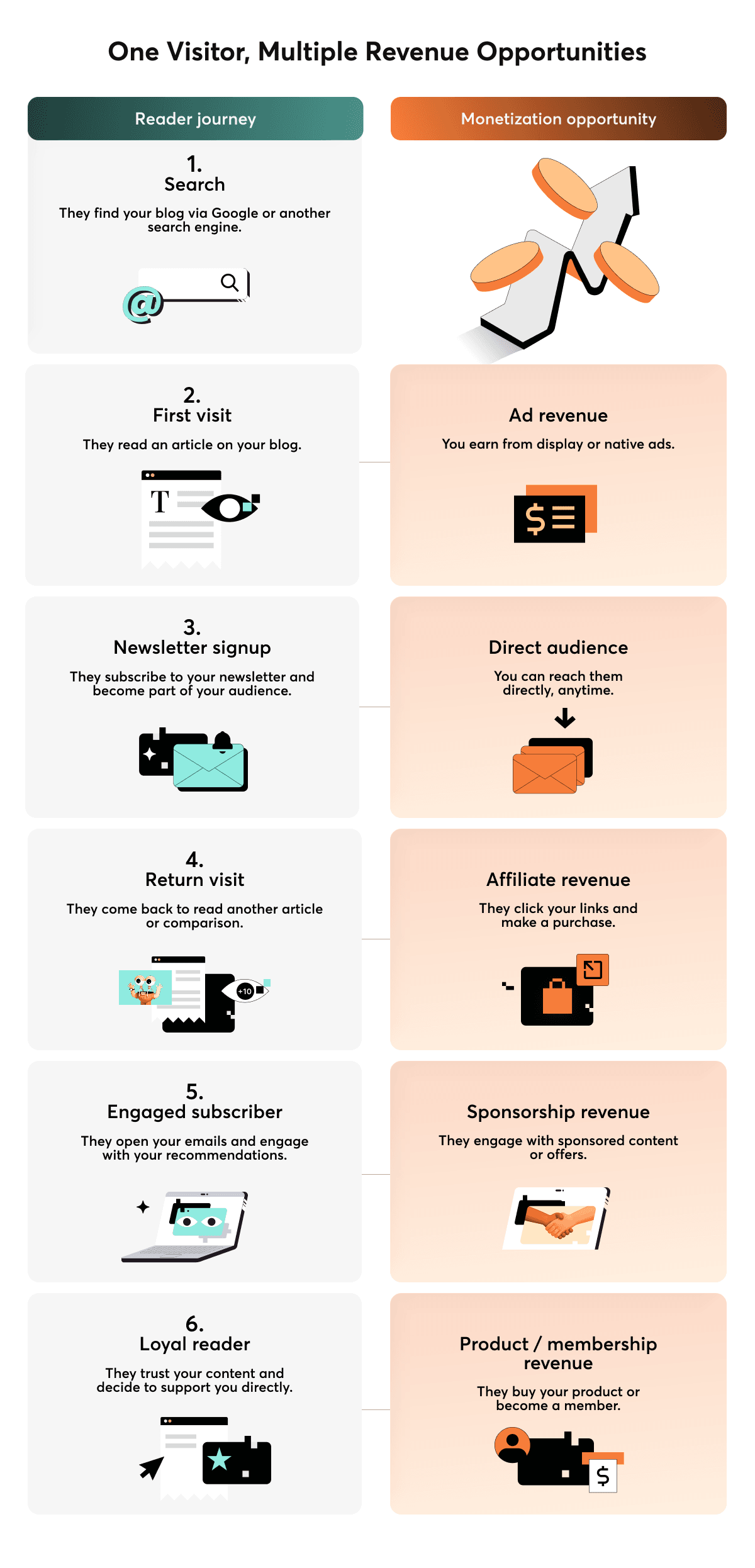
Start Watching Revenue per Visitor
We touched on revenue per visitor earlier. It matters even more when traffic stalls or search sends fewer people your way. Traffic is wonderfully easy to celebrate. “We hit 100K!” looks much better in a report than “revenue per visitor increased by 12%.”
The second number may matter more.
Imagine two months:
| Month A | Month B |
|---|---|
| 100,000 visitors → $5,000 revenue | 120,000 visitors → $5,200 revenue |
Traffic grew 20%. Revenue barely moved. That kind of growth is worth investigating to understand what it actually contributes to the business.
Look at how much value the average visitor generates across advertising, affiliate sales, subscriptions, sponsorships and products. Then look for the gaps. Maybe high-traffic pages have weak commercial intent. Maybe mobile ad performance is poor. Maybe thousands of readers arrive and leave without ever seeing another offer.
Give Every Revenue Stream a Different Job
This is where diversification becomes more than a nice piece of business advice.
Advertising can monetize scale. Affiliate offers can capture purchase intent. A newsletter can turn temporary traffic into a direct audience. Products can monetize expertise. Memberships can turn loyalty into recurring revenue. Sponsorships can monetize the value of a specific audience to brands.
They don't all need to work on the same visitor, and that's precisely the point.
- The old question was: How do we get more traffic?
- The better question for 2026 is: How many useful things can our business do with the traffic it earns?
Once you start looking at monetization that way, choosing a single “best” method makes less and less sense. What you really need is a stack.
Don’t Pick One Method: Build a Blog Monetization Stack
One thing I’ve learned from looking at monetized blogs: the more mature the business becomes, the harder it is to answer the question, “So, how does this blog make money?” with one sentence.
Usually, the answer is: a bit from here, quite a lot from there and something else that barely existed a year ago.
That’s a good thing. A monetization stack lets different parts of your audience generate value in different ways. The reader who never clicks an affiliate link can still generate ad revenue. Another may ignore every ad but buy the product you recommend. A loyal reader might eventually subscribe. And a brand may pay to reach the audience as a whole.
What a Monetization Stack Can Look Like
Think of it less like choosing winners and more like adding layers as the blog earns them:
| Monetization Mix by Growth Stage |
|---|
| Early stage |
| Affiliate marketing + a simple product or service |
| ⬇️ |
| Growing audience |
| Affiliate + product + newsletter + advertising |
| ⬇️ |
| Established blog |
| Advertising + affiliate + sponsorships + products + recurring revenue |
| ⬇️ |
| Publisher scale |
| Optimized advertising + direct sales + subscriptions + partnerships + licensing |
Notice that nothing says you need all of these. Trying to launch six monetization channels at once is a reliable way to become mediocre at six monetization channels.
Add a new revenue stream when it solves a specific problem: advertising can monetize informational traffic that rarely converts, a newsletter can bring search visitors back and subscriptions can turn loyal readers into recurring revenue.
Diversification Doesn't Mean Equal Revenue
Your stack doesn't need to be nicely balanced. One blog might make 60% of its revenue from affiliate marketing and use ads as a useful extra. Another may have advertising as its foundation, with subscriptions and sponsorships adding smaller but higher-value layers.
What matters is knowing where the dependencies are.
If one traffic source disappears, does revenue collapse? If an affiliate program cuts its commission, do you have another income stream? If advertising rates have a weak month, is there anything else carrying part of the load?
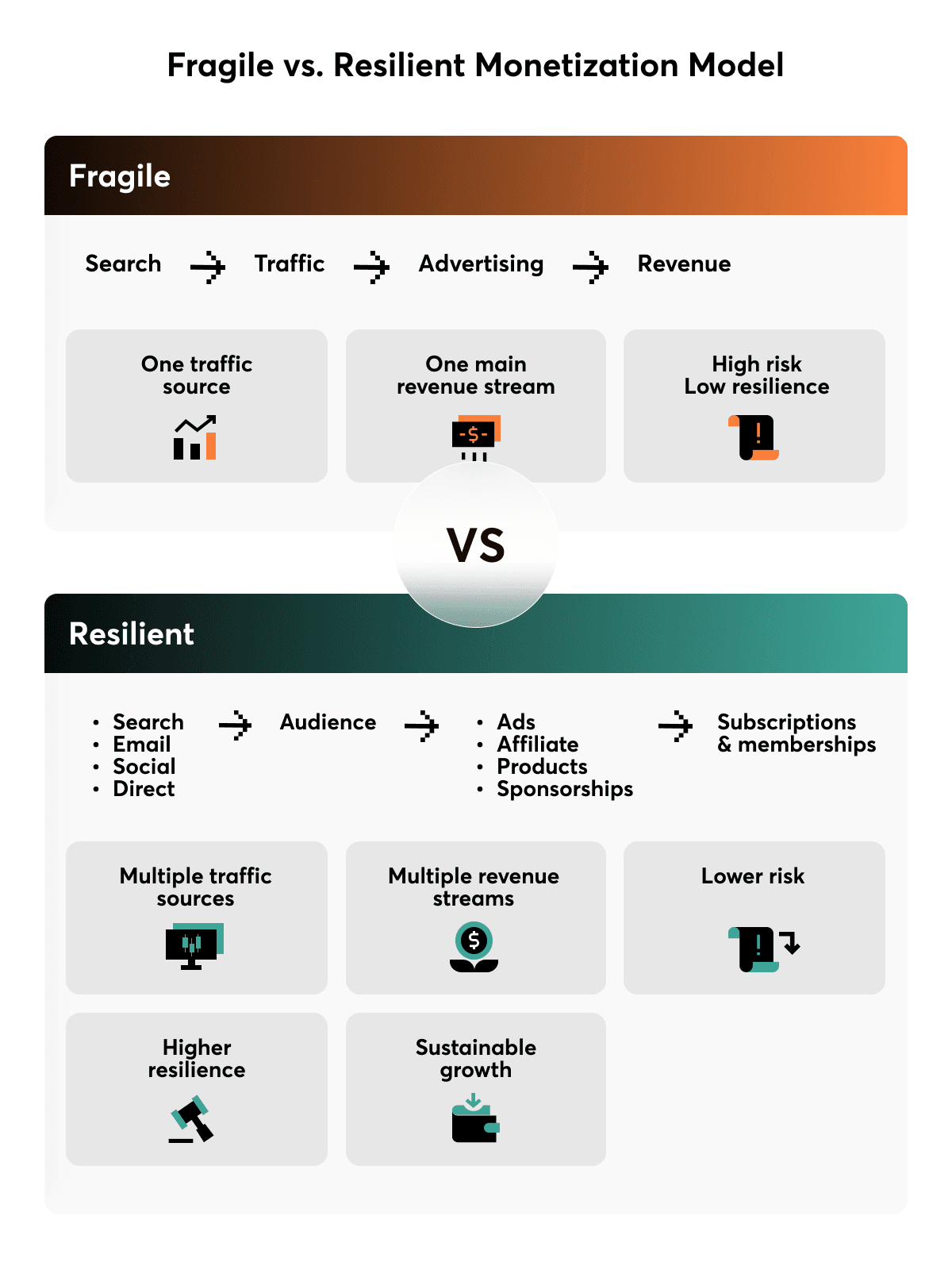
You don't need eight equal slices of a revenue pie. You need enough alternatives that one change outside your control doesn't eat the whole thing.
And if advertising is one of those layers — as it is for many content publishers — it's worth understanding exactly where native advertising fits rather than treating every ad format as interchangeable.
Where Does Native Advertising Fit?
Native advertising sometimes gets presented as an alternative to every other monetization method. In practice, I find it much more useful to think of it as one part of the advertising layer.
It solves a fairly specific problem: you have content and traffic, and you want to monetize that attention without turning the page into a collection of unrelated banners.
Here’s how I’d separate the main options:
| Monetization method | What you're monetizing | Main advantage | Main trade-off |
|---|---|---|---|
| Display advertising | Impressions | Easy to scale with traffic | Can add visual clutter |
| Native advertising | Impressions and engagement | Fits more naturally into the content experience | Requires thoughtful integration |
| Affiliate marketing | Purchase intent | Strong earning potential from the right traffic | No conversion, no commission |
| Direct ad sales | Audience access | More pricing and advertiser control | Requires sales and campaign management |
This is why native becomes particularly useful for content-heavy blogs. Not every reader arrives ready to buy something, subscribe or download your product. Advertising gives those visits a way to contribute to revenue anyway.
Platforms such as MGID handle the technical and demand side of native monetization, while publishers can integrate formats such as in-article, under-article and recommendation placements into the existing content experience.
But the same rule applies here as everywhere else in this guide: don't judge the setup by how many ads you managed to fit onto the page. Judge it by the revenue it adds without unnecessarily sacrificing engagement, speed or reader trust.
Native advertising can become a scalable part of a broader monetization mix.
How Long Does It Take to Monetize a Blog?
Technically, you can make your first dollar from a blog very quickly. Put an affiliate link in front of the right reader today, and they could buy tomorrow.
Building reliable blog income is a different story.
I’ve seen publishers get too focused on the date they “started monetizing,” as if a clock begins ticking from there. In reality, much of the work happens before that point: attracting the right audience, earning trust and creating content people actually return to.
Different revenue streams also run on very different timelines:
- Affiliate marketing can produce revenue early if your content already attracts people with purchase intent.
- Advertising can start generating income as soon as you're accepted by a platform and ads are live, although meaningful revenue usually requires more scale.
- Sponsored content can pay well from the first deal, but finding that deal may take time.
- Digital products and services can generate revenue with a relatively small audience, provided you've found something people actually want.
- Memberships and paid subscriptions usually need more patience because you're asking readers to make an ongoing commitment.
- Direct ad sales can bring larger deals, but sales cycles and campaign management make them much less instant.
I’d also watch returning visitors before focusing too heavily on revenue: repeat visits are an early sign that you're building an audience you can monetize over time.
What Can Speed Things Up?
Four things tend to matter more than how many months your blog has existed:
- Traffic quality: Ten thousand relevant visitors can be far more valuable than 100,000 poorly matched ones.
- Audience trust: Recommendations, products and subscriptions work much better when readers already have a reason to listen to you.
- Method–audience fit: A brilliant membership offer won't help much if readers only visit twice a year to check a product review. Affiliate marketing might.
- Existing audience: If you already have a newsletter, social following, YouTube audience or another distribution channel, you’re not really starting from zero. Those readers can give a new blog a much shorter path to its first meaningful revenue.
So, don't worry too much about whether monetization “should” take three months or a year. A better benchmark is whether each month gives you more evidence about what your audience will actually pay for directly or indirectly.
Blog Monetization FAQ
Can you monetize a blog with 1,000 monthly visitors?
Yes. Affiliate marketing, a small digital product or services can work even with a modest audience. At this stage, who those 1,000 visitors are often matters more than the number itself.
How much money can a blog make per 1,000 views?
There’s no reliable universal figure. Earnings vary widely by niche, audience location, traffic quality and monetization method — and ad revenue may be only one part of what those 1,000 views generate.
What is the easiest way to monetize a blog?
Affiliate marketing and advertising are relatively easy to launch because you don’t need to create your own product. Still, the easiest method to set up isn’t necessarily the easiest one to make money from.
When should you put ads on a blog?
When you have consistent traffic and the potential revenue is worth the impact on your pages. There’s no magic traffic threshold, so start small and see how ads affect both revenue and user experience.
Can you monetize a blog without ads?
Absolutely. Affiliate marketing, digital products, services, memberships, paid newsletters, sponsorships and content licensing can all generate revenue without on-page advertising.
How many monetization methods should a blog use?
Start with one or two that fit your audience and build from there. As the blog grows, adding complementary revenue streams can reduce your dependence on any single one.
Start With One Revenue Stream, Then Build the Stack
Here’s something worth doing after you close this article: open your analytics. Not to admire the traffic graph. Look at your top pages and ask a less comfortable question: what happens after someone lands here?
Do they click an affiliate link? Join your newsletter? See an ad? Discover a product? Come back next week? Or do thousands of visitors simply read, leave and take all their monetization potential with them? That gap is probably where your next revenue stream belongs.
You don't need all eight methods in this guide. You need the next one that makes sense for the audience you've already worked hard to build, and then another when the blog is ready for it.
If advertising is that next layer, MGID helps publishers monetize existing traffic with native formats that work within the content experience rather than fighting against it.
So, before setting another traffic goal, try setting a revenue-per-visitor goal instead. You may discover that the growth you've been chasing is already sitting on your blog.