
With AI, users’ questions are answered before they even reach a publisher’s page. Now, publishers need to figure out where to invest beyond search.
For years, the deal was straightforward: publishers created content, search engines sent traffic and those visits turned into revenue. AI search is quietly rewriting that deal, giving users the answer before they have a reason to click.
Publishers can't control every lost visit. What they can control is what happens on their own properties and how effectively they monetize the attention they earn. That's one reason why video is moving higher on the priority list. It creates premium ad inventory, opens up new campaign formats and matches the way audiences increasingly consume content.
Video Is Becoming a Bigger Piece of the Revenue Mix
Publishers have experimented with video for years, often with mixed results. Expensive production, clunky players and the like didn’t exactly make for a flawless business case. Most publishers tried, got burned once or twice and quietly moved video down the list.
What has changed is the economics around it. Global digital video advertising spend is projected to reach $236 billion in 2026. Advertiser demand has shifted toward video, and audiences have been trained by YouTube Shorts, TikTok and Reels to consume video content quickly and frequently throughout the day.
For publishers, video advertising has shifted in three specific areas:
- Production: Short-form video no longer requires TV-sized budgets.
- Inventory: Video gives publishers a premium format to sell alongside display and native.
- Campaigns: Brands get more room for demonstration, storytelling and sponsorship.
Together, they’re why video is starting to look more like a revenue product for publishers looking beyond traditional revenue sources.
Short-Form Video Changed the Economics
While publishers don’t need to redesign their homepages into TikTok, that doesn’t mean their audiences won’t bring their TikTok habits to them.
In fact, people now expect straight-to-the-point videos that work naturally on mobile and require very little commitment. According to Media.net, nine out of ten US consumers are open to watching short-form vertical videos on publisher websites, while sub-60-second vertical video has been shown to generate 2.5x higher engagement than standard formats.
For publishers, shorter videos remove one of the format’s biggest hurdles. With the audience’s preference towards short-form content, video advertising doesn’t have to be a major production anymore. For example, you can turn a 40-second explainer from an existing article or pull a few sharp clips from an expert interview to create entirely new, fresh video inventory.
And AI is making that even easier, turning the same reporting into multiple formats instead of one. We explored this approach in more detail in our guide to liquid content, where one story becomes the foundation for several content experiences, creating more chances to earn from it.
However, more video does not automatically mean more value. Video earns its place when it does something an article can't, like showing a product in action, visualizing a complex idea, or putting an expert on screen. If a 45-second clip simply reads the article back to the viewer, congratulations — you’ve invented a slower article.
What publishers should ask whenever contemplating creating a video from existing content is “Will a video make this particular story more useful, watchable or commercially valuable?” If the answer is no, the article should stay an article.
Why Advertisers Pay More for Video Attention
A video impression and a display impression may live on the same page, but their value is entirely different.
Video demands a more deliberate form of attention, combining sight, sound, motion and storytelling into one format. When someone chooses to watch, there's simply more room for a brand to communicate than a display ad that is competing with six other things on the page.
The pricing backs that up. Time, for example, has reportedly been commanding 25–40% higher CPMs for vertical video than for standard display inventory.
Although, a video player alone doesn't magically turn $5 inventory into $15 inventory. That is a premium that has to be earned.
So what actually makes video inventory more valuable?
Attention Rather Than Exposure
A video that people actively watch gives advertisers more than an impression served somewhere below the fold. A banner ad can be served and ignored in the same half-second; in contrast, a video only plays if someone lets it. Completion rate, watch time and interaction all give advertisers a stronger signal that someone was actually paying attention, not just scrolling past.
A Better Canvas for Native Campaigns
Video gives publishers more room to integrate brands without reducing the campaign.
Consider a tech publisher reviewing a new laptop. A display campaign can put the brand next to the review. Video can show the screen, ports, size and performance in use, then give the publisher room to package that content with a sponsorship or native campaign.
The advertiser is no longer buying proximity to the content alone. It can pay for a role inside the experience.
Scarcity
Publishers can generate display placements almost everywhere. Good video environments are harder to build. That limited supply — combined with advertiser demand — gives quality video inventory more pricing power.
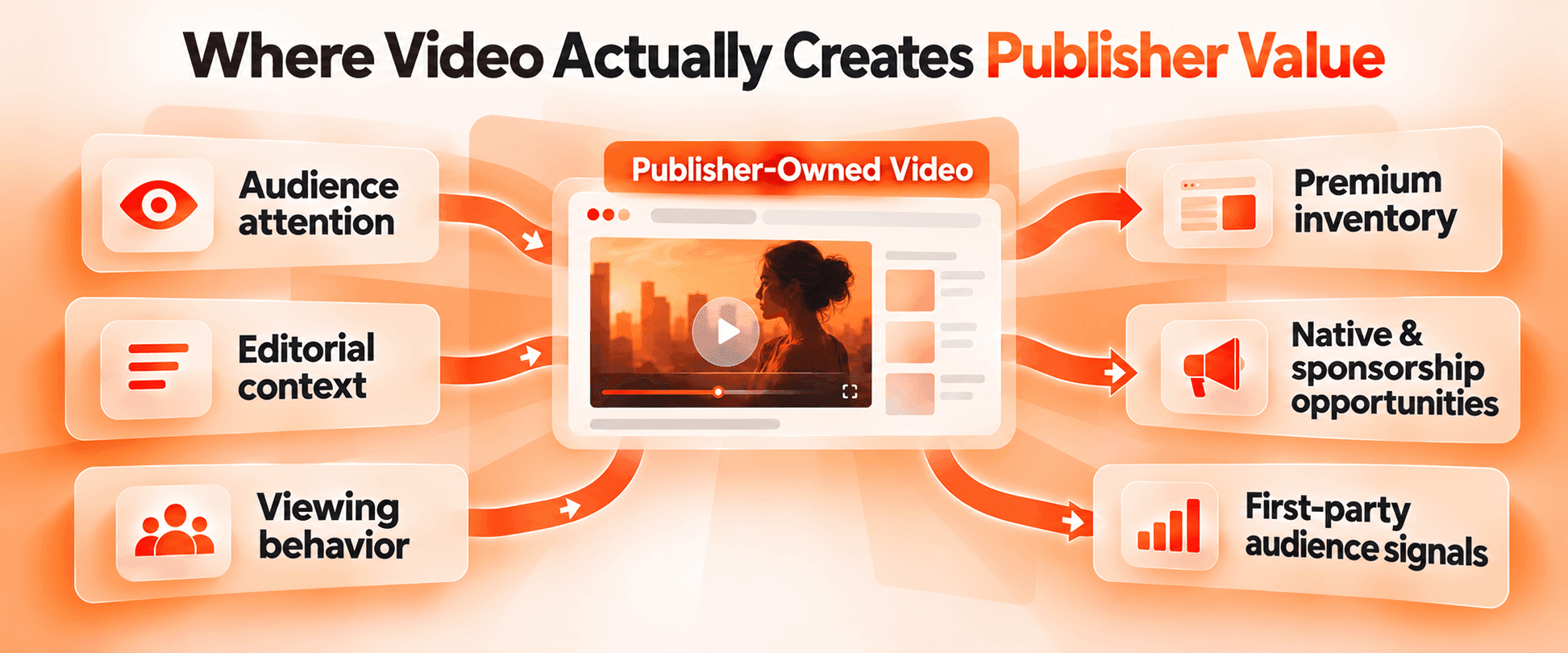
The lesson for publishers? Package video advertising around what advertisers are actually paying for: engaged viewing, relevant editorial context and richer storytelling. In practice, that often means pairing short-form video with native placements, sponsorships or related content rather than dropping every video impression into the same bucket.
The Best Video Audience Is the One You Don’t Have to Rent
A publisher can rack up impressive video numbers on TikTok, YouTube or Instagram and still have surprisingly little to monetize beyond the platform’s rules.
Social video isn't a bad investment, but keep in mind, its value comes from distribution.
On their own properties, publishers control where the video appears, what follows it, how advertising is integrated and what audience signals can be collected and used. Those direct relationships matter commercially, too. First-party audience data can help publishers make inventory more relevant to buyers and support higher-value direct and programmatic deals.
A food publisher posts a 30-second recipe video on social and gets 500,000 views, which is great for reach. However, if the publisher places those short recipe videos inside relevant articles and builds a “watch next” experience around them, the publisher can:
- sell video inventory against relevant food content;
- package a series for a kitchen or grocery brand;
- recommend another video after the first one ends;
- learn which topics its own audience actually watches;
- use those signals to make future content and ad packages more relevant.
What changed is who controls everything that happens after someone presses play.
Three Questions to Ask Before Investing
Before investing heavily in a new video format, ask three questions:
- Where does the next view happen? If every video ends with the audience returning to the feed, the platform owns the journey.
- Can this be sold differently? If video is simply dropped into the same programmatic pool as everything else, most of its premium potential is left on the table.
- What do we learn from the watch? Topics watched, completion behavior and repeat viewing can become useful first-party signals. If none of that comes back to the publisher, a valuable part of the exchange disappears.
By no means should you pull video off social platforms. They remain powerful discovery channels. However, the smarter play is to make them the front door to your video content rather than the entire operation.
How to Test Video Before Scaling
The case for video may look good on paper. Whether it actually works depends on your audience, your content and your revenue model. Before investing in more production and hoping engagement follows, publishers can learn a lot from a few focused tests.
Start Where Video Has a Job to Do
Product reviews, tutorials, interviews, sports highlights and visual explainers are natural video candidates. Start with these sections, adding video where it would improve the story.
Test Placement and Format
Placement can matter as much as the clip itself. Compare video embedded within relevant articles with dedicated feeds or recommended-video modules. Test vertical versus horizontal formats and different lengths. A great video can be left unwatched if it’s buried at the bottom of a page.
Measure the Money Alongside the Views
Views are useful, but they are only the beginning. Track watch time, completion rate, video CPMs, revenue per session and what viewers do next. Most importantly, compare those sessions with similar pages without video. If video views rise but revenue per session, session depth or return behavior barely move, you may have created more activity rather than more value.
The goal is to find the combinations of content, placement and format where audiences choose to watch and advertisers are willing to pay more for that attention.
Once publishers know where those pockets of value are, scaling stops being a bet and starts being an investment.
Video Has to Earn Its Place
Video won't replace the article, nor should it. Video’s strength lies in its opportunity to create value that publishers can’t get from other formats. With video, publishers can gain stronger attention, more valuable inventory or a better way to tell the story.
That makes the real challenge is about identifying where video actually changes the economics of publisher content.
The publishers who get the most out of video probably won't be the ones making the most of it. They'll be the ones who know where their audience actually wants to watch, what advertisers will actually pay more for and where the two overlap.