
In this guide, we explore how Answer Engine Optimization works and why visibility in AI-generated answers is becoming a critical part of modern search.
Search is moving from link-based discovery toward conversational AI interfaces. Users now ask questions directly in platforms like ChatGPT, Google AI Overviews, Perplexity and voice assistants and expect answers instead of lists of links. That changes how content needs to be written, structured and optimized.
Ready? Scroll down to start reading!
Table of contents
Click on any chapter to scroll directly to it.
Chapter 1
What is Answer Engine Optimization (AEO)?
Answer Engine Optimization (AEO) is the practice of structuring content for AI retrieval, synthesis and citation inside generated answers.
Unlike traditional SEO that targets search engine rankings, AEO targets the retrieval systems that decide what gets included in a generated response. The two approaches share some foundations but diverge significantly in how content is structured, evaluated and measured.
| Area | Traditional SEO | AEO |
|---|---|---|
| Main goal | Improve rankings in search results | Increase visibility inside AI-generated answers |
| Search experience | Users browse links | Users receive summarized responses |
| Content focus | Pages and keywords | Answers and knowledge chunks |
| Optimization target | Search engines | AI retrieval and synthesis systems |
| Success metrics | Traffic, rankings, CTR | Citations, mentions, answer visibility |
| Typical queries | Short keyword searches | Conversational and question-based prompts |
| Content structure | Long-form page optimization | Clear, extractable, answer-first formatting |
AEO does not replace SEO. Technical SEO, crawlability, authority and content quality remain foundational, but AI-driven search adds a retrieval layer that changes how content is surfaced and cited.
What Are Answer Engines?
Answer engines are AI-powered systems that generate direct responses to user questions. Platforms like ChatGPT, Google AI Overviews, Perplexity, Gemini, Claude and Microsoft Copilot are examples of answer engines, as they are designed to assemble information into conversational answers.
| Search engines | Answer engines |
|---|---|
| Return lists of links | Generate summarized responses |
| Focus on page rankings | Focus on answer selection |
| Users browse multiple sources | Users receive synthesized information |
| Discovery happens through navigation | Discovery happens through conversation |
| Pages are the main unit of ranking | Knowledge chunks are the main unit of retrieval |
Why AEO Exists
As AI became more mainstream, how people discovered information began to shift drastically. AI-sourced traffic surged 527% year-over-year in 2025, and Google AI Overviews now appear in roughly half of all searches. At the same time, organic click-through rates for informational queries dropped dramatically; in fact, many users never click past the AI answer, also known as zero-click search.
Yet AI-driven traffic converts significantly better than traditional organic traffic. Visitors from AI platforms are worth 4.4x more than traditional organic visitors, with 27% lower bounce rates for retail sites. AI-referred visits are 38% longer and involve more page views, meaning visitors arrive with higher intent and clearer context.
This combination of less traditional click-through traffic but higher-quality AI-driven visits is what makes retrieval visibility a distinct optimization challenge rather than just an extension of existing SEO.
Chapter 2
The Evolution of Search
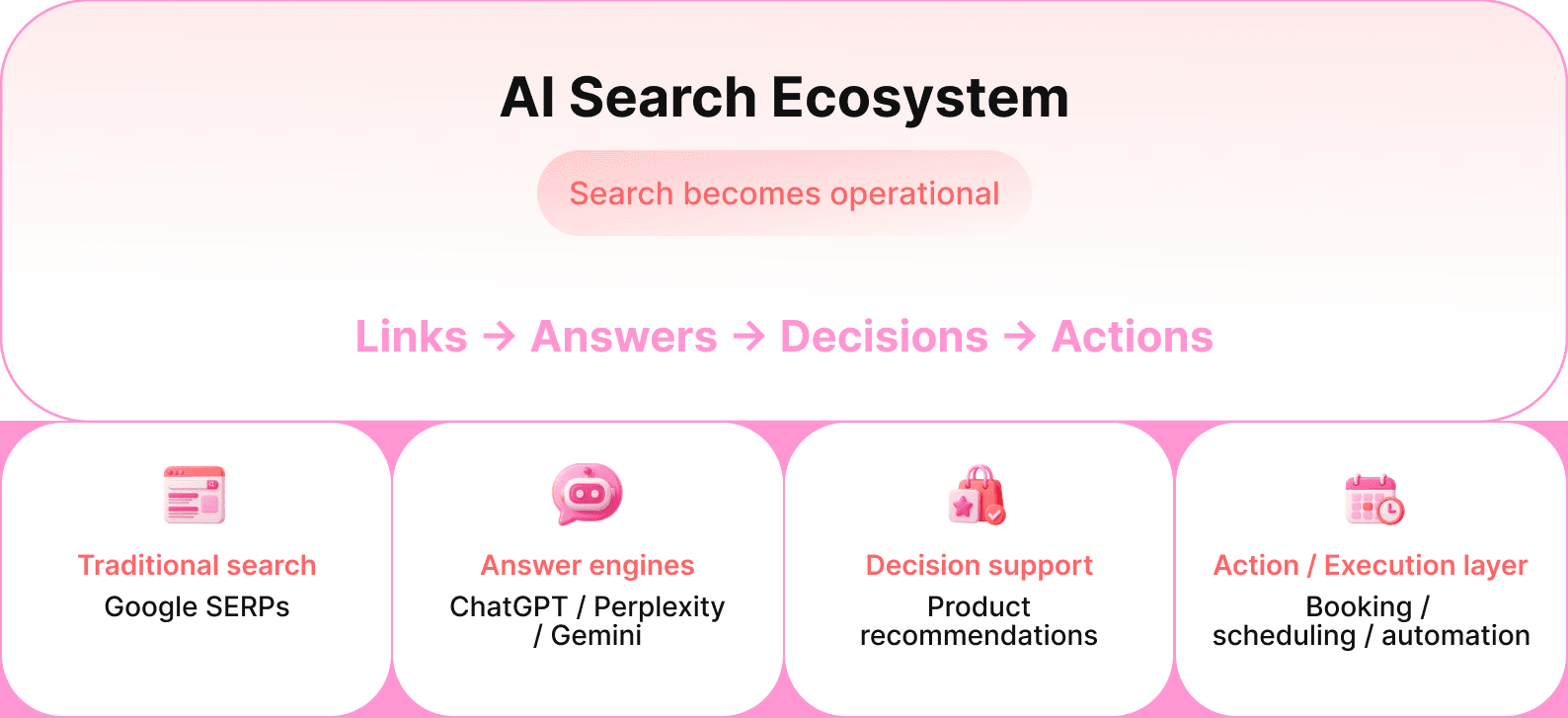
Search evolved from keyword matching to semantic and AI-driven systems that can interpret context and generate responses in real time. Each stage changed how information is discovered and what content performs well online.
1. The SEO Era
Early search engines relied heavily on keywords, backlinks and technical optimization. Visibility depended primarily on rankings inside link-based SERPs.
2. The Semantic Search Era
Search engines gradually shifted from exact keyword matching toward intent, entities and contextual understanding. This introduced semantic search features such as featured snippets, knowledge panels and People Also Ask results.
3. The AI Search Era
Modern answer engines retrieve information at the passage level and generate responses directly inside conversational interfaces. Visibility now depends not only on rankings but also on retrieval quality, semantic clarity and citation potential.
Chapter 3
How AI Search Actually Works
Traditional search engines primarily rank pages. Answer engines retrieve, evaluate and synthesize information dynamically.
Most AI retrieval systems follow a pipeline similar to this:
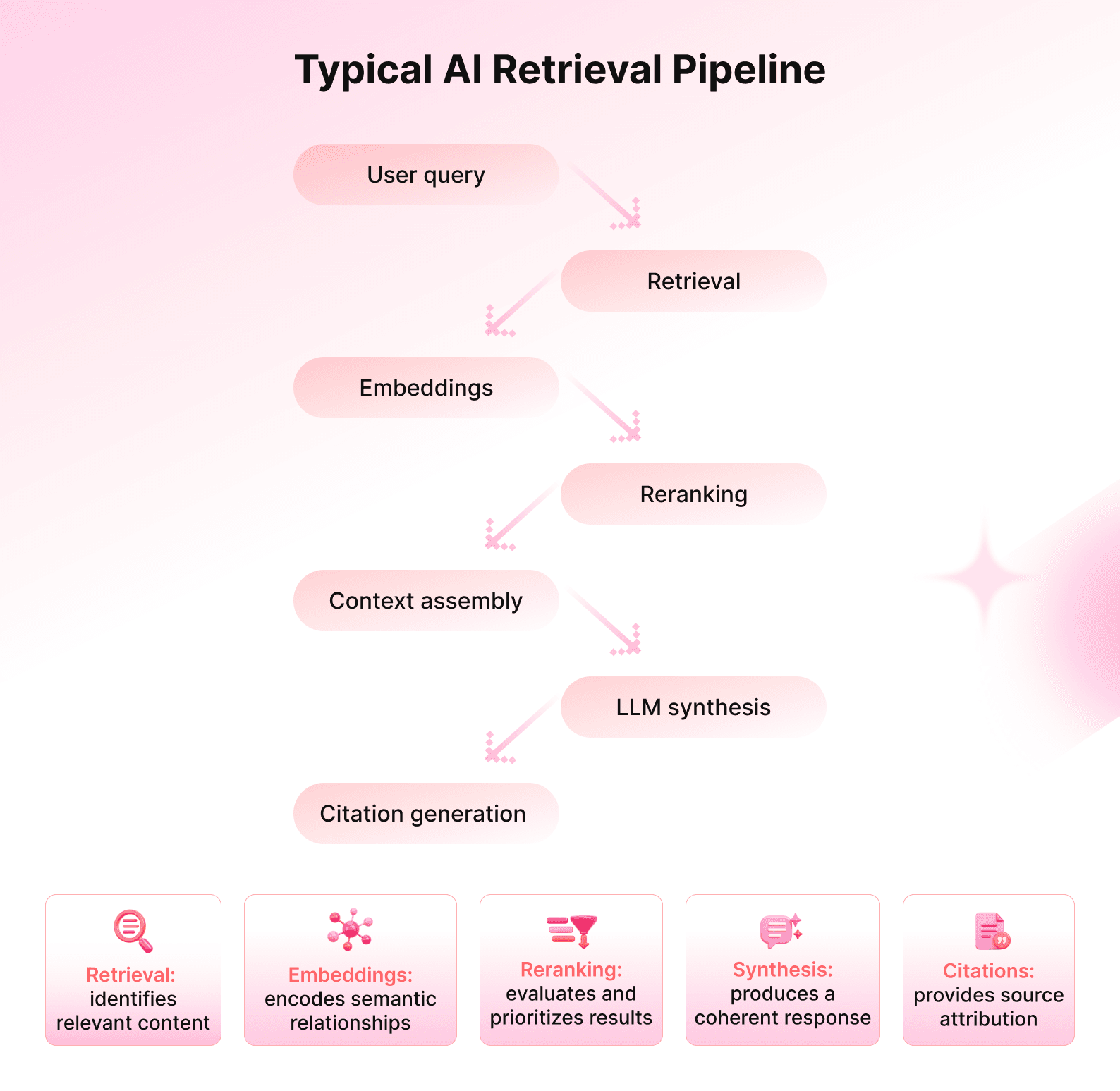
Retrieved content becomes embeddings that represent semantic meaning rather than exact keyword matches. Vector search retrieves information through semantic similarity rather than exact keyword matching.
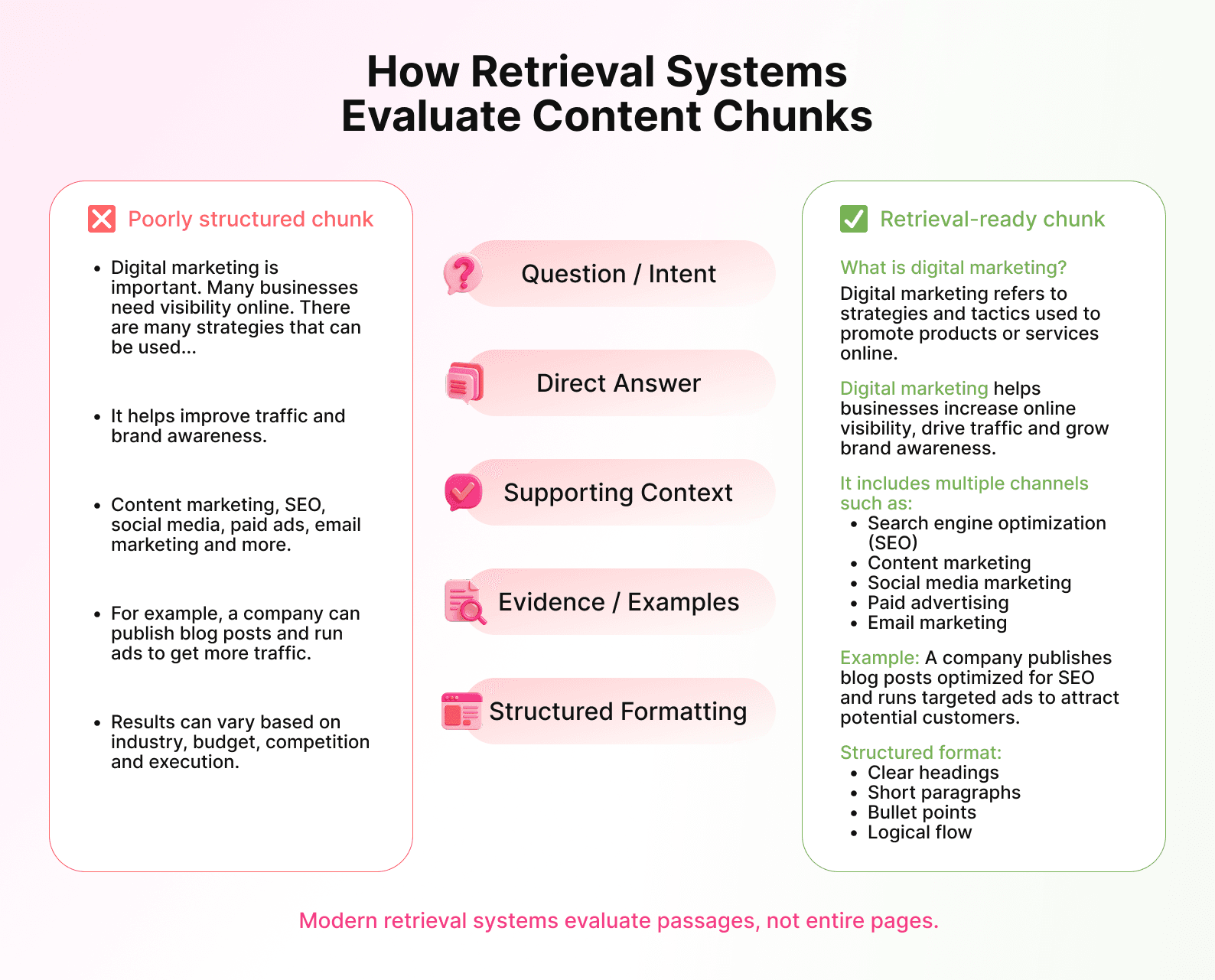
Modern retrieval systems operate at the passage level instead of evaluating entire pages as single units. Retrieval quality depends heavily on chunk structure, semantic clarity and contextual precision.
High-performing retrieval chunks typically contain:
- one clearly defined topic or question;
- direct answers;
- supporting context or examples;
- structured formatting;
- minimal filler.
Retrieval systems favor semantically dense, low-ambiguity content.
Citation Selection
After retrieval, answer engines rerank sources using signals such as:
- topical relevance;
- semantic similarity;
- source authority;
- factual consistency;
- corroboration across multiple sources;
- freshness.
Citation visibility does not always correlate with traditional rankings. High-ranking pages may still perform poorly in AI retrieval if content is difficult to extract, weakly structured or semantically generic.
At the same time, lower-ranking pages can appear prominently inside AI-generated answers when they contain highly relevant and retrieval-efficient information.
Chapter 4
Comparison of SEO, AEO, GEO and LLMO
As AI-driven discovery evolves, several overlapping optimization models have emerged across search and generative systems.
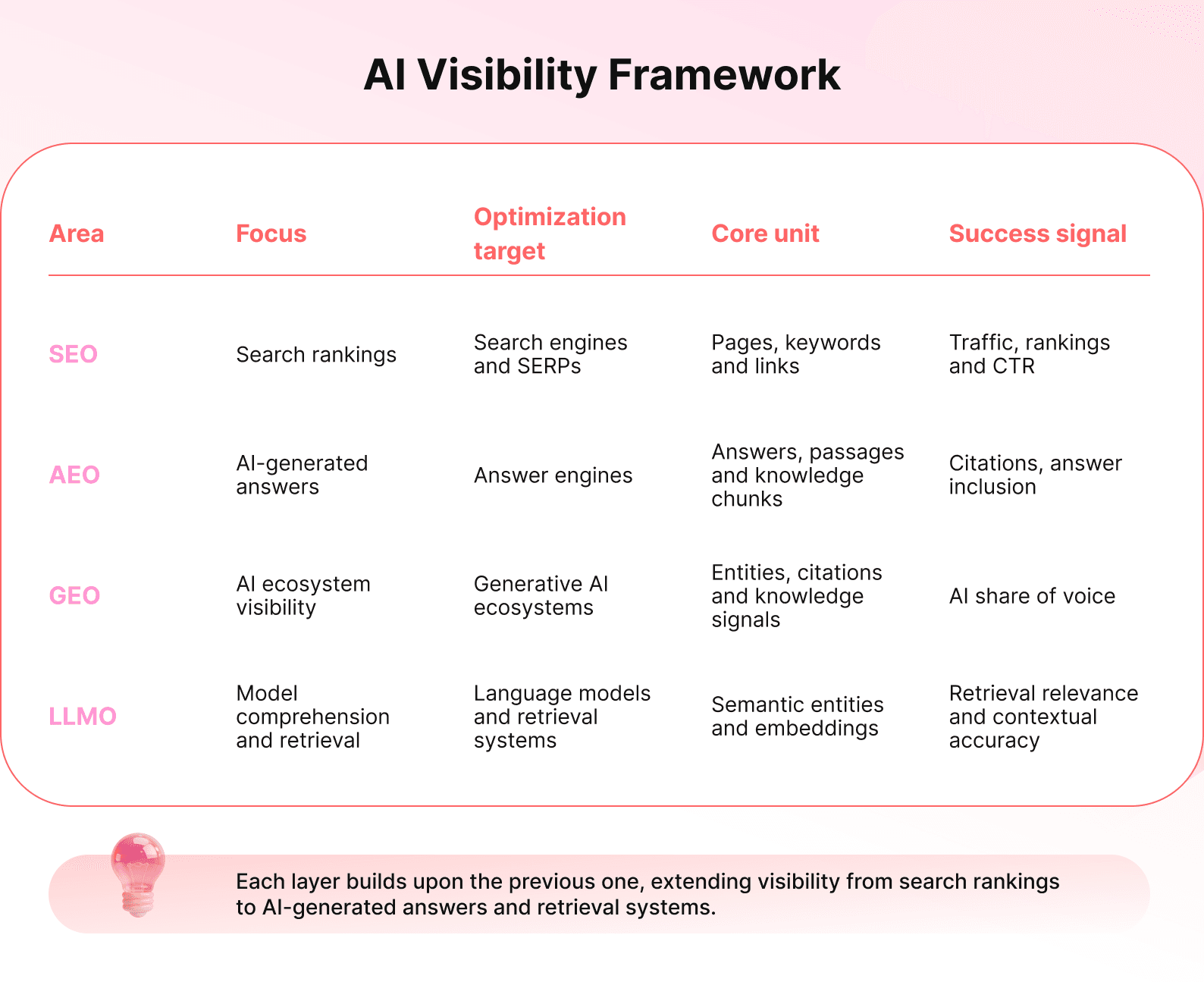
These models operate at different layers of the modern search ecosystem.
SEO remains the foundation for crawlability, indexing and authority. AEO focuses on retrieval and citation inside generated answers. GEO expands toward broader AI visibility across conversational systems, while LLMO focuses on how content is interpreted, embedded and retrieved by language models.
In practice, modern AI visibility strategies combine all four approaches.
Chapter 5
The New Unit of Search: Knowledge Chunks
Modern retrieval systems assemble answers from semantically relevant chunks. This shifts optimization from page-level rankings toward retrieval efficiency at the section level. A strong retrieval-ready chunk often follows:
- Question or topic
- Direct answer
- Supporting explanation
- Examples or evidence
- Structured formatting where useful
| Weak structure | Retrieval-ready structure |
|---|---|
| VPNs are becoming increasingly important in today’s digital environment because online privacy matters more than ever before and many people are now looking for ways to browse more securely across different networks and devices. | A VPN encrypts internet traffic and helps protect user data on public or unsecured networks. It creates a secure connection between a device and the internet, reducing the risk of interception and improving online privacy. |
AI retrieval systems prioritize semantic density, structural clarity and extraction quality over length and keyword repetition.
Chapter 6
How AI Systems Evaluate Trust
AI retrieval systems evaluate trust through semantic consistency, source authority and cross-source corroboration.
Unlike traditional ranking systems, answer engines compare patterns across multiple sources to estimate confidence and factual reliability.
Common trust signals include:
- topical authority;
- citation frequency;
- semantic consistency;
- source reputation;
- contextual relevance;
- freshness;
- corroboration across trusted sources.
Consensus plays a major role in retrieval systems. When multiple authoritative sources repeat similar explanations, recommendations or definitions, retrieval systems assign higher confidence to that information during synthesis.
Community-driven platforms such as Reddit, forums and Q&A sites also perform well in retrieval-driven environments because they naturally contain conversational phrasing, direct answers, practical examples and repeated real-world validation patterns.
What Answer Engines Look For
While retrieval systems vary across platforms, most answer engines tend to prioritize:
- direct answers;
- clear heading hierarchy;
- semantic clarity;
- supporting evidence and sources;
- topical authority;
- structured formatting;
- freshness when relevant.
Content that combines strong extractability with clear trust signals is more likely to be retrieved, cited and synthesized into generated answers.
Chapter 7
AI-Native Content Architecture
Answer-First Structure
Well-performing retrieval content places the primary answer near the beginning of a section instead of delaying it behind long introductions or SEO filler.
| Weak structure | Answer-first structure |
|---|---|
| Cybersecurity has become increasingly important in today’s digital world because organizations face many online threats and security challenges. | Cybersecurity protects systems, networks and data from unauthorized access, attacks and digital threats. Modern cybersecurity strategies include encryption, access controls and threat monitoring. |
Question-Oriented Headings
Question-based headings improve retrieval precision by aligning sections with conversational queries, comparisons and user intent.
| Less clear | More retrieval-friendly |
|---|---|
| VPN Benefits | What Does a VPN Do? |
| Privacy Features | How Does a VPN Improve Privacy? |
| Security Uses | When Should You Use a VPN? |
Atomic Structure & Information Density
Retrieval systems process content more effectively when each paragraph focuses on one clearly defined idea.
| Weak paragraph | Atomic structure |
|---|---|
| Content marketing, SEO, social media and email marketing all help businesses improve visibility online and connect with customers across multiple channels. | Content marketing attracts audiences through useful content. SEO improves visibility in search and AI-driven discovery systems. Email marketing supports direct audience communication. |
Structured Formatting
Structured formatting improves extraction quality by separating information into distinct semantic units. Common retrieval-friendly formatting patterns:
- bullet points;
- numbered lists;
- comparison tables;
- FAQ sections;
- definitions;
- schema markup.
| Unstructured formatting | Structured formatting |
|---|---|
| Cloud storage is widely used by businesses because it allows teams to access files remotely, improve collaboration, scale infrastructure, reduce hardware costs and support backup and disaster recovery processes across different environments. | Cloud storage helps businesses: - store files remotely; - access data across devices; - improve team collaboration; - scale infrastructure more efficiently; - reduce hardware maintenance costs; - support backup and disaster recovery. |
Chapter 8
Platform-Specific Optimization
Different answer engines use different retrieval systems, ranking signals and source preferences. Visibility patterns vary significantly across platforms:
- ChatGPT prioritizes authoritative, highly cited and semantically structured content.
- Google AI Overviews favor content supported by strong rankings, topical authority, structured data and answer-first formatting.
- Perplexity emphasizes well-sourced content, research, statistics and multi-source corroboration.
- Claude favors structured reasoning and logically organized content with clear semantic flow.
- Gemini emphasizes entity clarity, topical authority and fresh, well-structured information.
- Voice assistants favor short, direct and conversational answers supported by FAQ-style content and question-based headings.
Chapter 9
From Entity SEO to Entity AEO
Modern retrieval systems evaluate entities and semantic relationships.
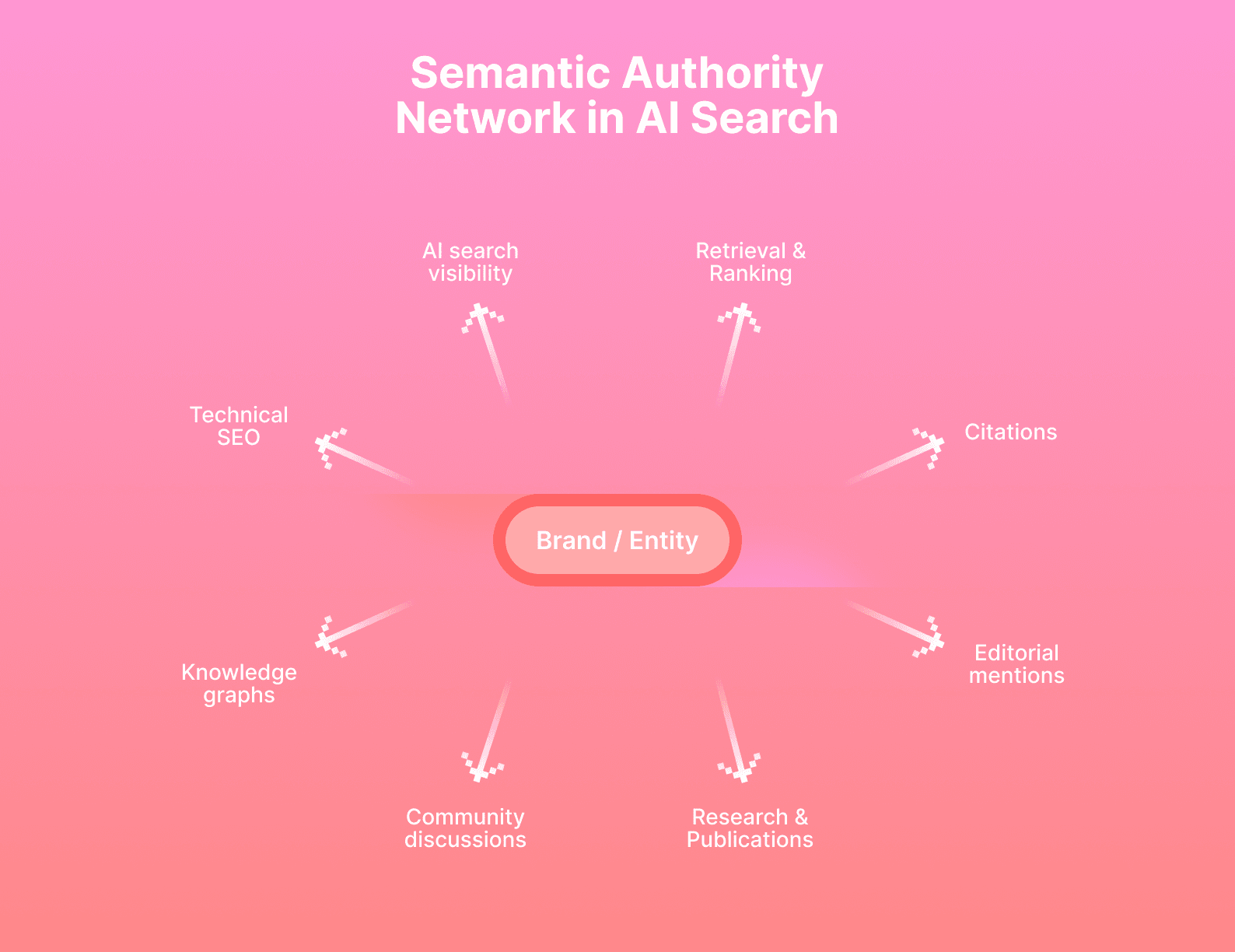
An entity can represent a brand, person, product, company, technology or concept. Retrieval models map relationships between entities and the topics they appear alongside across the web.
Semantic authority strengthens through repeated contextual association. When a brand consistently appears alongside topics such as “technical SEO,” “AI visibility” or “retrieval systems,” AI systems increasingly associate that entity with those subject areas during retrieval and synthesis.
These associations are reinforced through:
- editorial mentions;
- citations and references;
- expert commentary;
- community discussions;
- cross-platform visibility;
- consistent topical coverage.
This shifts optimization beyond keyword targeting toward building durable semantic relationships between entities and topics across the broader information ecosystem.
Chapter 10
AI Visibility & Measurement
AI-driven discovery changes how visibility is measured. Traditional SEO metrics such as rankings, impressions and clicks were designed for link-based search environments. As AI-generated answers increasingly separate visibility from traffic, AI visibility requires additional measurement models.
| Metric | What it measures |
|---|---|
| Citation share | How often a brand or source appears in AI-generated answers |
| Answer inclusion rate | How frequently content is included inside generated responses |
| AI visibility | Overall presence across AI platforms and answer engines |
| Prompt coverage | The range of prompts and intents a brand appears for |
| Entity recall | How strongly AI systems associate an entity with a topic |
Common AI visibility analysis methods include:
- citation monitoring;
- prompt testing;
- entity visibility tracking;
- conversational search auditing;
- cross-platform answer analysis.
Unlike traditional rankings, AI visibility often influences users before they visit a website. Citation growth may contribute to branded search demand, direct traffic and conversions even when referral traffic from answer engines remains limited.
AI attribution remains difficult because users may discover a brand through AI-generated answers but convert through other channels later.
Chapter 11
The AEO Framework
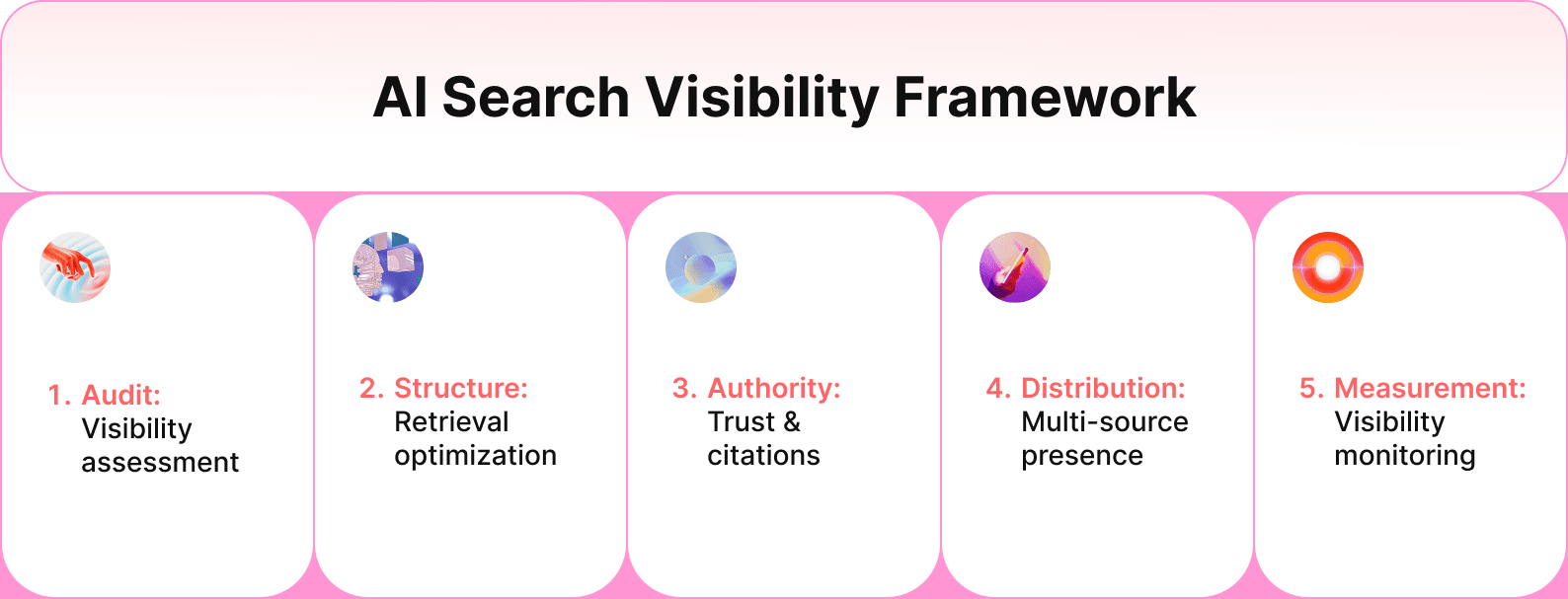
AEO works as a continuous visibility system. The framework below focuses on five core layers that influence retrieval, citation and AI visibility across answer engines.
1. Audit
The audit phase evaluates current AI visibility across answer engines. Typical activities include:
- prompt testing;
- citation analysis;
- competitor visibility research;
- topic gap analysis;
- entity association mapping.
2. Structure
This layer focuses on retrieval optimization and structural clarity. Key areas include:
- answer-first writing;
- chunk optimization;
- structured formatting;
- semantic organization;
- schema markup.
3. Authority
Authority is reinforced through:
- editorial mentions;
- expert citations;
- original research;
- PR visibility;
- third-party references;
- semantic consistency across platforms.
Freshness also plays an important role in AI visibility, particularly for commercial, product-related and rapidly evolving topics. Regular content updates help maintain retrieval relevance as answer engines increasingly prioritize current information.
4. Distribution
AI systems retrieve information from a broad ecosystem. Strong distribution often covers:
- LinkedIn;
- Reddit;
- YouTube;
- industry publications;
- forums;
- community platforms.
5. Measurement
AI visibility requires continuous monitoring and iteration. Measurement typically includes:
- citation tracking;
- prompt monitoring;
- entity visibility analysis;
- answer engine comparison;
- conversational search auditing.
Chapter 12
Tactical Playbook
The following tactics improve retrieval visibility, citation probability and AI visibility across answer engines.
Retrieval-Oriented Content Formatting
Retrieval systems favor content structured around direct answers, clear intent and extraction-friendly formatting. High-performing retrieval patterns often use:
- FAQ sections;
- answer-first paragraphs;
- question-based headings;
- comparison content;
- concise conversational phrasing.
Examples of retrieval-friendly headings:
- What is Vector Search?
- How Does AI Retrieval Work?
- SEO vs AEO: What’s the Difference?
Schema & Structured Data
Structured data improves machine readability and contextual interpretation. Schema types commonly used for AI visibility:
- FAQ;
- Article;
- Product;
- Organization;
- HowTo.
Statistics & Original Research
Original research, proprietary datasets, benchmarks and first-party data increase citation probability because AI systems often prefer primary sources over secondary references. Unique information creates differentiated knowledge that can be directly cited and attributed during retrieval and synthesis. First-party data is particularly valuable because it creates information that competing sources cannot easily replicate.
Chapter 13
Common AEO Mistakes
The most common mistake many websites still follow is SEO patterns designed primarily for rankings and keyword coverage. Here are the other most frequent AEO mistakes:
- Delaying answers behind long introductions.
- Burying important information deep inside pages.
- Using large paragraphs that cover multiple ideas at once.
- Weak structure, low semantic precision and filler-heavy content.
- Generic AI-generated content with limited originality.
- Weak topical consistency and poor entity associations.
- Missing citations, sources or trust signals.
- Content that ranks well in SERPs but remains difficult to extract and synthesize.
AI retrieval systems prioritize clarity, structural precision and extraction efficiency.
Chapter 14
The Future of AI Discovery
Answer engines have evolved far beyond simple discovery tools. They compare products, summarize research, recommend solutions and guide users directly within conversational interfaces.
Additionally, conversational interfaces are gradually progressing into environments capable of handling purchases, scheduling, workflow automation and service coordination directly inside AI systems.
Chapter 15
Final Conclusion
Ranking is no longer enough. AEO addresses the layer that traditional SEO doesn't. AEO targets how content is retrieved, synthesized and cited inside AI-generated answers. Brands that invest in semantic authority, retrieval visibility and structural clarity now are building an advantage that will only compound as AI-driven discovery continues to grow.
Chapter 16
FAQ
What is Answer Engine Optimization (AEO)?
AEO is the practice of optimizing content for AI retrieval, synthesis and citation inside AI-generated answers from platforms such as ChatGPT, Google AI Overviews and Perplexity.
Does AEO replace SEO?
No. SEO remains the foundation for crawlability, indexing and authority. AEO complements SEO by improving how content is retrieved and cited by AI systems.
How do answer engines choose sources?
Answer engines evaluate sources using signals such as relevance, authority, semantic clarity, freshness and corroboration across multiple trusted sources.
What content performs best in AI search?
Content with direct answers, clear structure, question-based headings, strong supporting evidence and retrieval-friendly formatting tends to perform best.
Why is freshness important for AEO?
Freshness influences retrieval relevance, particularly for commercial, product-related and rapidly evolving topics. Regular updates help maintain citation visibility across answer engines.
How do you measure AI visibility?
Common metrics include citation share, answer inclusion rate, prompt coverage, entity recall and overall visibility across AI platforms.
Chapter 17
Glossary
Answer Engine Optimization (AEO)
The practice of optimizing content for AI retrieval, synthesis and citation
Generative Engine Optimization (GEO)
A strategy focused on brand visibility across generative AI systems and conversational platforms
Large Language Model Optimization (LLMO)
Optimization for how language models interpret, retrieve and process content
AI visibility
The presence of a brand, entity or source inside AI-generated answers, citations and summaries
Entity
A recognizable concept that AI systems connect to related topics and entities, which can include brands, people, products, organizations, technologies or concepts
Retrieval
The process of locating and selecting relevant information before generating a response
Embeddings
Numerical representations of semantic meaning used to compare contextual similarity between pieces of content
Vector search
A retrieval method based on semantic similarity rather than exact keyword matching
Chunk
A retrievable section of content focused on a single topic, question or idea
Semantic authority
The strength of an entity’s association with a topic across citations, references and contextual mentions
Citation share
How often a source, brand or website appears inside AI-generated answers
Prompt coverage
The range of prompts and intents associated with a brand or source inside AI-generated responses
Zero-click search
Search experiences where users receive answers directly inside the interface without visiting external websites.