
Affiliate campaigns don’t fail because of bad offers. More often, they fail because the traffic doesn’t match the goal. Choosing a traffic source is not about what’s popular right now — it’s about choosing a source that actually fits your funnel, budget and conversion logic.
Some sources bring scale but low intent. Others deliver fewer users but higher-quality actions. The key is knowing what you need from traffic before you buy it, not after the budget is gone.
In this guide, we’ll break down how to evaluate and choose the best traffic sources for affiliate campaigns based on real performance logic — not hype.
Start With a Campaign Goal
Before comparing platforms or formats, you need clarity on one thing: what does success mean for this campaign? Affiliate goals usually fall into a few clear categories:
- Direct sales or purchases;
- Leads or sign-ups;
- Engaged sessions or qualified clicks;
- Retargeting users who already know the brand.
Each goal requires a different mindset when choosing traffic sources for affiliate marketing. For example, traffic that works well for awareness or engagement may perform poorly for last-click conversions.
If your goal is performance, you should consider which source aligns with user intent at this stage of the funnel. Once the goal is clear, evaluating affiliate traffic sources becomes much more straightforward and far less risky.
Match Traffic Intent to the Funnel Stage
Not all traffic is meant to convert right away, which is where many affiliate campaigns go wrong. Before choosing a source, it’s important to understand how close the user is to taking action.
At a high level, traffic intent usually fits into three funnel stages: top of funnel, middle of funnel and bottom of funnel.
Top of Funnel (TOF)
Users are browsing, discovering or consuming content. They’re not actively looking to buy. Native ads and content-driven placements often perform well here, especially when the offer requires education or context.
Middle of Funnel (MOF)
Users are comparing options, reading reviews or exploring solutions. This is where storytelling, advertorial formats and value-driven creatives can move users closer to conversion.
Bottom of Funnel (BOF)
High intent, action-oriented users who are ready to convert. Search and retargeting typically dominate this stage, but scale is often limited and costs are higher.
Understanding where your offer fits helps you choose affiliate marketing traffic sources that support the full journey rather than just the final click.
When traffic intent and funnel stage are aligned, you’re no longer forcing conversions. You’re guiding users naturally, which is exactly how the best affiliate marketing traffic sources deliver sustainable results.
Paid vs. Organic Traffic: What Affiliates Really Need to Know
On paper, organic traffic sounds ideal: free clicks, long-term value, strong intent. However, in reality, most affiliate campaigns rely on paid channels because they offer speed, control and scale.
Organic traffic (SEO, content, email lists) works best when:
- You already have an audience;
- Time is not a limiting factor;
- The offer converts well with warm traffic.
Although, organic growth is slow and hard to scale on demand, especially for affiliates working with time-sensitive offers or testing new GEOs.
Paid traffic, on the other hand, gives affiliates flexibility:
- Fast launch and quick feedback;
- Precise targeting and optimization;
- Predictable scaling once performance is proven.
That’s why most performance-driven affiliates focus on the best paid traffic sources for affiliate marketing because not only are they cheaper but also they’re measurable and controllable.
The key takeaway is simple: organic traffic is a great asset, but paid traffic is a working tool. If your goal is testing, scaling and optimizing offers efficiently, paid channels usually do the heavy lifting.
Understand the Strengths of Different Traffic Source Types
Not all channels behave the same. Each type has its own strengths, limitations, and best-fit use cases.
Search traffic
Search traffic has high intent and strong conversion potential, especially for bottom-of-funnel offers. The downside? It has limited scale and rising competition; therefore, it works best when the offer already has demand.
Social traffic
Social traffic is great for fast reach and emotional hooks. Social platforms can drive volume quickly, but traffic quality heavily depends on creatives, moderation rules and algorithm changes.
Display traffic
Display traffic offers broad reach and low CPCs but usually requires aggressive filtering and optimization to maintain quality. It is best used with strong pre-landers or retargeting strategies.
Native advertising
Native advertising sits between content and performance and performs best when an offer needs explanation, context or storytelling before conversion.
Google Discover deserves special attention in this context. Its algorithm pushes content based on user behavior and topic affinity, creating an audience that arrives with a natural interest in browsing and discovery. This intent profile aligns naturally with native advertising, which is why publishers powered by Discover-driven traffic often show stronger engagement and more stable performance. It allows affiliates to shape user intent rather than rely on it already existing.
One important nuance many affiliates overlook is that native advertising is not a single traffic source — it’s an ecosystem. At MGID, native traffic is aggregated directly from publishers, which allows us to see and classify the actual upstream origins of that traffic: organic, social, Google Discovery, direct, referral and other sources.
This transparency helps explain why certain publishers consistently deliver stronger engagement or more stable conversion behavior for specific verticals. In practice, native traffic is a mix of different acquisition channels, unified by a content-driven placement environment. Being able to identify and analyze those upstream sources allows affiliates to optimize more intelligently than in channels where the supply chain remains opaque.
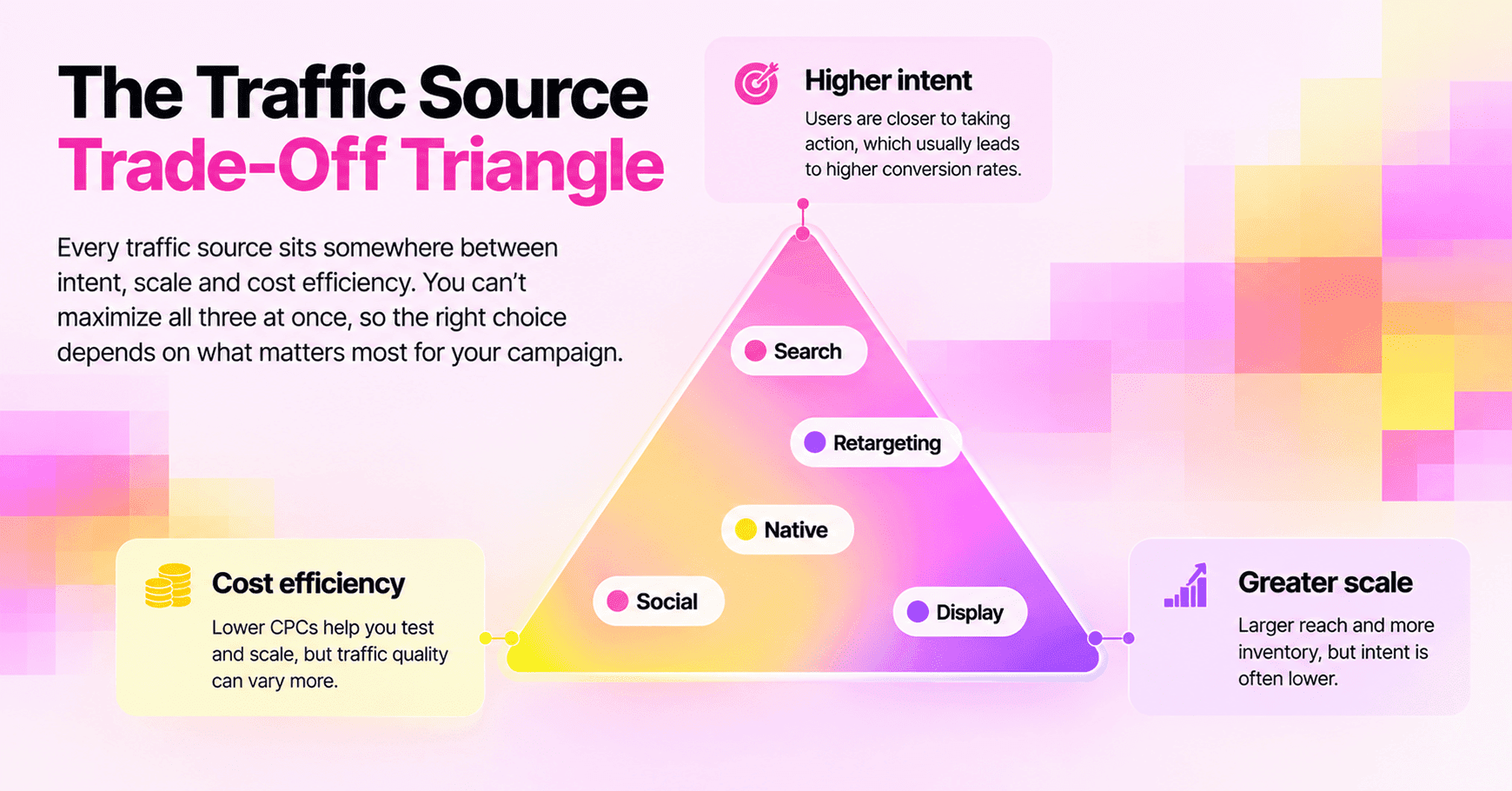
The point isn’t to label one channel as best. The real advantage comes from understanding what each source is designed to do — and choosing based on how users behave, not how platforms position themselves. That’s how experienced affiliates narrow down the best traffic sources for affiliate marketing without wasting budget on mismatched channels.
Not sure where to start? Use the quick selector below to find the best-fit traffic source for your campaign.
Evaluate Traffic Quality Beyond Volume and CPC
High traffic volume doesn’t equal high performance, and low CPC doesn’t mean profitable traffic. When choosing traffic sources for affiliate marketing campaigns to rely on, affiliates often focus too much on surface metrics. In practice, traffic quality shows up deeper in the funnel.
Here’s what actually matters:
- User behavior after the click: Time on site, scroll depth, interactions, these signals quickly show whether users understand and trust the offer.
- Consistency of performance: A source that delivers stable results week after week is more valuable than one that spikes once and then burns out.
- Creative responsiveness: Good traffic reacts to new angles, headlines and formats. If changing creatives has no impact, the issue may be the source itself.
- Alignment with the offer logic: Some offers need education, others need urgency. Not every source can support both.
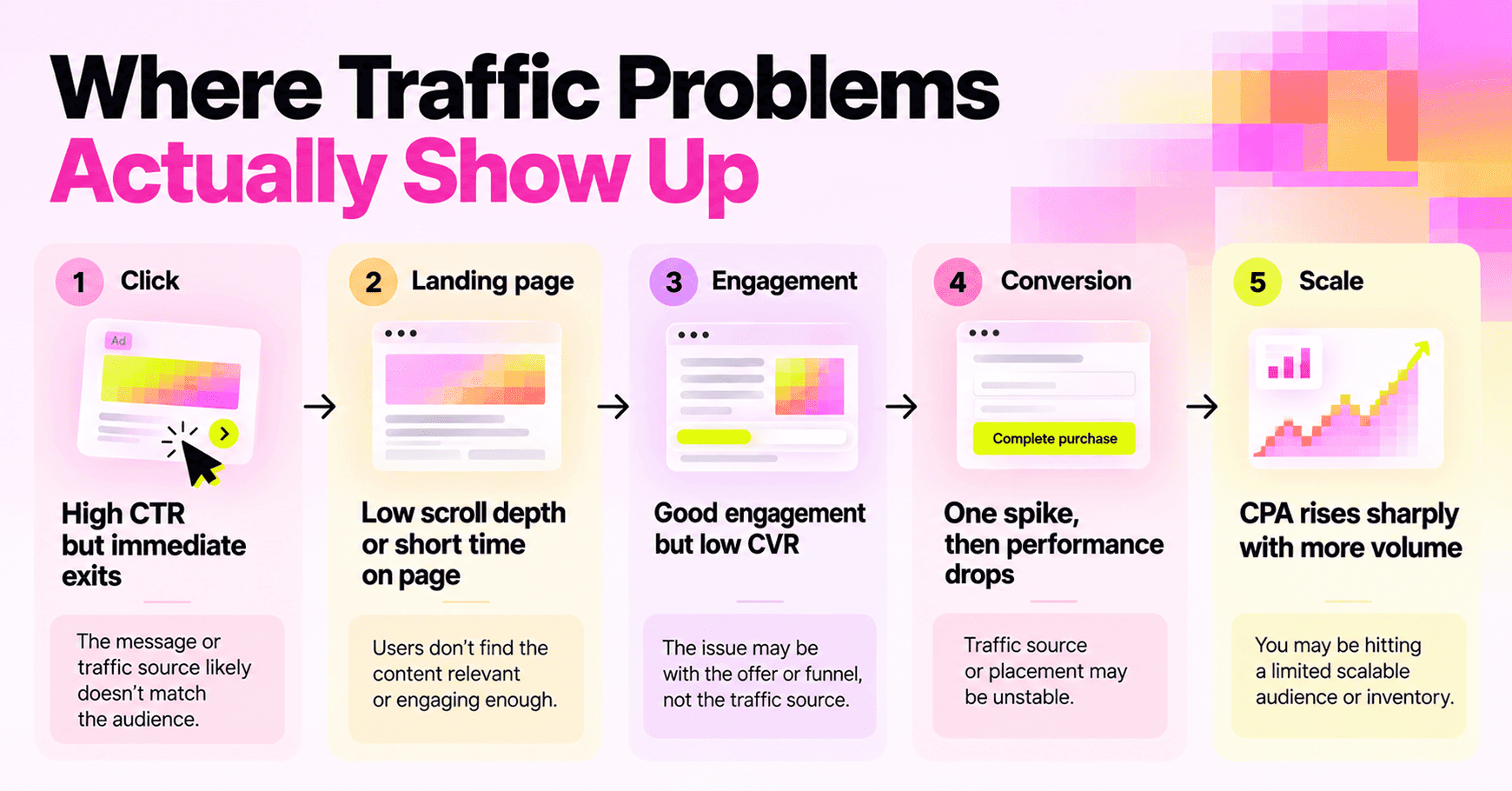
Experienced affiliates judge affiliate traffic sources by how well they support optimization — not just by how cheap the clicks look in reports.
If traffic allows you to test, learn and improve results over time, it’s doing its job. If not, scale only amplifies the problem.
When traffic comes from multiple sources and behaves differently across publishers and placements, achieving stable results becomes more complex. Scale alone doesn’t guarantee performance, especially when intent varies across traffic origins.
This is where tools like CTR Guard and CPA Tune come into play. CTR Guard helps stabilize upper-funnel KPIs by identifying early signs of creative fatigue and protecting engagement quality, while CPA Tune dynamically evaluates where and how bids should be distributed based on performance signals across different traffic sources, placements and user behavior patterns.
Instead of optimizing each source in isolation, this approach focuses on results, aligning delivery decisions with what actually drives higher-quality actions.
How to Choose and Test the Right Traffic Source
There’s no universal formula for picking traffic. What works for one offer or GEO can fail completely for another. That’s why experienced affiliates treat traffic selection as a testing process, not a one-time decision.
A simple framework can help narrow down traffic sources for affiliate marketing without unnecessary risk.
Start small and controlled
Test one source at a time with clear KPIs, and avoid launching across multiple platforms simultaneously. Launching multiple platforms at once makes results harder to read.
Match the source to the offer mechanics
Offers that need explanation benefit from content-driven environments. Straightforward, impulse-driven offers often perform better with high-intent traffic.
Watch behavior, not just conversions
Early signals like engagement and click quality often predict long-term performance better than first-day conversions.
Scale only after patterns appear
Once performance becomes consistent, scaling is safer and more predictable. That’s when a source earns its place among your best traffic sources for affiliate campaigns.
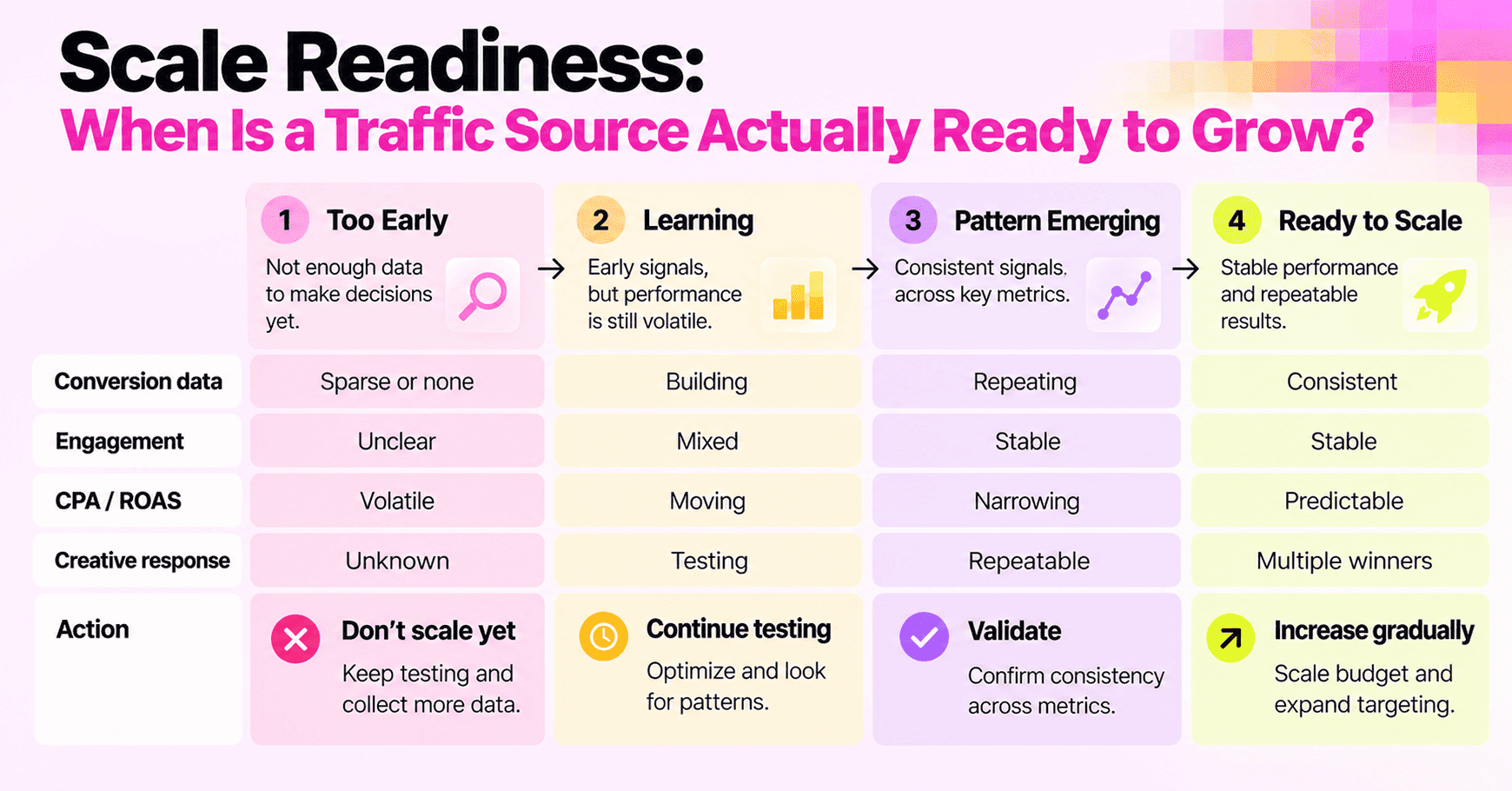
The goal is to build a short, reliable list of best affiliate marketing traffic sources that you can understand, optimize and scale with confidence.
Conclusion: Focus on Fit, Not on Hype
Choosing traffic is about understanding how users behave, how offers convert and how different environments influence decision-making.
The best traffic sources for affiliate marketing are rarely universal. They’re contextual. What matters is how well a source supports testing, learning and optimization — not how loud it’s promoted in the industry.
Successful affiliates treat traffic as a system. They test carefully, read signals early and scale only what proves its value. That’s how reliable affiliate marketing traffic sources are built over time.
When traffic aligns with intent, funnel stage and offer logic, performance becomes predictable — and that’s where real affiliate growth starts.