Updated: September 2026
One sale, one $500 commission. That’s the math that makes high-ticket affiliate marketing so tempting and the math that can get expensive fast.
A big payout means little until you know how many visitors it takes to earn it, how much those visitors cost and how many sales survive approval, refunds and reversals. With thin enough margins, even a small drop in conversion rate can turn impressive commissions into bad economics.
The trick is knowing which one you’re looking at before you pay for the lesson.
- What Is High-Ticket Affiliate Marketing?
- Is High-Ticket Affiliate Marketing Actually More Profitable?
- How to Choose a High-Ticket Affiliate Offer
- A Simple Beginner Funnel for a High-Ticket Offer
- How to Optimize High-Ticket Conversions
- What to Track: Clicks Are Not Enough
- High-Ticket Affiliate Programs: Three Current Examples
- When a High-Ticket Offer Is Not Ready to Scale
- A Beginner Plan: From Offer to First Validated Sales
- High-Ticket Affiliate Marketing FAQ
What Is High-Ticket Affiliate Marketing?
The “high-ticket” part can be misleading, though. Three numbers often get lumped together:
| Term | What it actually means |
|---|---|
| High product price | The customer pays a large amount for the product or service. |
| High commission rate | The affiliate earns a relatively large percentage of an eligible sale. |
| High commission payout | The affiliate earns a large dollar amount from an eligible sale. |
They can overlap, but they don’t have to. A $5,000 product with a 5% commission pays $250, while a $1,000 product with a 30% commission pays $300. Recurring commissions can change the equation again.
So, when evaluating high-ticket affiliate programs, don’t let the product price do the thinking for you. Start with the commission you can actually earn and the conditions attached to it.
How High-Ticket Affiliate Marketing Works
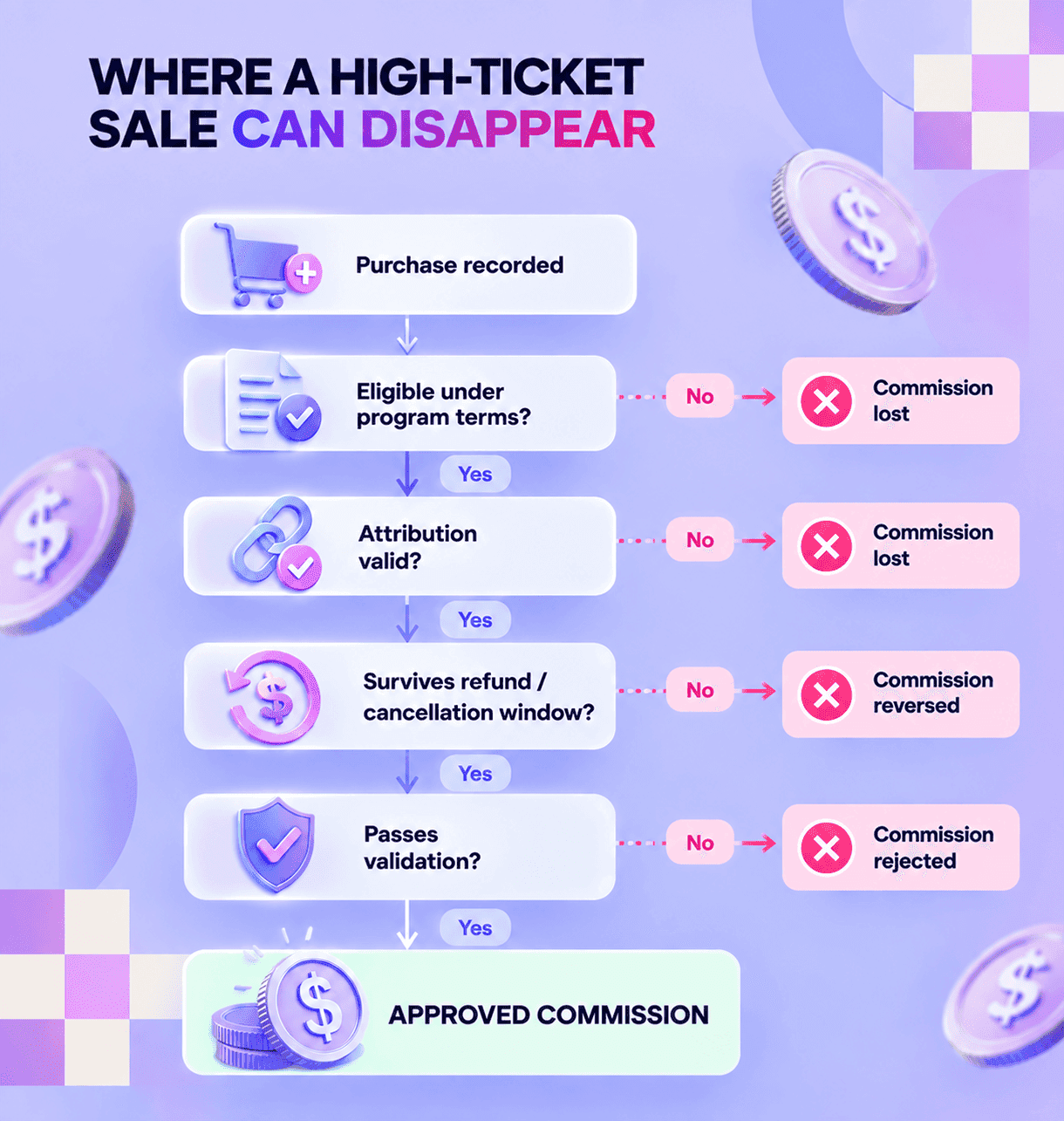
A high-ticket affiliate sale rarely ends at the moment someone clicks “Buy.” What happens between that click and the commission hitting your account matters just as much as the advertised payout.
Most high-ticket affiliate programs use one or a combination of these commission structures:
- Flat payout: a fixed amount for each eligible sale, regardless of the purchase value.
- Percentage commission: a percentage of the eligible purchase amount.
- Recurring commission: ongoing payouts while the referred customer remains subscribed or continues to meet the program’s terms.
- Tiered commissions or bonuses: higher rates or additional payouts after specific performance thresholds are reached.
However, the headline commission is only the beginning. A typical path can look more like this:
Is High-Ticket Affiliate Marketing Actually More Profitable?
A larger commission gives you more room to acquire a customer. Whether any of that room turns into profit depends on how much traffic costs and how often it produces an approved sale.
Take a hypothetical high-ticket affiliate offer paying $300 per approved sale.
| Scenario A | Scenario B | |
|---|---|---|
| Visits | 1,000 | 1,000 |
| Approved-sale conversion rate | 0.5% | 0.2% |
| Approved sales | 5 | 2 |
| Commission per approved sale | $300 | $300 |
| Gross commission | $1,500 | $600 |
| Traffic cost at $1 per visit | $1,000 | $1,000 |
| Remaining before other costs | +$500 | -$400 |
Nothing about the offer changed. The payout stayed at $300 and traffic still cost $1 per visit. A 0.3 percentage-point change in the approved-sale conversion rate was enough to move the campaign from $500 above traffic cost to $400 below it.
And even that is not the final profit calculation. Content production, tools and other operating costs still need to come out of the first scenario’s $500. Payout delays also affect cash flow, while later refunds or reversals can reduce commissions that initially appeared in the affiliate dashboard.
Keep the math in context, though: these figures are illustrative assumptions rather than benchmarks or earnings forecasts. Actual results depend on the offer, traffic source, audience, attribution rules, approval process, refunds, reversals and other costs.
Want to see how sensitive the economics are to your own assumptions? Plug in the numbers below and stress-test the offer.
How to Choose a High-Ticket Affiliate Offer
A $700 commission can make an offer look irresistible. Before building content or buying traffic around it, find out exactly what has to happen for that $700 to become yours.
Start with these seven checks:
| What to check | What you need to know |
|---|---|
| Audience need | Does the offer solve a problem your audience actually has, with enough intent to justify the price? |
| Evidence of product quality | Can you verify the product’s claims, reputation and customer experience rather than relying on affiliate copy? |
| Eligible sale | What exactly must happen for a conversion to qualify for commission? |
| Attribution window | How long after your referral can a purchase still be credited to you? |
| Payout delay | How long will you wait between generating an approved sale and receiving the money? |
| Refund and clawback rules | Can a refund, cancellation or other event reverse a commission, and for how long? |
| Traffic restrictions | Does the program restrict paid search, native advertising, social ads, email, brand bidding or other acquisition methods? |
You can find high-ticket offers through affiliate networks or directly through merchant programs. The same screening rules apply either way.
The details become even more important when the buying cycle is long. A 7-day attribution window, for example, may be a poor fit for an offer people routinely research for weeks. A generous commission can also lose much of its appeal if refunds are frequent or your main traffic source is prohibited. If you need a refresher on how credit is assigned across that journey, see our guide to attribution in affiliate marketing.
A Simple Beginner Funnel for a High-Ticket Offer
High-ticket buyers often need time to compare options, check the evidence and decide whether the purchase is worth the commitment. Your funnel needs to support that research instead of rushing straight to the merchant page.
A simple setup can look like this:
1. Review
Explain what the product does, who it suits, where it falls short and what evidence supports its claims. A useful review should explain what the product does, who it suits, where it falls short and what evidence supports its claims.
2. Comparison
Give readers realistic alternatives. Price, features, limitations and use cases help them narrow the choice while keeping your recommendation credible.
3. Opt-in
For someone who isn’t ready to spend yet, offer a useful next step: a buyer’s checklist, calculator, short guide or another resource directly connected to the decision.
4. Follow-up
Use email to answer questions that rarely fit into a single page: common objections, use cases, additional evidence and practical guidance. Our guide to affiliate email marketing covers this stage in more detail.
5. Merchant hand-off
Send the prospect to the merchant when they have enough context to take the next action, whether that is booking a demo, starting a trial, requesting a consultation or completing the purchase.
How to Build Evidence Before Asking Someone to Buy
A $2,000 purchase puts vague claims under a microscope. “Best in class,” “life-changing” and “worth every penny” won’t answer the questions buyers have before spending that kind of money.
Strong high-ticket affiliate marketing content gives buyers something they can actually evaluate:
- Firsthand experience: Show how the product works when you have used or tested it yourself.
- Specific use cases: Explain who the offer makes sense for and in which situations.
- Proof behind claims: Use demos, screenshots, specifications, verified results or other evidence you can substantiate.
- Real limitations: Cover meaningful drawbacks, requirements and situations where the product may be a poor fit.
- Useful comparisons: Compare the offer with credible alternatives using criteria that matter to the purchase.
- Clear disclosure: Make the affiliate relationship easy to understand rather than burying it around the recommendation.
You don’t need to manufacture certainty where it doesn’t exist. If you haven’t tested a product yourself, say so and work with evidence you can verify. If a performance claim comes from the merchant, attribute it accordingly.
A simple test is to remove the affiliate link and reread the page. If the content still helps someone make a better purchase decision, the recommendation has enough substance to stand on its own.
How to Optimize High-Ticket Conversions
Before trying to improve your conversion rate, define what the conversion actually is. An email signup, demo request, completed purchase and approved sale are four very different events, yet all can appear as “conversions” in a report.
That makes universal benchmarks particularly shaky for high-ticket offers. A 10% conversion rate might be perfectly plausible for a low-friction opt-in in some contexts. Expecting 10% of visitors to complete and retain a high-value purchase is an entirely different assumption.
Instead, measure the journey stage by stage. For example:
Now you can see where the real friction occurs. If plenty of people opt in but few request a demo, the follow-up may need work. If demos turn into purchases but many commissions are later reversed, improving the landing page won’t solve the underlying problem.
Optimization should follow the bottleneck. Test the elements closest to it — offer framing, evidence, comparison, CTA, form, follow-up sequence or traffic source — and change one meaningful variable at a time.
What to Track: Clicks Are Not Enough
A funnel can look healthy right up until you calculate what each approved commission actually cost to produce. Track enough of the journey to find out where the money is being made — or lost.
The most useful metrics depend on your funnel, but typically include:
- Cost per visit: How much you spend to bring someone into the funnel.
- Opt-in or lead rate: How many visitors take the first meaningful action.
- Merchant click-through rate: How many prospects continue to the merchant.
- Purchase rate: How many referred visitors complete a purchase.
- Approved-sale rate: How many visits ultimately produce a commission that qualifies for payment.
- Refund or reversal rate: How often recorded commissions are later lost.
- Approved commission: The amount that survives the program’s validation process.
Two simple calculations can then tell you much more than click volume alone:
If you’re paying for traffic:
That second number still isn’t profit — content, tools and other operating expenses remain. It does, however, quickly expose an offer that needs $1,000 in traffic to generate $700 in approved commissions.
Track these numbers by traffic source, campaign and offer where possible. An overall average can easily hide one source producing profitable approved sales while another burns through the margin.
High-Ticket Affiliate Programs: Three Current Examples
Here’s how three real programs structure commissions and eligibility differently:
| Program | Commission structure | Attribution / timing | What to watch |
|---|---|---|---|
| Shopify | Fixed payout for eligible full-price plan referrals; currently $150 in many major markets and $25 in several others | Referral must meet Shopify’s eligibility and tracking requirements | Payout varies by the referred merchant’s GEO and eligible plan |
| WP Engine | $100 for Lite; $200 or the first month’s payment, whichever is higher, for other eligible hosting plans | 180-day cookie; qualifying referrals must remain in good standing through the validation period | Final payout depends on the plan purchased |
| ClickFunnels | Percentage-based commissions, including recurring SaaS commissions; rates depend on affiliate tier and eligible offer | Commissions are subject to the program’s qualification and payout rules | The highest advertised rate may not be the rate available to every affiliate |
These examples are not evidence of typical or expected earnings. They show why comparing high-ticket affiliate programs requires more than scanning the commission column: check what qualifies, how attribution works, when a commission becomes payable and what can cause it to be reversed.
Program terms change, so verify the current conditions on the official affiliate page before building a campaign around any offer.
When a High-Ticket Offer Is Not Ready to Scale
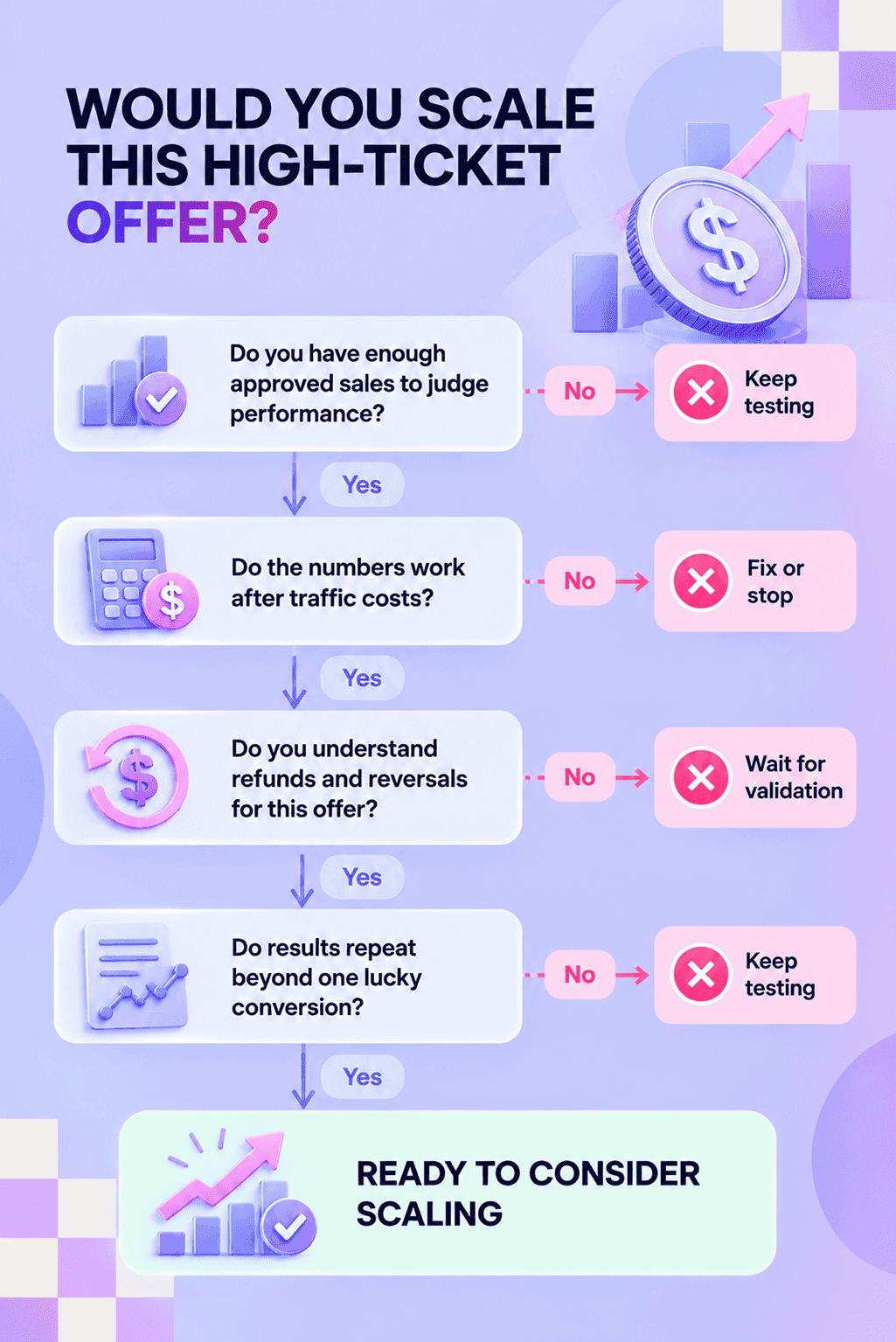
A few early sales can make increasing traffic feel like the obvious next move. With high-ticket offers, a small sample can be deceptive: one approved sale can dramatically change the numbers, while one reversal can pull them straight back down.
Before putting more money or content behind an offer, check whether any of these are still true:
That last one is easy to miss. If an offer only becomes profitable at a 0.5% approved-sale rate and your campaign has produced one sale from 200 visits, you haven’t established a 0.5% conversion rate. You have one sale and a very small sample.
A Beginner Plan: From Offer to First Validated Sales
The fastest way to make high-ticket affiliate marketing complicated is to test too many things at once. For a first run, keep the setup deliberately narrow:
- Pick one real audience problem: Start with something people are actively trying to solve and expensive enough to research before buying. You need purchase intent, not just an interesting niche.
- Screen one or two offers: Check the product, commission terms, attribution window, payout timing, refund rules and traffic restrictions. If the economics only work under perfect conditions, keep looking.
- Build enough evidence to earn the click: Create a useful review, comparison or other decision-stage content. Answer the awkward questions too: who shouldn’t buy, where the product falls short and what credible alternatives exist.
- Give buyers one clear path forward: A complex funnel isn’t automatically a better one. Use only as much nurturing as the decision needs, whether that means review → merchant or review → opt-in → follow-up → merchant.
- Spend to learn, not to prove yourself right: Set a testing budget you can afford to lose and watch where the funnel breaks before increasing traffic.
- Wait long enough to judge the result: Don’t call the test after the first promising conversion. Give purchases time to pass the program’s approval process, then compare what you actually earned with what you spent.
Your first campaign doesn’t need to scale. It needs to give you a clean answer: keep it, fix it or kill it.
High-Ticket Affiliate Marketing FAQ
What is considered a high-ticket affiliate commission?
There is no universal threshold. What counts as high-ticket varies by niche, product and commission model, so the payout should always be considered alongside the effort and cost required to generate an approved sale.
Is high-ticket affiliate marketing good for beginners?
Yes, but start narrow. One offer, one audience and one acquisition path make it much easier to learn what works without burning through a testing budget.
How much does it cost to start high-ticket affiliate marketing?
There is no fixed starting cost. Organic strategies trade more time for lower traffic costs, while paid acquisition requires a budget large enough to test the offer without depending on immediate returns.
Can you do high-ticket affiliate marketing without paid ads?
Yes. SEO, email, video and social content can all drive affiliate traffic, making paid advertising optional rather than a requirement.
How long does it take to get paid for a high-ticket affiliate sale?
It depends on the program. Approval periods, refund windows and payment schedules can all create a gap between the purchase and the actual payout.
What is an approved affiliate sale?
It is a referred conversion that has met the program’s eligibility requirements and passed validation. A recorded purchase can still be refunded, rejected or reversed before reaching this stage.
Are high-ticket affiliate programs more profitable?
Not automatically. Profitability depends on approved-sale conversion rates, acquisition costs, refunds, reversals and other expenses rather than the commission size alone.
What should you check before joining a high-ticket affiliate program?
Check the eligible-sale definition, attribution window, payout timing, refund and clawback rules, traffic restrictions and product quality. Then test whether the economics work for your traffic source.
So, Is High-Ticket Affiliate Marketing Worth It?
The real advantage of a high-ticket offer is room: more room to educate the buyer, more room to acquire traffic and more room to test. What matters is how much of that room is still left when the sale is approved and the costs are counted.
Start narrow, learn what one approved sale actually costs you and earn the right to scale.
Once you have an offer worth scaling, MGID can help you reach new audiences with native advertising, campaign optimization tools and expert support.