This article compares MGID’s built-in tracking analytics system with third-party analytics tools like GA4, explaining the critical difference between passive observation dashboards and real-time optimization engines. Learn why delayed, black-box analytics hurt your ROI, how to feed precise conversion signals directly to AI bidding algorithms, and why building a hybrid tracking stack is the smartest play for scaling performance campaigns.
Every media buyer knows the drill: launch a campaign, observe traffic, then check your numbers.
However, depending on where you are checking, those numbers will differ. For example, the affiliate network dashboard shows 50 conversions. Google Analytics says you only have 12. Your external tracker claims 45. So, who is right? In reality, nobody is lying. They just measure the exact same reality using completely different logic.
But when you are spending thousands of dollars a day, discrepancies are more than just a reporting headache. They actively destroy your ROI. In the current era of campaign tracking advertising, manual bidding is practically dead. AI algorithms run the show. These systems do not have intuition, relying entirely on the data you feed it. If you starve the machine, or give it delayed signals, your optimization simply breaks down.
This brings up a critical question. Should you rely on external analytics to run your media buying, or should you pass data directly back to the traffic source?
To answer this question, let’s explore how observation tools differ from optimization engines.
The Problem with Observation Mode (GA4 and External Trackers)
Almost every website runs a Google Analytics tag. It is the default. However, if you have ever tried to leverage GA4 for paid traffic to manage high-speed campaigns, you know that is a brutal trap.
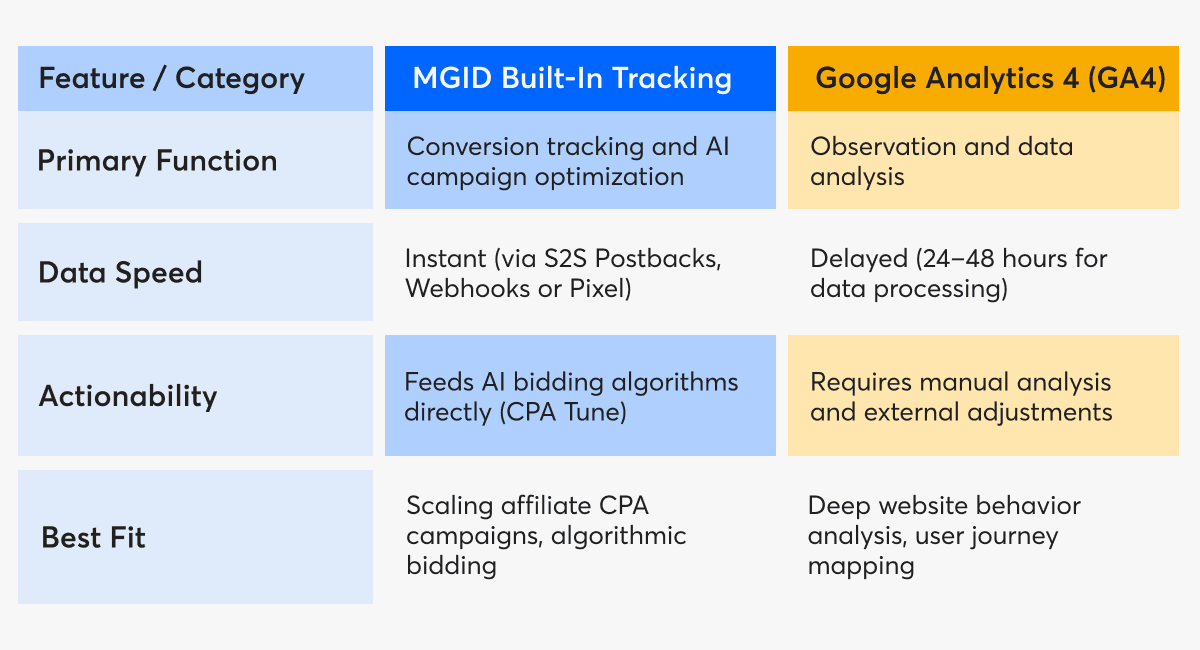
GA4 maps out broad trends beautifully. It sits at the very end of the funnel and takes notes. It observes. It reports yesterday's news. Say you drop a fresh creative today, or a random placement suddenly starts converting like crazy. If you have to wait for Google's dashboard to aggregate that info, your momentum is lost, and the optimization window is permanently closed.
Now let’s look at the heavy-duty tech. We can’t deny that dedicated ad tracking tools — your Voluums and RedTracks — exist for a reason. Media buyers need serious affiliate tracking solutions to route clicks, run split tests and wrangle dozens of traffic sources. No argument there. They organize the daily chaos exceptionally well.
However, the problem starts when the data stops moving. Glaring at green numbers in an external tracker does absolutely nothing to train your traffic source. A dashboard observation isn't an optimization. When conversion signals get stuck inside a third-party interface, the actual bidding algorithm back at the network gets nothing. It just keeps guessing.
What Is MGID Built-In Tracking? (The Optimization Engine)
MGID built-in tracking isn’t your run-of-the-mill reporting dashboard. It acts as a direct line to the AI bidding algorithm (CPA Tune). When you pass conversion data straight back to the network, the algo sees actual performance and makes even better predictions for the campaign, learning the patterns that lead to conversions.
You are no longer observing the data. With MGID built-in tracking, you enable the system to start acting.
So, how do you feed the machine? Read on to discover what data fuels this analytics system.
The MGID Pixel (1st-Party Sensor)
Third-party cookies are practically extinct with browsers blocking them aggressively and swiftly. Our sensor code sidesteps that entire mess by operating strictly on 1st-party cookies. It grabs the unique click ID the exact millisecond a user hits your page. Since the cookie belongs to your own domain, privacy filters ignore it.
In addition to conversion tracking MGID Pixel does more than count sales. It automatically pulls deep MGID analytics straight into your dashboard, which we call Engagement Metrics. With these metrics — Time on Site, Cost per Visit (CPV) and Landing Rate — you immediately know if a pre-lander actually hooks your audience or just racks up bounce rates.
Postbacks (S2S) and Webhooks
Browser pixels sometimes drop. Users close tabs too fast, or internet connections glitch. That is exactly why serious media buyers rely on Server-to-Server (S2S) Postbacks or Webhooks.
Your server talks directly to the MGID server. If a user buys a product, your backend instantly pings our system with the exact event and revenue value. Zero browser interference, zero missing data. It is arguably the most bulletproof setup you will find among modern conversion tracking tools.
Native Integrations
Hate messing with custom postback URLs or JavaScript snippets? We get it, and that brings us to Native Integrations.
If you already use a supported heavyweight platform like Voluum, you can link the platform directly inside the MGID Ads dashboard. It requires absolutely zero coding. The platforms connect via API, and the data syncs completely behind the scenes.
Core Differences: Why Observation Limits Optimization
Algorithms eat data. If you starve them, your budget withers.
Speed and Decision-Making
When a specific placement suddenly starts printing money, you need to know instantly. If you’re using Google Analytics to aggregate those numbers, you won’t see those numbers for 24 to 48 hours. By the time you see the spike, the auction is completely over. Serious media buying demands real-time campaign analytics. MGID postbacks and webhooks fire the exact second a user converts. CPA Tune reacts immediately without aggregation delays.
Categorizing User Intent
Sending a generic "event" ping back to a traffic source tells the algorithm almost nothing. Did the user view a landing page, or did they pull out a credit card? The difference between the two is drastic, and not knowing can mean wasted spend. MGID solves this using Conversion Categories.
With Conversion Categories, you label the exact funnel step. You tell the system if the action was a simple Page View, an Add to Cart, or a finalized Purchase. By labeling the action, the machine learning model stops confusing casual window shoppers with high-intent buyers. It dynamically shifts your ad spend toward the specific categories that actually drive your ROI.
Attribution Logic: Black Box vs. Deterministic
Now let's look at tracing the sale. It is imperative that you tie revenue back to the exact click to calculate your margins. Unfortunately, this is exactly where GA4 attribution limitations will wreck your media buying math. Google relies on its own proprietary data-driven models. The entire process happens inside a locked black box, and you have zero control over how conversion credit gets assigned.
MGID does not guess. We use a simple 1-to-1 matching system. Every time a user clicks your ad, we generate a unique click ID for that exact click. When that person finally buys something, your setup simply passes that exact click ID back to us. We match click with conversion. It is pure, undeniable math. No black-box algorithms trying to claim credit for random sales. If you are serious about conversion tracking affiliate marketing, relying on this kind of exact, proof-based tracking is absolutely necessary.
The Smart Play: The Hybrid Approach
So, should you delete your GA4 account? Absolutely not. However, you should not use it to manage your active bids.
The smartest media buyers do not choose one over the other. They run a hybrid tracking stack. They plug MGID tracking directly into the campaign to feed the CPA Tune algorithm. Whether it is a Postback, a 1st-party Pixel or a Native Integration, this native connection handles the real-time heavy lifting and optimizes traffic.
Meanwhile, GA4 sits quietly in the background. Use it for what it actually does best: deep website behavior analysis, identifying cross-channel overlap and long-term user journey mapping.
Conclusion: Optimization Over Observation
The era of manual bidding is over. Bidding algorithms now require 1st-party data and instant server pings just to survive the auction.
MGID tracking exists to take action while external analytics exist to observe. If you want to scale your daily spend without burning through your margins, you absolutely need real-time, platform-level signals. Stop making optimization decisions based on delayed dashboards and algorithmic guesswork.
Give the machine the raw data it needs, step back, and let the algorithm do its job.
FAQ
1. What is MGID built-in tracking?
MGID built-in tracking is a platform-level analytics system that measures impressions, clicks, CTR and conversions in real time. Crucially, it directly feeds optimization algorithms like CPA Tune so they can adjust your bids instantly.
2. Is GA4 enough for affiliate and performance campaigns?
No. While using GA4 for paid traffic is useful for broad analysis and reporting, it completely lacks the real-time optimization signals and campaign-level automation needed to scale performance advertising.
3. Can I use MGID tracking together with GA4?
Yes, absolutely. The smartest advertisers run a hybrid setup. They use MGID tracking as their real-time optimization engine for active campaigns, and rely on GA4 for overarching website behavior and long-term funnel analytics.
4. Why does MGID tracking react faster than GA4?
MGID tracking operates directly at the platform level. It processes data instantly, completely bypassing the sampling, 24-to-48-hour delays, and algorithmic modeling typical of external analytics tools.
5. Does MGID tracking support privacy-first advertising?
Yes. MGID tracking (via 1st-party cookies and S2S postbacks) is explicitly designed to work in cookieless and privacy-restricted environments, ensuring you get accurate optimization signals while remaining fully compliant.