In a 3BHK in Ahmedabad, two weeks before the wedding, the bride’s family is arguing over cushions. The living room is full of relatives, mithai boxes and open browser tabs from Pepperfry, Urban Ladder and local stores. Someone is reading an article titled “Simple Indian Wedding Home Prep Ideas for Newlyweds.” A moodboard circulates for a welcome area complete with a console, a brass urli, a mirror, a jute rug and warm lighting. Every item is tagged, every tag leads to a product. By the end of the evening, the family stops arguing because they’ve ordered everything for the big day — most of it from one brand.
No one felt like they were reading an ad, but that’s exactly what they were doing.
For Indian home & interior decor brands, this is the real battleground: not the last-click discount banner but that sudden moment of inspiration, when someone imagines a Diwali-ready living room or a Pinterest-style kitchen in a small Indian flat.
Native advertising slips into that moment. It’s the article they save, the makeover they share on WhatsApp, the “Shop this Look” they tap at midnight.
This guide shows how home & decor brands can use native ads to live inside those moments and turn everyday inspiration into demand.
Why Native Ads Resonate with Indian Consumers
If there’s one thing uniquely true about Indian home buyers, it’s this: they decorate for meaning. A living room is where Diwali guests gather. A bedroom is where newlyweds start their life. A kitchen is a statement about family, culture and convenience.
Native ads blend seamlessly into this emotional and cultural decision-making process, resonating with Indian consumers because they feel like guidance rather than promotion. Here are five main reasons why native ads connect so deeply in India:
- Indians trust advice-based content: A listicle like “5 Space-Saving Furniture Ideas for Indian Flats” feels like a friend’s recommendation. When products appear inside this kind of content, purchase resistance drops dramatically.
- Native ads align with India's information-heavy buying journey: Indians research heavily before buying, compare materials, check vastu tips, ask family opinions and research maintenance. Native ads support this research mindset rather than interrupt it.
- Native ads match the natural browsing flow: Indians spend hours on content-heavy sites like Bollywood news, cricket updates and festival guides. Native ads blend into these environments, appearing exactly when users are relaxed and open to ideas.
- Native ads don’t feel like forced selling: Traditional display ads often feel pushy, but native ads feel more like tips, ideas, guides, and consumers appreciate the difference.
- Native ads reflect everyday Indian home problems: When a native article says “How to hide clutter before guests arrive” or “Bedrooms for homes without separate wardrobes,” it instantly connects because these are real Indian pain points. Native placements allow brands to solve everyday problems.
Content-Led Buying in India’s Home Decor Market
India’s home & interior industry is booming, driven by rising incomes, urban migration, hybrid work lifestyles and the emotional importance of home ownership. And what’s accelerating the market even more is content-led buying. Today, Indian consumers start with content: a makeover video, a Diwali decor article, a small apartment hacks reel, a vastu guide… and then they buy.
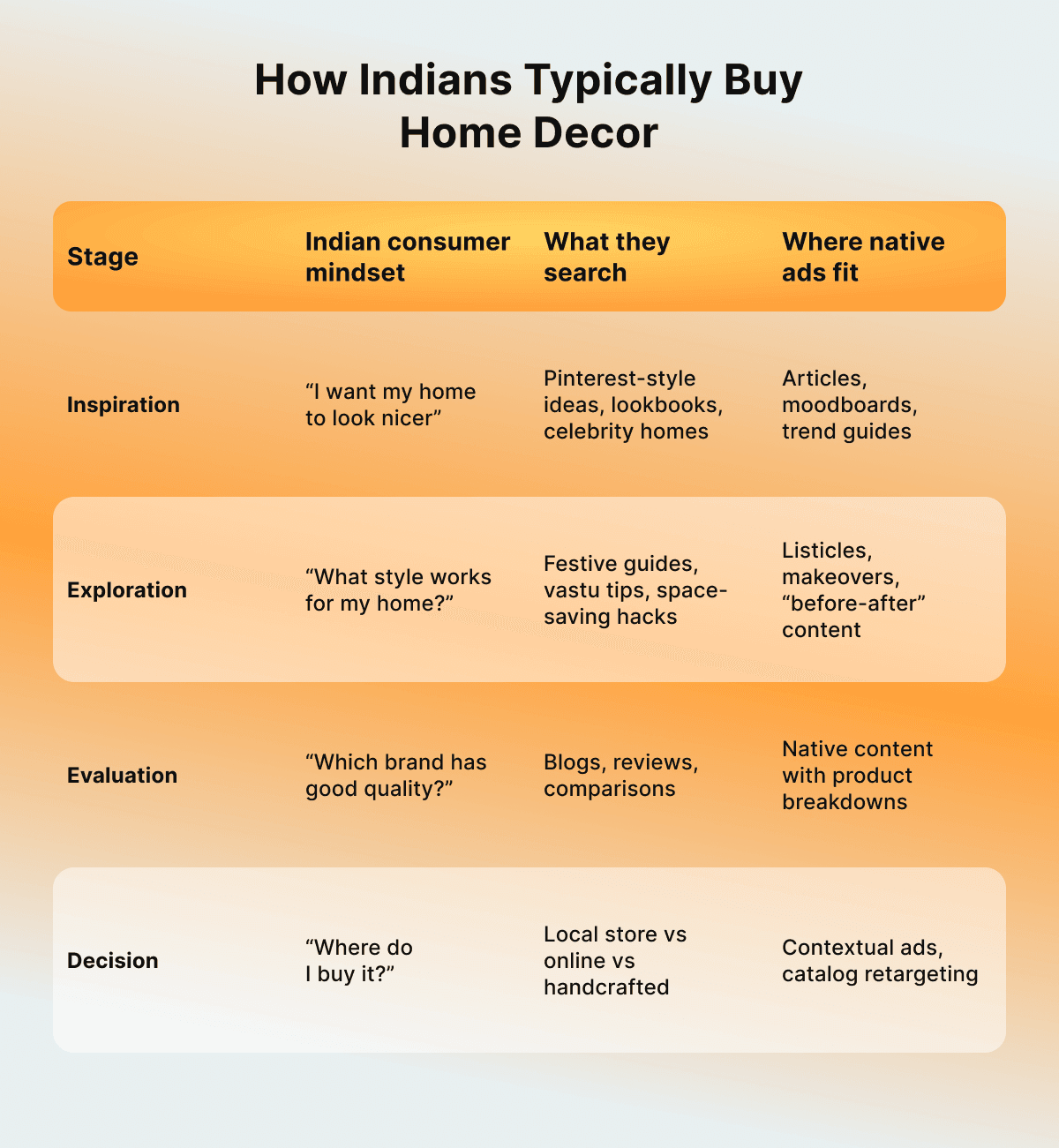
Native advertising influences three out of four stages, long before a user even reaches your website.
Why This Matters for Brands
Indian decor shopping is driven by aspiration. A Tier 2 consumer looking for a ₹7,000 coffee table will still browse 10 makeover guides before choosing one. A strong native strategy lets your brand:
- Become the “expert voice” guiding users;
- Show up early enough to shape preferences;
- Introduce product categories users didn’t even know existed;
- Build trust before sales messaging appears.
In simple terms, content creates demand, and native ads capture that demand earlier than competitors.
The Rise of Inspiration-Driven Shopping on Indian Lifestyle Portals
In India, home decor inspiration comes from the everyday sites people browse without any intention to shop. Bollywood portals, festival guides, Hindi and Tamil lifestyle sites, renovation blogs, even wedding planning pages quietly shape what Indians want their homes to look like.
A reader scrolling through “Diwali Lighting Ideas for a Small Apartment” or “Inside Kareena Kapoor’s Minimalist Living Room” is already in a mindset of curiosity and inspiration. When your products appear inside these stories, styled naturally within Indian homes, they feel like part of the advice rather than an ad.
So why do these portals work so well for native ads?
- High attention: Indians often spend several minutes reading long-form content.
- Soft influence: Users are open to ideas, not yet resisting buy now messaging.
- Cultural fit: Regional language content and local aesthetics (cane, teak, marble, jute) build instant trust.
- High sharing behavior: Articles get forwarded on WhatsApp during home makeovers, weddings or festive prep.
Inspiration happens on these portals every day, and native ads let your brand quietly enter that moment, guiding users from idea to interest to intent.
Understanding the Indian Home & Interiors Audience
India’s home decor buyers are a mix of life stages, cultural habits, housing realities and emotional triggers, and knowing these segments helps native ads feel precise rather than generic.
Key Consumer Segments
- Homeowners: They seek long-term, durable furniture. These audiences care about materials (sheesham, teak), vastu alignment and premium aesthetics.
- Renters: They prioritize affordability, compact designs, easy assembly and renter-friendly decor (no drilling, lightweight units).
- Newlyweds: They are inspired by trends, celebrity homes and festive buying, often redesigning entire rooms at once.
- NRI Buyers: They purchase for parents or new investments, prefer trusted Indian brands and low-maintenance pieces.
Influence of Weddings, Festivals & Vastu
Home improvements in India often revolve around cultural moments:
- Weddings: Entire-home refresh, guest-room setups, gifting furniture & décor
- Festive seasons (Diwali, Eid, Durga Puja, Onam): Lighting, textiles, wall decor, puja setups
- Vastu preferences: Bed placements, colours, mirror positions and entryway decor all influence purchases
High-Intent Moments
These are the moments when consumers are most open to inspiration-led shopping:
- Griha Pravesh: New homeowners upgrading essentials quickly
- Renovation cycles: When people actively seek makeovers, layouts and before-after stories
- Pre-festive upgrades: Quick decor changes (rugs, lighting, cushions, wall art) to refresh homes before guests arrive
These segments and moments guide how brands should craft native ads, matching the real-life situations driving decor decisions.
Best Native Advertising Formats for the Indian Market
India’s home & decor audience respond to ideas that feel instantly usable. The strongest native formats are the ones that mirror how Indians naturally search for inspiration and imagine changes in their homes.
Story-Led Article Ads on Top Indian Publishers
Articles like “How to Refresh Your Living Room Before Diwali Guests Arrive” or “Small Apartment Layout Mistakes Most Indians Make” organically weave your products into practical advice. These placements work because readers are already in solution mode.
Listicles Made for Indian Aesthetics
“Top Sheesham Wood Beds Under ₹25,000” or “10 Ethnic Decor Pieces That Transform a Bare Wall” blend culture, price sensitivity and style cues Indians understand. Users appreciate curated guidance more than hard-selling catalogues.
Trend-Driven Lookbooks
Whether its Bollywood-inspired decor, South Indian minimalism, Rajasthani prints or Kerala woodwork, visual lookbooks tap into strong regional and cultural style identities. These formats convert well when paired with “Shop the Look” callouts.
Before-and-After Makeover Stories
Before-and-after storytelling is one of the most powerful formats in India’s urban centers. Showing how a 2BHK in Mumbai or Bangalore transforms using compact furniture, lighting and multipurpose pieces feels relatable and aspirational.
Short-Form Native Videos with Regional Language Options
Quick 20-30 second clips (“1-Minute Balcony Makeover,” “Budget Bedroom Refresh”) perform extremely well, especially when available in Hindi, Tamil, Telugu, Bengali or Marathi. Regional language creatives dramatically increase engagement and trust.
Creative Native Ad Ideas for Indian Home & Interior Decor Brands
Native ads work best when they tap into familiar Indian lifestyles, small-space challenges, festive rhythms and regional aesthetics. Here are high-impact concepts that consistently perform across publisher networks in India.
Small Indian Apartments, Big Style
This concept is a perennial winner. Show how to transform a 1BHK or 2BHK using compact sofas, foldable dining sets, vertical storage or multipurpose furniture. Real Indian layouts (not Western lofts) make this format instantly believable.
Festive Home Decor Inspirations
From Diwali lighting and Eid centrepieces to Durga Puja colour palettes and Onam floral setups: festivals dictate India’s biggest home-improvement cycles. Brands can feature textiles, lamps, wall art, rangoli accessories or accent pieces styled in season-appropriate themes.
Indian Wedding Home Prep Ideas
Perfect for newlyweds and families upgrading homes before ceremonies. It may be something like guest-room solutions, entryway styling, puja corners and vanity setups. In addition, including price tiers helps match the high-expense wedding environment.
Affordable vs. Premium Decor
India loves comparisons. Side-by-side visuals (₹5,000 vs. ₹25,000 living room upgrades) help consumers quickly evaluate value. Great for brands with wide product ranges across price points.
Craftsmanship Stories From Indian Artisans
Short narratives about Rajasthani woodwork, Kutch embroidery, brass artisans from UP or Banarasi textile techniques add emotional and cultural depth. These stories elevate brand perception and justify premium pricing.
Top Home Decor Trends in India — Annual Edition
This shareable, bookmark-worthy concept includes trending colours, materials (cane, sheesham, marble), modular storage ideas and eco-friendly options. It works exceptionally well during the January-March renovation season.
Regional Style Guides
Help consumers explore styles rooted in local culture:
- South Indian minimalism (warm woods, earthy tones);
- Rajasthani royalty (bright colours, jharokha mirrors);
- Kerala craftsmanship (solid wood, brass accents).
Such guides feel personal and culturally intelligent, which builds trust.
Leveraging MGID Native Ads for Indian Home & Decor Brands
MGID works especially well for home & decor brands in India because its publisher ecosystem mirrors where Indians naturally seek inspiration: lifestyle portals, Bollywood news, architecture blogs, regional-language sites and festival-focused content hubs. By pairing that environment with MGID’s AI-driven targeting, brands can reach audiences at the exact moment they are imagining a home upgrade.
To get the most out of MGID, home & interior advertisers should focus on:
- Top-performing publisher categories: lifestyle, Bollywood, home improvement, architecture, wedding & festive guides
- AI audience targeting: homeowners, newlyweds, decor enthusiasts, upper-middle-class urban buyers and design-interested NRI traffic
- Regional targeting: campaigns for Tier 1 cities and fast-growing Tier 2 hubs -like Jaipur, Coimbatore, Indore, Lucknow and Kochi
- Dynamic retargeting: catalog-based creatives that show exact SKUs with relevant price points
- Analytics insights: metrics that illustrate dwell time on content, scroll depth, festive uplift trends and regional engagement patterns to shape future creatives
The combination of inspiration-rich environments and audience intelligence makes MGID one of the strongest native platforms for Indian decor brands trying to convert browsing into intent.
Content Angles That Work Well in India
Indian home buyers connect most with content that mirrors their daily life: small-space challenges, festive rhythms and the emotional meaning attached to setting up a home. A short story about refreshing a rented 2BHK before Diwali or a guide on making a vastu-friendly bedroom instantly feels relevant.
Cultural pride also plays a major role: features highlighting Rajasthani craftsmanship or Kutch textiles consistently outperform generic decor content. Inspiration that feels local and practical is what drives engagement in India.
Ad Creative Best Practices for Indian Home & Decor Brands
Below is a compact table summarizing how creatives should be adapted for India’s visual expectations.
| Creative element | What works in India | Why it matters |
|---|---|---|
| Setting | Real Indian homes (compact rooms, balconies, modular kitchens) | Adds authenticity and relatability |
| Materials | Sheesham, teak, cane, marble, brass, handloom | Matches familiar Indian aesthetics |
| Layout | Space-saving staging, multi-use pieces | Reflects actual living conditions |
| Aesthetic | Regional palettes and styles | Appeals to cultural identity |
| Seasonality | Festive and wedding cues | Aligns with peak buying moments |
Targeting Strategies for Maximum ROI in India
The most effective targeting understands India’s layered reality: life stages, cultural triggers and urban vs. Tier 2 dynamics. Advertising to 25–40-year-olds is too broad, whereas targeting newlyweds who are reading wedding prep content or homeowners browsing renovation stories delivers far higher intent. Regional nuance also matters: a premium teak collection performs better in metros, while compact furniture resonates strongly in fast-growing Tier 2 cities.
A simple and high-performing mix includes:
- Interest targeting: home decor, vastu, DIY, architecture
- Intent targeting: moving, renovating, festive home prep
- Contextual placements: lifestyle portals, Bollywood sites, festive guides
- Geo segmentation: metros for premium, Tier 2 for value-driven designs
This layered approach ensures you reach Indians at the exact moment they’re imagining a change at home.
Measurement and Optimization for Indian Campaigns
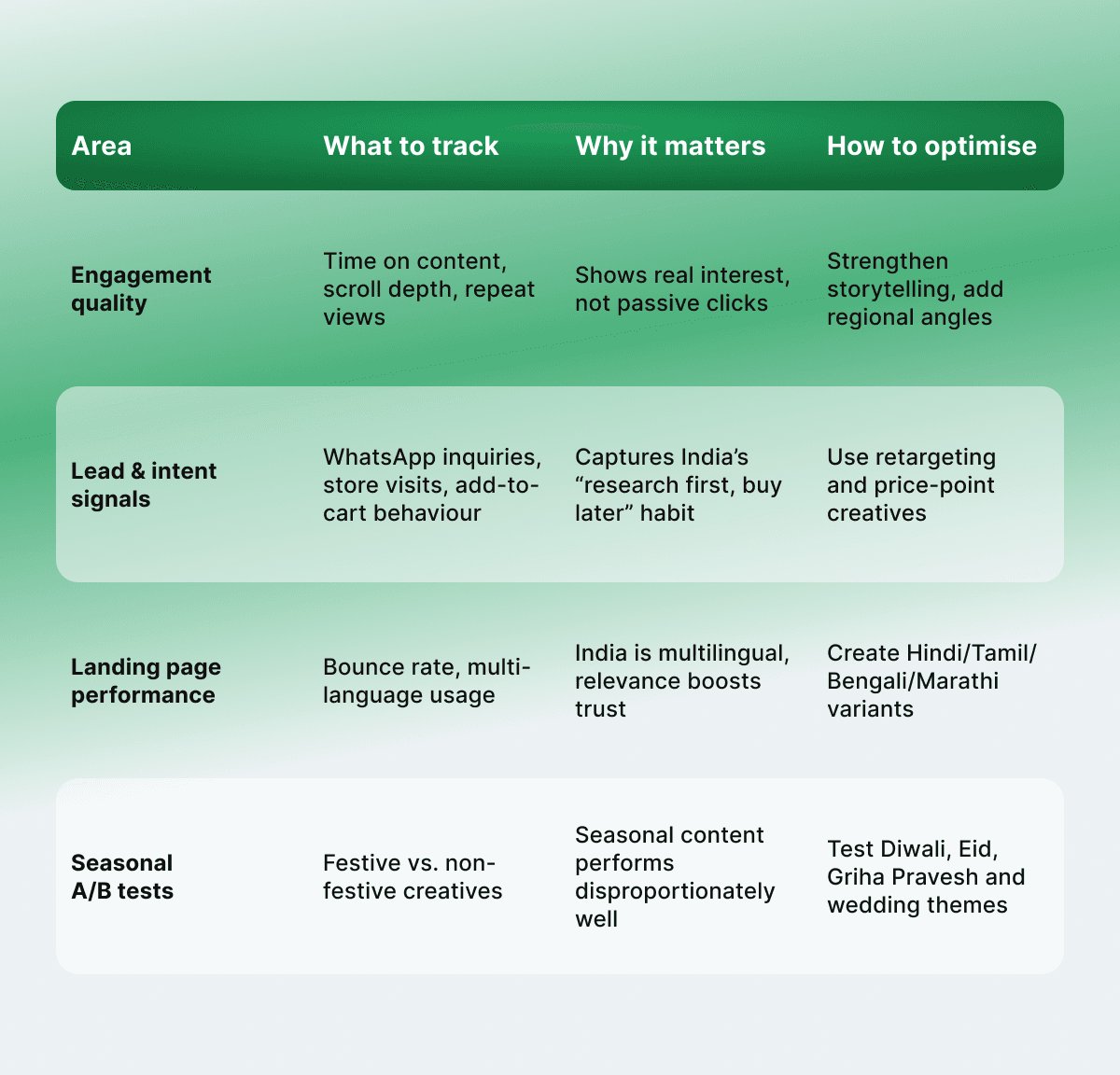
Indian users often engage deeply with home-decor content, so clicks only won’t measure success. The real signal is how long they stay with the content and what they do next.
Here’s a concise framework for what to measure and how to optimise.
Real-World Wins From Indian Home & Decor Campaigns
Below are India-focused case scenarios that illustrate how home & decor brands can successfully use native advertising to drive engagement and conversions.
How a Furniture Brand Increased Festive Sales via Native Ads
A mid-range furniture retailer ran Diwali-focused native articles like “5 Easy Ways to Refresh Your Living Room Before Guests Arrive.” By showcasing compact sofas, nesting tables and lighting setups inside practical tips, the campaign saw a major uptick in WhatsApp inquiries and a 40% lift in festive-season conversions. The key driver: India’s habit of upgrading home decor before Diwali festivities.
Indian Artisanal Brand Increased Success Using Story-Led Content
An artisanal brand used storytelling pieces featuring artisans from Rajasthan and Banaras. Articles such as “The Craft Behind Your Brass Decor” produced longer dwell time and higher trust, leading to a 3x increase in add-to-cart actions. Cultural pride and authenticity proved more persuasive than discounts.
Before-and-After Renovation Content Boosted Leads in Tier 1 Cities
A decor brand targeting urban professionals launched makeover-style content “See How This Mumbai 2BHK Transformed With Just 5 Smart Decor Updates.” Before-and-after visuals, cost breakdowns and “Shop This Look” tags drove qualified leads and a notable spike in Tier 1 traffic. The relatable apartment layout made the content feel instantly achievable.
Why Native Advertising Feels Uniquely at Home in India
India’s home decor journey is emotional and inspiration-led, and native ads fit seamlessly into that flow. By showing real homes, solving everyday challenges and speaking through stories instead of sales talk, brands earn trust early and naturally.
In a country shaped by festivals, weddings, small spaces and regional tastes, native advertising is the most intuitive way to guide consumers from imagination to action.