The first 90 days in affiliate marketing are a chance to turn what you’ve learned into real experience with offers, traffic, testing and conversions.
Starting affiliate marketing can get overwhelming fast. There are dozens of programs to join, traffic sources to explore, tools to try and people recommending completely different ways to do all of it. It's easy to stay very busy without getting much closer to your first meaningful results.
This guide is a set of beginner-focused affiliate marketing tips built around a simple idea: if I were starting today, I'd keep those first three months narrow — choose one clear direction, get something live and use the first real data to decide what deserves more attention.
We'll walk through the first 30, 60 and 90 days: what's worth focusing on at each stage, which numbers actually matter and which mistakes tend to slow beginners down the most. By the end, you'll have a practical framework for getting through your first real cycle of offers, traffic and data.
- What Should Your First 90 Days in Affiliate Marketing Look Like?
- Days 1–30: Build Your Foundation
- Days 31–60: Launch and Get Real Data
- Days 61–90: Optimize What Shows Potential
- How to Use AI in Your First 90 Days of Affiliate Marketing
- Affiliate Marketing Mistakes That Can Derail Your First 90 Days
- What Should You Have After Your First 90 Days?
- FAQ on Your First 90 Days in Affiliate Marketing
What Should Your First 90 Days in Affiliate Marketing Look Like?
Three months is enough time to move from reading guides and comparing options to having your own traffic and performance data to learn from.
A simple way to structure that time is:
| Period | Main focus | What you want to have by the end |
|---|---|---|
| Days 1–30 | Choose your niche, offers and first traffic source | A basic setup that’s ready to launch |
| Days 31–60 | Start driving traffic and collecting data | Enough activity to see early patterns |
| Days 61–90 | Test, optimize and focus on what shows potential | A clearer idea of what to keep, change or drop |
There's no need to treat these dates as hard deadlines. Your first conversion might come on day five or day 55, and either one can be misleading on its own. A single early conversion often says more about luck than about a working offer; some of the beginners I've seen get a sale in week one end up chasing that same angle for a month before realizing it doesn't repeat. Give the pattern time to show itself before you trust it.
What matters is the order. Get the basics in place, launch, collect data and make the next decisions based on what you learn. That sequence guides the rest of this article.
Days 1–30: Build Your Foundation
The first month is mostly about making a few good decisions and getting ready to test them in the real world. This is also where beginners can lose a surprising amount of time researching every possible niche, program and traffic source — often without launching anything.
Here’s where I’d put the attention first:
- Choose a niche you can realistically work with.
- Understand the audience and the problem they’re trying to solve.
- Pick one or two offers to start with.
- Check the affiliate programs behind those offers carefully.
- Choose one primary traffic source.
- Set up basic tracking before you launch.
Six decisions are already plenty for month one. Let’s take them one at a time.
1. Choose a Niche and Understand Who You’re Selling To
A good niche gives you enough room to test different offers without forcing you to talk to everyone at once. Finance, health, beauty, travel, software and eCommerce can all work, but the category itself tells you very little about whether you can make it work.
Before committing to one, look at a few practical things:
- Demand: Are people actively looking for products or solutions in this space?
- Offers: Are there enough legitimate products and affiliate programs to choose from?
- Competition: Who are you going up against, and how are they promoting similar offers?
- Traffic options: Can you realistically reach this audience through the channel you plan to use?
- Your knowledge: Do you understand the topic well enough to create convincing content and recognize a questionable product when you see one?
Then get specific about the audience. "People interested in fitness" isn't particularly useful. Someone looking for a home workout program has different motivations from someone comparing running shoes or researching supplements, and that difference shows up fast in the numbers.
For example, a broad “fitness” offer gives you very little information about who you're really speaking to. Narrow the angle to something like “post-injury home workouts,” and suddenly the audience, message and reasons to click become much clearer.
You don't need a 20-page customer persona at this stage. You need to understand what the person wants, what might stop them from buying and what information they need before they click.
2. Pick One or Two Offers and Check the Program Behind Them
This is where a big commission can become distracting. A 50% commission looks fantastic on an affiliate program page. It matters much less if the product is difficult to sell, the landing page is poor or the program has unreliable tracking and payouts.
Before promoting an offer, check:
- the commission structure and payout terms;
- the conversion action you actually get paid for;
- cookie or attribution rules;
- available creatives and landing pages;
- geographic restrictions;
- traffic sources the program allows;
- the product’s reputation and whether its claims hold up;
- the quality of tracking and reporting.
And spend some time with the product itself. You don’t necessarily need to personally use every product you promote, but you should understand what it does, who it’s for and why somebody would choose it.
There’s also your own credibility to think about. Every recommendation puts a little of it on the line, especially if you’re building an audience through content, email or social media. A generous commission won’t mean much if the product leaves people regretting your recommendation.
Starting with one or two offers also makes your early data much easier to read. If you launch ten offers at once and nothing converts, you’ve created ten different problems to investigate.
3. Choose One Primary Traffic Source
SEO, YouTube, TikTok, email, paid search, native advertising — when you’re just starting out, it’s easy to put together a list of channels that looks like a complete marketing strategy. Managing all of them as a beginner is much harder.
For the first month, one primary traffic source is usually enough. It gives you a cleaner view of where visitors are coming from, how they behave and whether your offer actually connects with that audience.
Your choice will depend mostly on your resources and skills:
| If you… | A good place to start may be… |
|---|---|
| Enjoy writing and can wait for traffic to build | SEO and content |
| Are comfortable creating short-form content | Social media |
| Know how to make useful demos, reviews or tutorials | Video |
| Already have access to an audience | |
| Have a testing budget and want data faster | Paid traffic, including native advertising |
Paid traffic deserves a little caution here. It can get a new offer in front of an audience quickly, which also means you can start collecting useful data sooner. But every test costs money, and inexperienced campaign decisions can burn through a small budget surprisingly fast.
Native advertising is one paid option worth exploring when you’re ready to test beyond organic traffic. Platforms such as MGID let affiliates run campaigns across publisher sites and test different creatives, audiences and placements while tracking what actually converts.
I’d start paid campaigns with a budget I could comfortably treat as learning money. The first time I let a beginner-style budget run without a hard cap, it disappeared in under two days on a broad targeting setup that looked reasonable on paper — the audience was just too wide to ever convert efficiently.
A tighter daily cap and a narrower audience the second time around produced worse-looking numbers on day one and far better ones by day five. Early tests have a habit of teaching expensive lessons, and expecting every dollar to come back immediately makes it tempting to stop or change campaigns before they've produced useful data.
You can add more channels later. For now, learning how one traffic source behaves is already a valuable skill.
4. Set Up Tracking Before the First Click Arrives
Tracking is one of those jobs that feels easy to postpone. There’s nothing to analyze yet, so why spend time setting it up?
Once traffic starts arriving, you'll want to know what happened to it, and tracking installed after the fact can't recover data you never captured.
At minimum, make sure you can identify:
- where your traffic came from;
- which campaign, content piece or creative generated the click;
- how many clicks you received;
- how many resulted in conversions;
- how much you spent, if you’re using paid traffic;
- how much revenue or commission those conversions generated.
Your affiliate program or network will usually provide some reporting, while analytics and tracking tools can give you a more detailed view of the journey before the conversion.
You don’t need an elaborate tracking stack on day one. You do need enough visibility to answer a basic question: which activity produced the result I’m looking at?
A first conversion feels great. A first conversion you can trace back to the exact traffic source, campaign and creative is much more useful.
By the end of your first 30 days, the goal is to have something real ready to test: an offer you understand, an audience you can describe, a traffic source you can work with and tracking you trust. Now the interesting part starts — putting it in front of actual people.
Days 31–60: Launch and Get Real Data
By the second month, you should have enough of the basics in place to stop preparing and start learning from actual behavior.
This stage can feel a little chaotic. Some content gets ignored. A creative you liked gets no clicks. Another one you made in ten minutes somehow performs better. That's the kind of signal you're here for: it only shows up once actual visitors start interacting with your offer.
5. Launch a Few Different Angles
One offer can be presented in several ways.
Take a budgeting app. You could focus on saving money, getting out of debt, tracking subscriptions or simply understanding where your salary disappears every month. Same product, very different reasons to care.
A single creative or message rarely tells you enough on its own. If it fails, you still don't know whether the problem was the offer or simply the way you presented it.
For an early test, keep the variations manageable. You might try:
- three different headlines or hooks;
- two or three creatives;
- different benefits or pain points;
- a review versus a comparison;
- a short landing page versus a more detailed explanation.
The exact format depends on your traffic source. The principle stays the same: give yourself enough variation to learn something without creating so many combinations that the results become impossible to read.
6. Watch a Small Set of Metrics
The first dashboard can be dangerous. Suddenly there are dozens of numbers available, and every one of them looks like something you should be checking.
You don’t need all of them yet. For your first campaigns, start with a small group:
| Metric | What it helps you understand |
|---|---|
| Clicks | Whether people are interested enough to take the next step |
| CTR | How well your creative or content attracts attention |
| Conversions | Whether traffic is completing the action you’re paid for |
| Conversion rate | How effectively clicks turn into conversions |
| Cost per conversion | What each result costs when you’re buying traffic |
| Revenue / commission | What those conversions are actually worth |
Depending on the affiliate program, EPC (earnings per click) can also be useful because it gives you a quick sense of how much value your traffic is generating per click.
The numbers become more useful when you read them together. A strong CTR with almost no conversions, for example, may tell you something very different from a campaign that gets fewer clicks but converts well.
7. Give Your Tests Enough Time to Say Something
One of the easiest beginner habits to fall into is checking results constantly and reacting to every small movement.
- Five clicks and no conversion? Change the headline.
- One conversion? Increase the budget.
- CTR drops for an hour? New creative.
I once pulled a campaign after 40 clicks and zero conversions, convinced the offer was dead, only to see it settle into a normal 2–3% conversion rate once it crossed a few hundred clicks on a relaunch with the exact same creative. The early sample was just too small to mean anything; the "failure" was noise rather than signal.
Small samples can swing wildly. Give a test enough traffic and time to produce a useful signal before deciding what it means. How much is "enough" depends on the offer, traffic source, conversion rate and cost, so there isn't a magic number that works for every campaign.
What you can control is your testing discipline. Keep track of what changed, when you changed it and what happened afterward. If you change the creative, targeting, bid and landing page at the same time, even a better result won't tell you which change helped.
Change one important variable at a time whenever you can. Every early test should leave you with something useful to apply to the next one.
By day 60, you’re looking for patterns rather than perfection. Which message gets attention? Which traffic converts? Where are people dropping off? Those early answers give you something much more useful to work with in month three.
Days 61–90: Optimize What Shows Potential
By month three, you should have something your first month couldn’t give you: your own data.
Maybe you’ve already made a few commissions. Maybe you haven’t. Either way, you should know more about which messages attract clicks, which traffic sticks around and where people disappear before converting.
Now you can start making better decisions.
8. Find Your Winners and Your Weak Spots
Start by looking for patterns across the whole journey.
A simple way to diagnose performance is to work from one step to the next:
- Low impressions or traffic → look at reach, targeting or distribution.
- Traffic but few clicks → look at the headline, creative, placement or offer angle.
- Clicks but few conversions → look at audience intent, the landing page, offer fit or the path to conversion.
- Conversions but poor economics → look at traffic costs, commissions, EPC and the value of the offer.
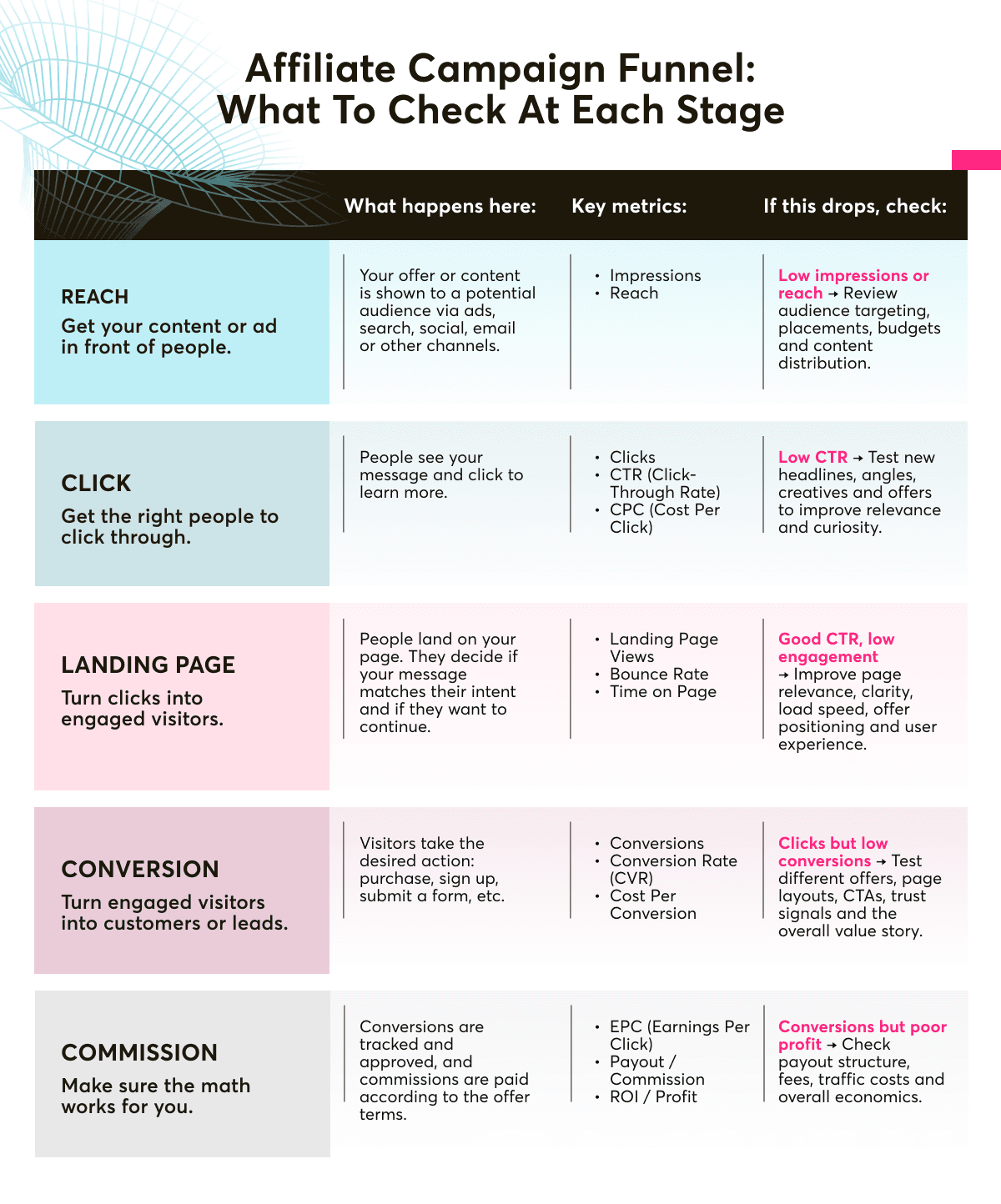
This won’t diagnose every campaign problem on its own, but it gives you somewhere sensible to start.
The tempting reaction to poor results is often to replace everything at once. Usually, it’s more useful to isolate the weakest part of the journey first. A perfectly fine offer can look like a failure when one bad creative is doing all the damage.
9. Build on What Is Already Working
Once something starts showing promise, create more opportunities to learn from it.
If one headline consistently beats the others, test variations of that angle. If a particular review brings qualified clicks, build related content around the same intent. If one placement or audience segment converts well in a paid campaign, test whether it can handle a little more budget.
The keyword here is ** gradually.** Early performance can disappear when you scale too quickly. A campaign that works at $20 a day won’t necessarily behave exactly the same way at $200. Organic channels have their own version of this problem: producing ten times more content doesn’t help much if quality falls apart along the way.
Keep a simple record of:
- what you changed;
- why you changed it;
- when the change went live;
- what happened afterward.
It sounds basic, but after a few weeks of tests, memory becomes a terrible analytics tool.
10. Decide Whether You’re Ready to Expand
By this point, adding another offer, traffic source or format may start to make sense. There’s no prize for doing it on day 61, though.
Before expanding, ask:
- Do I understand why my current setup is working or failing?
- Can I track results reliably?
- Do I have enough time or budget to manage another test properly?
- Is the new channel solving a specific problem?
- Can I keep the current setup running while I learn the new one?
If the answer is mostly yes, expansion becomes a reasonable next experiment. You might add email to support a content site, test video alongside written reviews or introduce paid traffic to an offer that has already shown conversion potential.
If the answers are mostly no, another channel will likely just add another pile of data you don't yet know how to read.
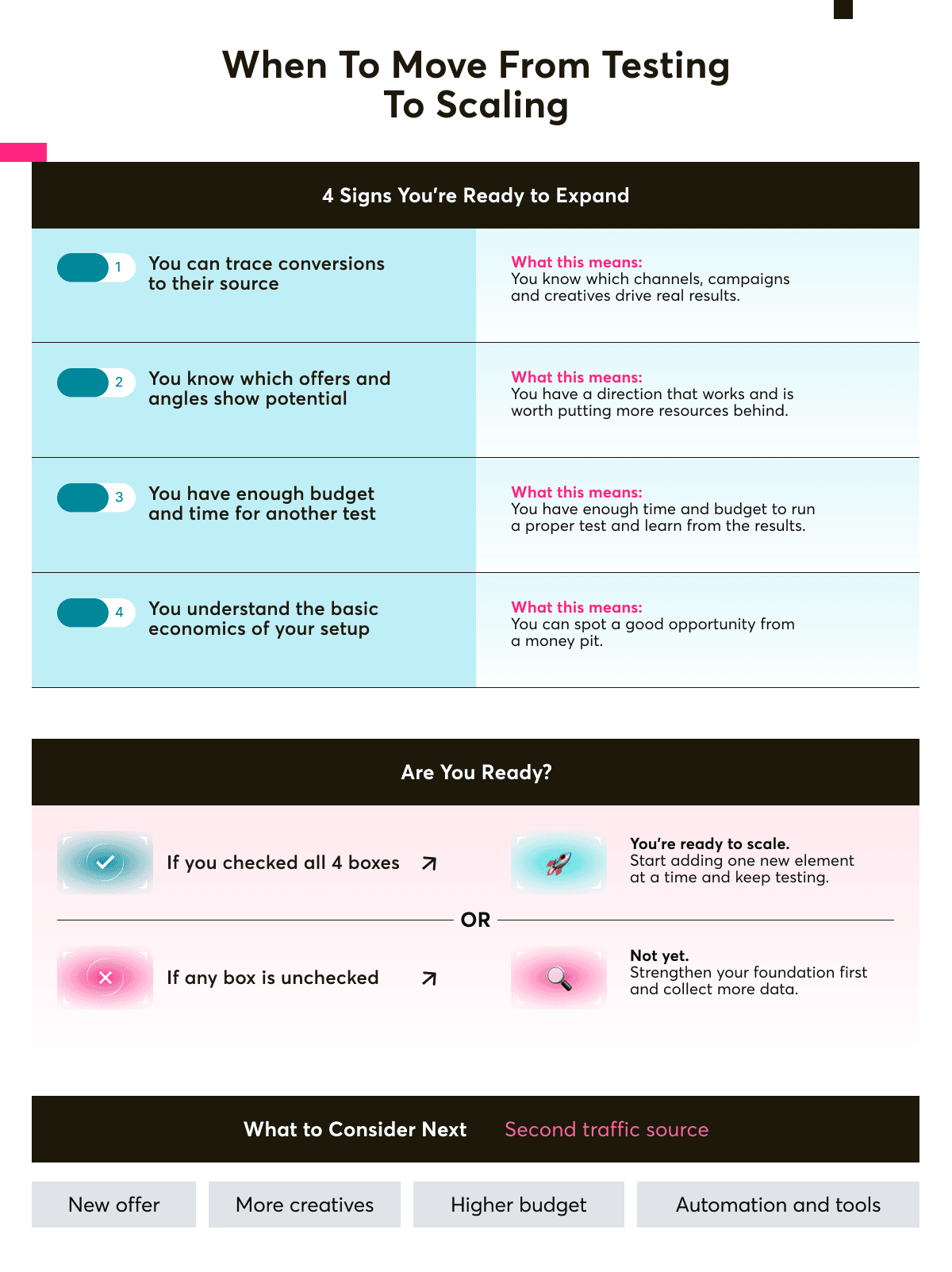
A second traffic source should have a job before it has a budget.
By the end of 90 days, you don't need a huge affiliate operation. A far better outcome is one setup you understand, reliable tracking, some real performance data and a clear sense of what deserves your next month of work.
How to Use AI in Your First 90 Days of Affiliate Marketing
AI can save a beginner a huge amount of time. Used carelessly, it can also fill your folders with generic copy just as fast. A lot depends on what you ask it to do and how closely you review the result.
The easiest way to use it early on is to look at your workflow task by task. Some are perfect candidates for AI assistance from day one. Others are worth keeping much closer to you while you're still learning how affiliate campaigns actually work.
| Good tasks for AI | Keep a human in charge |
|---|---|
| Brainstorming content and creative angles | Choosing which offer is worth promoting |
| Generating headline and copy variations | Making final claims about a product |
| Summarizing product and competitor research | Checking whether those claims are accurate |
| Creating first drafts and outlines | Final editing and brand voice |
| Organizing campaign results | Deciding why performance changed |
| Spotting patterns in larger datasets | Deciding when to stop, continue or scale a test |
Use AI to Create More Variations
This is probably where I'd use AI most heavily as a beginner. Instead of spending an hour trying to come up with the perfect headline, start with one idea and ask an AI tool to explore ten different angles around it. Then pick the few that actually sound convincing and test those.
The same works for:
- ad headlines;
- hooks for short videos;
- email subject lines;
- product-review structures;
- landing-page angles;
- calls to action.
The human pass afterward matters just as much as the generation step. AI has no problem confidently producing bland copy, repeating questionable product claims or making every offer sound like it will "transform your life."
Use AI to Help Read Your Data
Once your campaigns start producing enough information, AI can also help with analysis.
For example, you can organize performance by creative, placement or audience and use AI to help spot patterns, compare groups or generate questions worth investigating.
Just be careful with the conclusion. If Creative A has a higher conversion rate than Creative B, an AI tool can identify that difference immediately. It doesn’t automatically know whether the cause was the headline, audience, placement, sample size or pure chance.
I learned pretty quickly that a neat explanation isn’t necessarily the right explanation. Campaign data still needs context.
Don’t Automate Something You Haven’t Learned Yet
Automation becomes much more useful once you understand the task being automated.
If you've never evaluated an affiliate offer yourself, letting AI choose one for you doesn't teach you what makes a good offer. If you don't understand your basic metrics, an AI-generated campaign summary can sound impressive while telling you very little.
Learn the process first. Then look for the repetitive pieces that are eating up your time.
Use AI to shorten the work. Keep the judgment.
That approach gives beginners the biggest practical advantage of AI — speed — while still building the skills they’ll need when campaigns become larger and more complicated.
Affiliate Marketing Mistakes That Can Derail Your First 90 Days
Most early affiliate mistakes look reasonable while you're making them. Joining another program feels like creating more opportunities. Opening another traffic source feels like growth. Changing a campaign after two bad days feels like optimization.
A few weeks later, you may have five half-tested ideas and very little idea what you've actually learned.
These are the mistakes worth watching most closely in the first three months.
Chasing the Highest Commission
A generous payout can make an offer attractive, but commission size is only one part of the economics.
A $150 commission doesn't help much if hardly anyone converts. A lower-paying offer with stronger demand, a better landing page and reliable tracking may produce considerably more revenue over time.
Look at the whole path from click to commission.
Promoting Too Many Offers at Once
Testing several offers eventually makes sense. At the beginning, every additional offer brings another landing page, audience, conversion rate and set of variables to understand.
Start small enough to learn why something happened. Once you understand how one or two offers behave, comparing them with new ones becomes much more useful.
Trying Every Traffic Source
This one is especially tempting because there's always somebody doing extremely well on a channel you haven't tried yet.
You start with SEO. Then you see someone making money with TikTok. Three days later, there's a YouTube case study. Then somebody tells you native advertising is where the real scale is.
Hopping between channels usually delays the useful part: getting good enough at one of them to understand what drives performance.
Give your first traffic source a proper test before opening another front.
Launching Without Reliable Tracking
If you can see a commission but can’t tell which campaign, creative or piece of content produced it, you’ve earned money without learning much.
The same problem gets worse with losses. Knowing that you spent $100 and earned $30 is useful. Knowing where the $70 disappeared is what helps you improve the next test.
Check your tracking before you start sending meaningful traffic.
Expecting “Passive Income” Too Early
Affiliate income can continue coming from content or campaigns after the initial work is done. Getting them to that point still takes research, traffic, testing, maintenance and plenty of decisions along the way.
During your first 90 days, I wouldn’t use income alone as the scorecard. A campaign that breaks even but teaches you which audience converts can be valuable. So can a review that hasn’t generated much revenue yet but starts attracting qualified search traffic.
Your first months should leave you with something you can build on: better data, better judgment and fewer expensive guesses.
What Should You Have After Your First 90 Days?
Day 90 isn’t graduation day. There’s no affiliate marketing certificate waiting in your inbox, and your campaign doesn’t suddenly become profitable because three months have passed.
What you should have is a much clearer picture than you had on day one.
By this point, ideally you can answer questions like:
- Which offers have shown the most potential?
- Where is your best-quality traffic coming from?
- Which creatives, topics or angles consistently attract attention?
- What happens after someone clicks?
- Which metrics are improving, and which ones are holding you back?
- How much does it cost you to generate a result?
- Which tests are worth continuing?
- What have you already tried that clearly isn’t worth more time or budget?
You don’t need a perfect answer to every question. Even knowing “I’m getting clicks, but the offer isn’t converting” gives you something specific to investigate in month four.
So, What Comes Next?
This is where your path starts depending much more on your own results.
If one offer is converting, test more creatives or related offers. If content is beginning to attract search traffic, expand around the topics showing demand. If a paid campaign has workable economics, start thinking about careful scaling. And if nothing has worked yet, your first 90 days should still give you enough evidence to decide what needs another test and what deserves to be dropped.
This is also a good time to consider adding a second traffic source, more advanced tracking or automation: there's much more value in those tools once you have real campaigns and data to apply them to.
From here, the conversation naturally shifts from getting started to building a broader affiliate strategy: choosing which channels to combine, where automation can help and how to scale what’s already producing results.
FAQ on Your First 90 Days in Affiliate Marketing
How many affiliate programs should a beginner join?
One or two can be enough to start. It's easier to understand your results when you're testing a small number of offers rather than spreading traffic across ten different programs.
Should I start with organic or paid traffic?
It depends on your resources. Organic traffic usually requires more time but less upfront budget, while paid traffic can generate useful data faster but costs money to test.
How long should I test an affiliate campaign?
There’s no universal number of days or clicks. Give the campaign enough traffic to identify a pattern, and avoid making decisions based on a handful of early results.
Which metrics should I track first?
Start with clicks, CTR, conversions, conversion rate, EPC and revenue. If you’re buying traffic, add cost per conversion to the list.
When should I add a second traffic source?
Once you understand how your first one performs and can track it reliably. Add another channel when you have a clear reason for it and enough time or budget to test it properly.
Can AI run affiliate marketing for me?
It can automate research, drafts, creative variations and parts of analysis. Offer selection, fact-checking, final creative decisions and interpreting results still need human judgment.
What if I haven’t made money after 90 days?
Look at what happened before the conversion: traffic, clicks, engagement and where users dropped off. Even without profit yet, that data can show whether the problem is the offer, traffic, creative or conversion path.
Your First 90 Days Are Just the Start
You can spend months reading about affiliate marketing and still wonder which offer your audience will click, which creative will flop or how much your first conversion will actually cost. The answers start appearing once you launch and have actual behavior to learn from.
Give yourself 90 focused days to build, test and pay attention to what happens. Expect a few good calls, a few expensive lessons and at least one result that makes no sense until you dig into the data. That's part of learning how this business behaves outside a spreadsheet.
By day 90, aim to have solid traffic data, a handful of real results and a much shorter list of guesses. Take a good look at what those three months taught you, pick the strongest signal you found and make that the starting point for what comes next. Then run the next test. You'll know a lot more this time.